
TU Dublin President Makes the Case for Sustainable Investment in Technological Universities at Oireachtas Committee
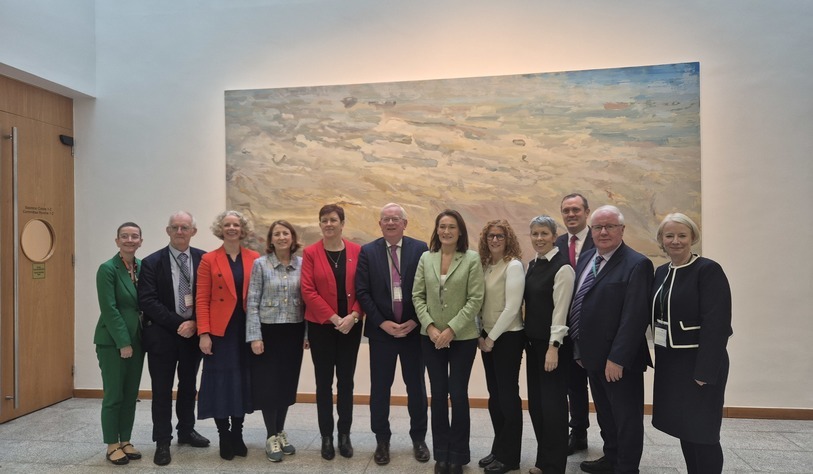
The President of Technological University Dublin, Dr Deirdre Lillis, has highlighted the vital contribution of technological universities to Ireland’s education system, regional development and innovation during an appearance before the Oireachtas Committee on Further and Higher Education, Research, Innovation and Science.
Dr Lillis attended as part of a delegation from the Technological Universities Association (TUA), alongside TUA CEO Claire McGee and senior colleagues from South East Technological University, Technological University of the Shannon, Atlantic Technological University and Dundalk Institute of Technology.
The TUA represents five technological universities and two institutes of technology, collectively serving more than 105,000 students across 29 campuses in 18 counties.
Reflecting on the Committee meeting, Dr Lillis said:
“I was pleased to attend the Committee with Claire McGee and colleagues from across the technological university sector to make the case for enhanced funding and to highlight the essential role our institutions play in providing accessible education, developing skilled graduates and supporting regional economic growth.
“Technological universities offer education from Level 6 to doctoral level, alongside apprenticeships and lifelong learning. Between 80% and 86% of our graduates are employed within nine months of graduation. We also make a significant contribution to research and innovation, supporting businesses, public services and national priorities such as housing, healthcare, artificial intelligence and the energy transition.”
A central focus of the delegation’s engagement was the need for increased and sustainable Government investment to enable technological universities to respond to growing demand and fulfil their potential. The TUA outlined four key funding priorities: sustainable core funding and enhanced student supports; increased research and innovation investment, including a proposed increase in annual core funding from €10 million to €50 million; investment in modern campuses, digital infrastructure, student accommodation and academic career development and the strategic use of the National Training Fund surplus to support facilities and flexible learning in response to Ireland’s evolving skills needs.
Dr Lillis emphasised the importance of ensuring technological universities receive appropriate recognition and a fair share of resources within the higher education funding system.
“Overall, we made a strong case for long-term funding that recognises the important role technological universities play in education, innovation and regional development. I believe technological universities are entitled to the same level of support and resources from Government as universities established before 2019.
“I was also pleased to take questions on matters of particular importance to TU Dublin, including the unitary charge and IReL funding. We made the case for a level playing field in these areas and I was very encouraged by the interest and support expressed by members of the Committee.”
Dr Lillis also thanked the Committee Chair, Erin McGreehan and welcomed the recognition given to TUS President, Professor Vincent Cunnane, who is due to retire early in the new year.
“It was particularly pleasing to see the Committee acknowledge Vincent Cunnane and his long and outstanding contribution to public service and higher education. He has had a distinguished career and has made a significant contribution to the sector. It was wonderful to see his work recognised by Oireachtas members.”
The Committee meeting provided an important opportunity for the technological university sector to highlight its contribution to Ireland’s economic and social development and to make the case for the sustained investment needed to ensure it can continue to deliver for students, employers and communities across the country.