
Presenters
Information about the presenters and their talks is provided in this page.
Register here to attend this symposium on 10 June 2026
Paul Rouse
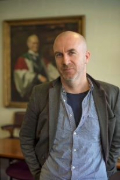 Professor Paul Rouse: Paul is a Professor at University College Dublin, where his main research interest lies in the history of sport. His expertise extends to popular culture, the history of agriculture and Irish history in general. Paul has made significant contributions to public history projects, including the GAA Oral History Project, which is the largest oral history project undertaken by any sporting organisation in the world
Paul’s paper at this conference is entitled Sport and the Asylum. Paul will delve into the rich history of sport in Grangegorman and its environs with a particular focus on the multi-layered approach to sport in the Richmond Lunatic Asylum and its successor the Grangegorman Mental Hospital.
Ed Randolph
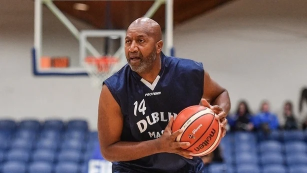 Originally from Tallahassee, Florida, Ed Randolph arrived in Belfast in 1982, beginning his Irish basketball journey with Sporting Belfast before representing Ireland at the European Championships. He went on to play with the Claremont Admirals and later competed with clubs across Dublin, Limerick, and Killarney. Finally settling in Bray, Ed joined Dart Killester, winning a league title and two cup finals in the 2000s, including a memorable victory at age 48.
A driving force in Irish schools’ basketball, Ed has coached thousands of young players, blending sport with life skills. He founded Dublin Raiders Basketball Club in 1989 and continues to lead its development, while also serving as a PE teacher and basketball coach at St. Joseph of Cluny Secondary School.
Jerome Westbrooks
.jpg) A Chicago native, Jerome Westbrooks arrived in Ireland in 1981 to join Killester and went on to build a distinguished career as a player, coach, and leader, earning induction into the Basketball Ireland Hall of Fame in 2026. The first American signed by Killester, he also enjoyed major success with St Vincent’s, winning the 1994 National Cup and a Superleague title, and was a key member of the Irish team that captured the Promotions Cup. Returning to Killester in the 2000s, he contributed to Superleague and Cup victories in 2001, 2007, and again in 2008 at age 51.
A Chicago native, Jerome Westbrooks arrived in Ireland in 1981 to join Killester and went on to build a distinguished career as a player, coach, and leader, earning induction into the Basketball Ireland Hall of Fame in 2026. The first American signed by Killester, he also enjoyed major success with St Vincent’s, winning the 1994 National Cup and a Superleague title, and was a key member of the Irish team that captured the Promotions Cup. Returning to Killester in the 2000s, he contributed to Superleague and Cup victories in 2001, 2007, and again in 2008 at age 51.
A dedicated educator, Jerome has spent decades teaching art and PE at Portmarnock Community School and coaching at St Fintan’s Sutton and Holy Faith Clontarf, guiding teams to numerous All-Ireland schools titles.
Terry Clavin
Terry Clavin joined the Dictionary of Irish Biography (DIB) project in 2006 and researches, writes and edits DIB entries, primarily on twentieth century and early modern figures. He has published over four hundred entries in the DIB and also helps select DIB entries for inclusion. In 2022 he co-edited, along with Turlough O’Riordan, Irish Sporting Lives, which is a collection of sixty sporting biographies drawn from the DIB.
Siobhán Doyle
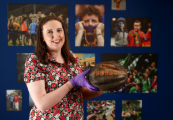 Siobhán Doyle is a Curator in the National Museum of Ireland (NMI). She holds a PhD in Museum Studies from Technological University Dublin. Siobhán’s first book, A History of the GAA in 100 Objects, was published by Merrion Press in 2022 and was nominated for Sportsbook of the Year in the An Post Irish Book Awards. The book has since been developed in a multi-media exhibition in NMI Collins Barracks. Siobhán's second book Irish Sport in 100 Objects, will be published this autumn.
The Gaelic Athletic Association (GAA) is often evoked through objects: medals passed down from generation to generation, jerseys worn in All-Ireland finals, Michael Cusack’s blackthorn stick, Cúl Camps backpacks. This talk focuses on Dublin GAA and explores objects and stories, which were uncovered by Siobhán Doyle when researching and writing her book A History of the GAA in 100 Objects. This talk highlights the challenges and the charms of telling stories through objects and how even the most ordinary, everyday objects can tell remarkable stories.
Julien Clenet
 Julien Clénet currently works in the School of History in UCD. His research focuses on recreation and leisure in nineteenth-century Dublin and most specifically the redefinition of public space as a legitimate place to play. His first monograph, Sport in Victorian Dublin, has just been published by Peter Lang.
Julien's presentation will address how the Phoenix Park was Ireland’s largest playground throughout the nineteenth century. Early on, wrestlers or hurlers informally met there on summer days while foot races took place all year long. As sport became increasingly organised from the 1830s, cricketers gathered within the Phoenix Cricket Club and polo players established the All-Ireland Polo Club in the Nine Acres field. From the 1880s, countless cycling or soccer clubs made it their home as most of the Dublin male population began to experience rising living standards and became actively involved in sport. For those not playing, the excitement of sporting contests, meeting friends, enjoying a day out, or simply winning a bet were further incentives to gather in the stands of the Phoenix Park racecourse (1902) or crowd Chesterfield Avenue in 1903 to watch cars speeding along.
The presentation firmly links the games that took place within the Phoenix Park with the ongoing organisation, democratisation, and commercialisation of sport in Ireland. Conversely, socio-economic and cultural trends redefined the concept of public space and impacted Dubliners’ access to leisure and playgrounds throughout the century. In the 1880s and 1890s, a few Home Rule politicians echoed land issues and resented the privileges held by the cricket and polo clubs which had enclosed their grounds and effectively privatised a portion of a public park. By and large, however, it was the relentless imposition of middle-class morality and values on popular leisure that most affected the Dublin labouring class. The erection of the band stand at the centre of the hollow at the turn of the 1890s stands out in that respect. Meant to offer ‘music for the people’ on Sunday afternoons, it incidentally drove away the wrestlers and their supporters who had gathered on this specific spot at that specific time for decades.
Anna Maria Mullally
 Anna Maria Mullally teaches in the TU Dublin School of Media. In addition to her teaching interests, centred on media literacy, her research interests include swim histories, women and football and sports and the media. She is a member of the Shamrock Rovers in the Community research team, which has organised two symposia in partnership with Shamrock Rovers FC. A third symposium, on Women and Football, will take place in late 2026. She is also an experienced open-water endurance swimmer.
Cormac Moore
 Dr Cormac Moore is founder and director of the history consulting company History Link. He has published widely on modern Irish history including the books The Root of All Evil: The Irish Boundary Commission (2025) and The Irish Soccer Split (2015). He is a columnist with the Irish News as well as editor of its daily ‘On This Day’ segment. He is co-host with Tim McGarry of The Irish History Boys podcast show. He is co-editor of the Atlas of Irish Sport due to be published in September 2026.
Conor Curran
 Dr Conor Curran (website) is a social and cultural historian with a specialisation in sport. He was previously a postdoctoral research fellow in the School of Education at Trinity College Dublin and has taught sports history at the International Centre for Sports History and Culture at De Montfort University, Leicester and at the University of Giessen and University of Marburg. He has published extensively on the history of sport and society in Ireland, including six monographs.
This presentation examines the development of British football clubs’ supporters’ clubs in Ireland, with particular emphasis on Liverpool Football Club. While it has been previously established that this interest was at times linked to domestic and European success, and the fielding of Irish players, this article examines how these supporters’ clubs facilitated travel to and from matches and how British clubs in turn nurtured this interest. How Liverpool supporters experienced major stadium disasters at Heysel in 1985 and Hillsborough in 1989 is examined. How these tragedies were marked in Ireland will also be assessed. At times, crowd safety issues involving British clubs’ supporters in Ireland were also noticeable, and how these were dealt with by Irish authorities will also be discussed. By the 1990s, a wider range of British supporters’ clubs were available to those in Ireland, although interest in Liverpool, Manchester United and Glasgow Celtic still remained highest in the early twenty-first century.
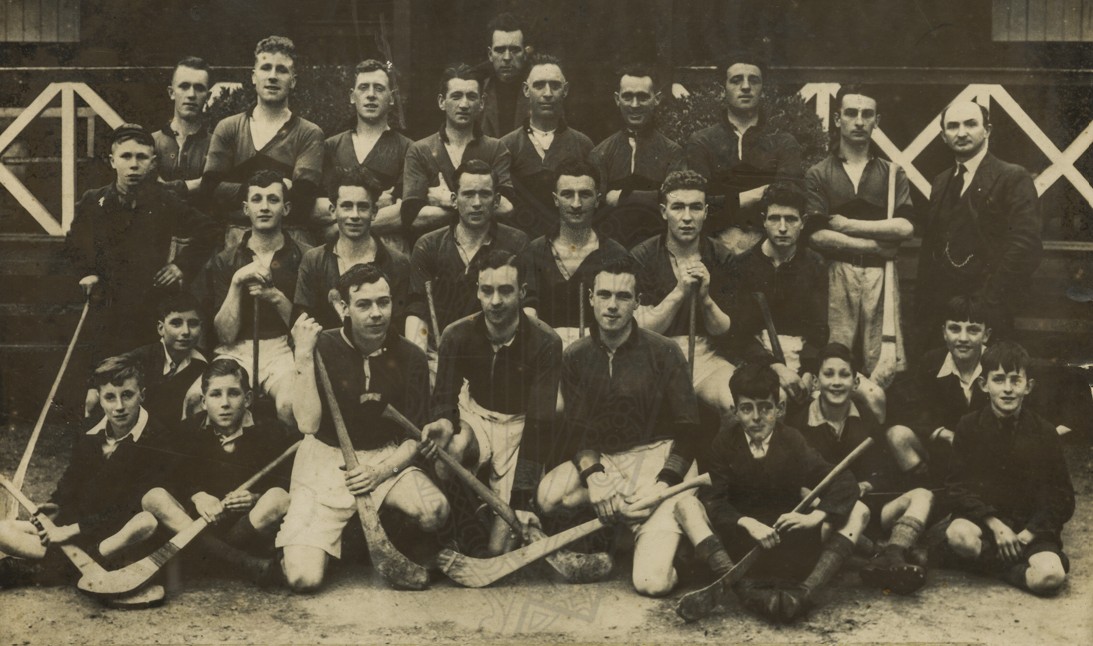
Photo Credit: St Dympna's Hurling Club, Grangegorman, 1935, National Archives of Ireland, Priv 1223/29/98