
TU Dublin Present at EDEN 2026 Conference in Porto
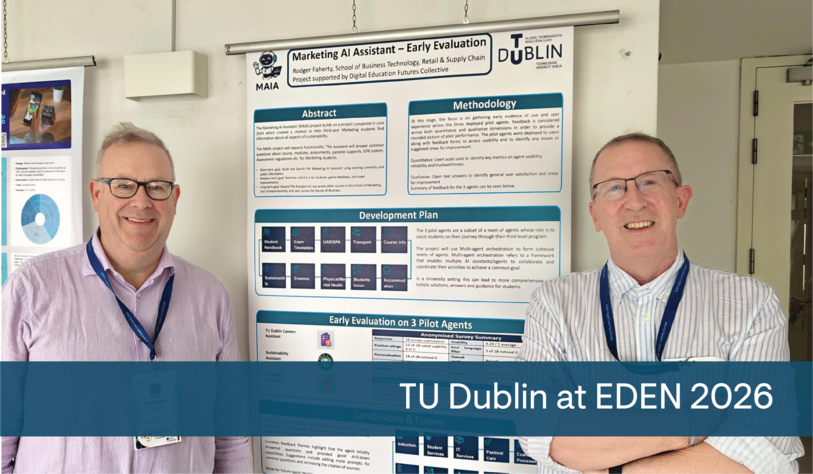
TU Dublin colleagues contributed to the EDEN 2026 Annual Conference, held in Porto, Portugal, from 14 – 16 June. The conference theme, “Beyond Technology: Human-AI Collaboration for Learning and Teaching”, brought together educators, researchers and institutional leaders to explore how human-AI partnerships are shaping learning design, inclusion, assessment and institutional practice.
Dr Fionnuala Darby, School of Global Business, presented the paper “Create, Think, Trust: Embedding Engagement in GenAI through Student Partnership”, which was recognised by the session Chair as a valuable contribution to the conference theme and to discussions on how human-AI partnerships are transforming education. The paper outlined an embedded pedagogical approach designed to help educators and learners engage confidently with Generative AI through discovery, critical analysis and reflective practice. The presentation considered how structured AI integration can support inclusive learning environments and transparent assessment practices, while also advocating for the co-development of “AI ethicists” in higher education. This approach positions educators and learners as active, critical and ethical participants in the use of AI-supported tools.
Rodger Faherty, School of Business Technology, Retail and Supply Chain, presented work on the Marketing AI Assistant (MAIA) project. Building on an earlier chatbot developed to support third-year Marketing students with sustainability-related information, MAIA aims to expand this functionality by helping students access information on courses, modules, assessments, pastoral supports, GPA, assessment regulations and related areas. The project’s short-term goal is to build and launch the assistant using existing university and public information, with future plans to evaluate its usefulness for students and explore wider application across the School of Marketing and Entrepreneurship and the Faculty of Business.
Shaun Ferns, Dr Barry Ryan and Dr Fionnuala Darby also presented work from the University Education Model under the title “Programme-Level TEL for Human-Centred Educational Decision-Making”. This contribution focused on the design and early use of programme-level technology-enhanced learning decision-support tools developed to support curriculum conversations in an Irish higher education context. Drawing on work with Microsoft Forms, Power BI and emerging curriculum analytics approaches, it argued that the value of TEL and AI-supported curriculum intelligence lies not in replacing professional judgement, but in helping programme teams see, discuss and take responsibility for the cumulative consequences of their design decisions. Further information on the Programme-Level TEL Decision-Support work, including the EDEN 2026 contribution and related tool examples, is available on this companion site.
Dr. Kevin Byrne, Head of School, School of Business Technology, Retail and Supply Chain, said: “EDEN provided some unique insights into GenAI and the tensions it creates across all actors in the education sector. As we move into Agentic AI, these takeaways will assist us in influencing the journey of our own staff and students in the advancement of EdTech.”
Together, the contributions reflected TU Dublin’s growing engagement with international conversations on human-centred digital education, responsible AI, curriculum design, learner partnership and institutional educational change.