
Generative Art and AI in Focus as TU Dublin Leads ‘Rhetorical Machines’ Workshop
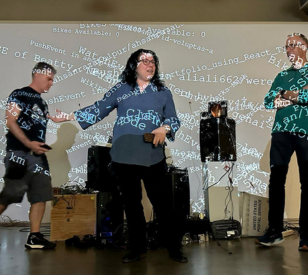
TU Dublin Leads Groundbreaking International Workshop on AI and Artistic Innovation
TU Dublin in partnership with the University of Washington’s DXARTS programme, has successfully concluded ‘Rhetorical Machines’, an intensive international workshop exploring the evolving relationship between artistic creativity and artificial intelligence.
Held in Seattle from 23rd June to 4th July 2025, the workshop brought together researchers, artists, and technologists from across Europe and the United States to examine how large language models and generative AI are reshaping contemporary creative practices. The initiative forms part of the MSCA-funded EpiSTEAM project, coordinated by TU Dublin and supported by Horizon Europe.
The programme culminated in a public exhibition and performance on 3rd July, showcasing experimental works developed over the course of the two-week workshop. These included AI generated poetry, performative installations, and interactive digital environments; all aimed at interrogating the rhetorical and aesthetic potential of machine creativity.
The EpiSTEAM consortium comprises 14 academic and non-academic partners, committed to advancing research and innovation at the intersection of STEM, experimental arts, media studies, architecture, and neuroscience. Several of the academic institutions are founding members of the ECT+lab, a research platform dedicated to the development of new epistemologies and collaborative methods for techno-cultural enquiry.
EpiSTEAM Academic Partners:
- Technological University Dublin – Coordinator
- Universidad Politécnica de Cartagena
- Technological University of Cluj-Napoca
- Hochschule Darmstadt
- Riga Technical University
- Cyprus University of Technology
- Université de Technologie de Troyes
- University of Washington
- Sarvajanik College of Engineering and Technology
Non-Academic and Innovation Partners:
- Baltan Laboratories
- Apo3
- GSI
- InSTEAD
- Cluj Innovation Park
Through initiatives like Rhetorical Machines, TU Dublin continues to play a leading role in reimagining the role of higher education and research institutions in shaping ethical, creative, and socially engaged responses to technological change.
For further information on the EpiSTEAM project, please visit: https://ectlab.eu/project/episteam/