
TU Dublin’s SM:ART Completes First Live Deployment on Lifford Bridge
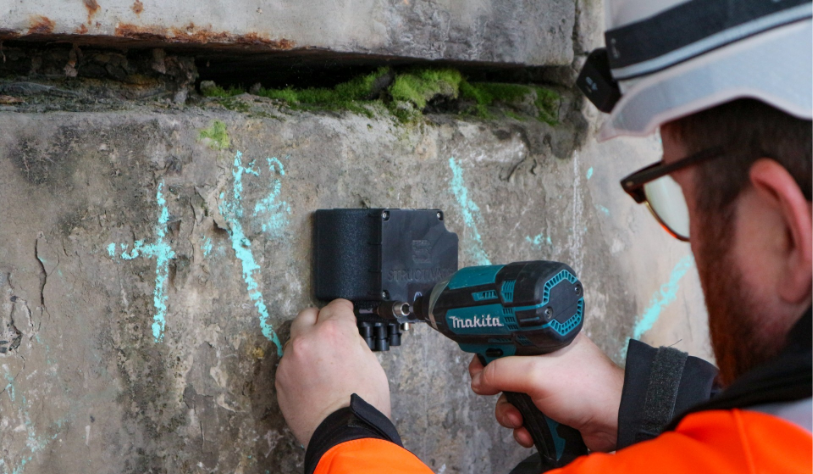
TU Dublin SM:ART, an Enterprise Ireland-funded technology developed by Dr Sean Bond and his team at TU Dublin with support from TU Dublin Innovation, has completed its first live deployment on Lifford Bridge, a 62-year-old reinforced concrete structure on the border between Co. Donegal and Co. Tyrone.
The deployment marks a significant milestone for SM:ART, a corrosion intelligence system designed to provide continuous monitoring of ageing reinforced concrete infrastructure.
Working in partnership with the Department for Infrastructure (DfI) Northern Ireland, Dr Bond and his team retrofitted four SM:ART systems onto the bridge’s half-joint connections. Live data was streaming before the team left the site.
The deployment comes less than two years after Dr Bond secured the €1 million Enterprise Ireland Commercialisation Fund award, well ahead of the programme’s 2027 conclusion. The funding is supporting the development of SM:ART and the establishment of the TU Dublin spin-out.
Tackling the challenge of ageing infrastructure
Thousands of concrete bridges across Ireland and the UK were built during the 1950s to 1970s and are now well beyond their intended lifespan. Many rely on half-joint connections, critical load-bearing points where bridge spans meet, which can be highly vulnerable to hidden corrosion but difficult to inspect.
Many bridge assessments continue to rely on periodic visual inspections, meaning decisions about structural condition and remaining service life can be based on snapshots rather than continuous evidence.
What SM:ART does differently
Many monitoring systems can measure conditions within concrete. SM:ART combines sensor technology with an intelligent interpretation layer, agentic workflows and machine-learning predictive analysis to turn raw sensor data into actionable information. The compact, self-contained technology can be retrofitted onto existing structures without major disruption.
At Lifford Bridge, four SM:ART systems were installed at the half-joint connections, each continuously measuring:
- Corrosion activity – detecting whether reinforcement steel is actively corroding
- Concrete resistivity – assessing how easily corrosion can progress
- Temperature and humidity – monitoring the environmental conditions that drive deterioration
- Vibration and tilt – monitoring structural movement and load response
Rather than simply providing engineers with a dashboard of numbers, SM:ART interprets the data and provides information on what is happening within the structure, why it matters and what action may be required.
Discussing the live deployment Dr Sean Bond said:
Lifford Bridge is exactly the kind of structure SM:ART was built for, ageing concrete, critical half-joints, and decisions that until now were based on periodic snapshots rather than real evidence. Going from the Commercialisation Fund award to live data on a real bridge in under two years shows what’s possible with the right support behind you.
What’s next for SM:ART?
Dr Bond is now leading the SM:ART trial programme with asset owners, government agencies and local authorities across Ireland and the UK, with further deployments planned before the Enterprise Ireland programme concludes in 2027.
The goal is to support continuous corrosion monitoring of ageing concrete infrastructure, providing asset owners with greater evidence on structural condition and helping inform decisions around inspection, maintenance and intervention.
The development of SM:ART demonstrates the journey from TU Dublin research to commercial application, supported by Enterprise Ireland’s Commercialisation Fund and TU Dublin Innovation.
About SM:ART
SM:ART (Structural Monitoring and Real-Time analytics) is a TU Dublin pre-spin-out developing corrosion intelligence technology for reinforced concrete infrastructure. The technology combines retrofittable sensors, real-time data analytics and decision-support tools to enable continuous, evidence-based monitoring of structures.
SM:ART is supported by Enterprise Ireland’s Commercialisation Fund and TU Dublin Innovation.