
TU Dublin PhD Researcher Hossein Raghib Presented Two Papers at ICEAA–IEEE APWC 2026
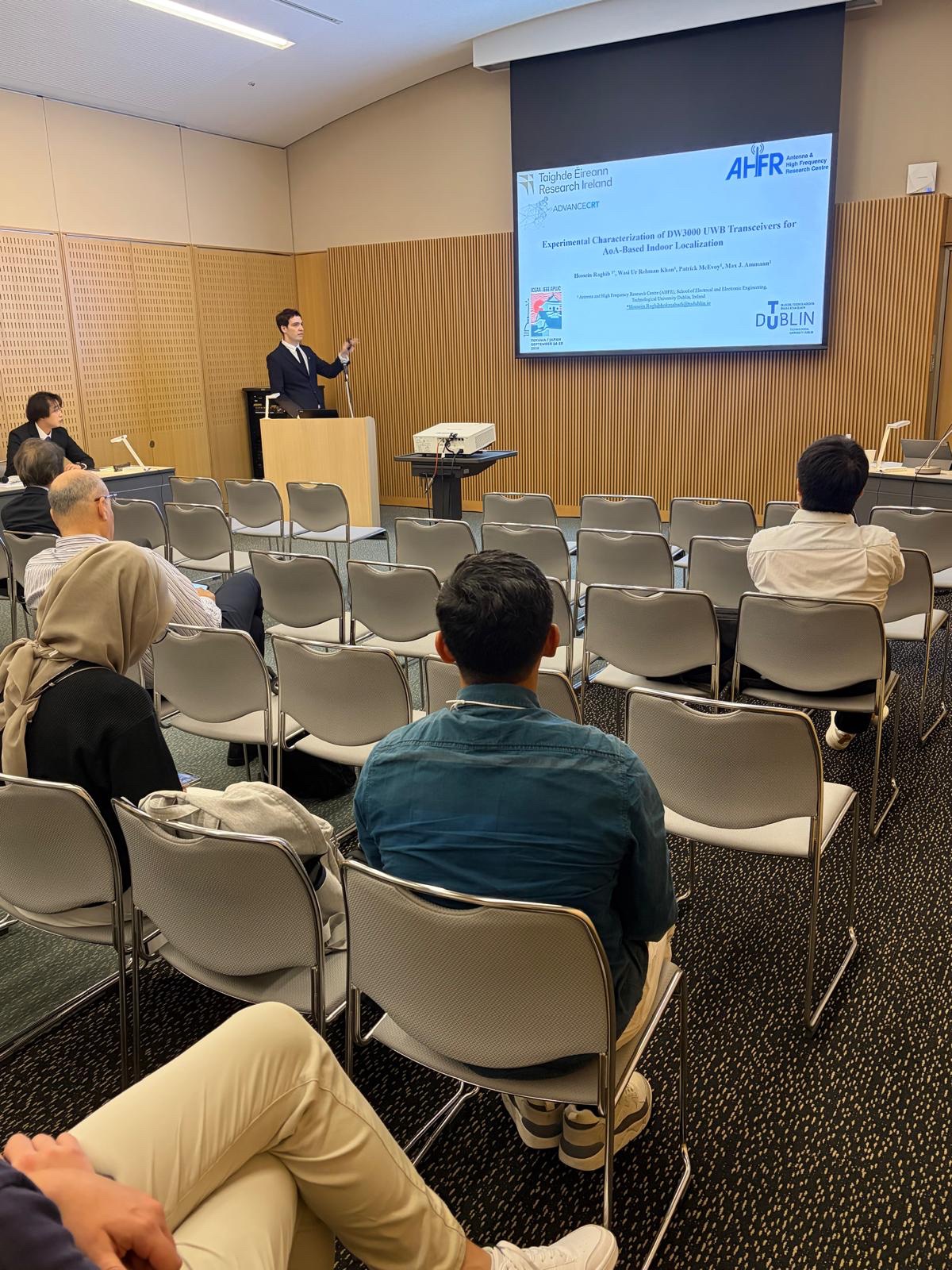
PhD researcher Hossein Raghib from TU Dublin’s AHFR research centre presented two research papers at at ICEAA–IEEE APWC 2026 , TOYAMA, JAPAN
PhD researcher Hossein Raghib Hokmabadi from TU Dublin’s Antenna & High Frequency Research Centre (AHFR) presented two research papers at ICEAA–IEEE APWC 2026, held in Toyama, Japan.
The first paper, “Experimental Characterization of DW3000 UWB Transceivers for AoA-Based Indoor Localization,” investigated the practical performance of commercial IEEE 802.15.4z Ultra-Wideband (UWB) transceivers for Angle-of-Arrival (AoA)-based indoor positioning, focusing on Phase Difference of Arrival (PDoA), AoA estimation, and ranging behaviour.
The second paper, “Anchor Node Antenna Array Configurations for Dual Plane PDoA/AoA in UWB Indoor Localization,” explored compact antenna-array configurations capable of supporting both azimuth and elevation estimation for UWB indoor localisation.
Together, the two studies address both transceiver-level performance and antenna-array design, contributing to the development of more accurate and robust UWB localisation systems. The work forms part of ongoing research at TU Dublin’s AHFR.
Participation in ICEAA–IEEE APWC 2026 provided an opportunity to disseminate TU Dublin’s research internationally, exchange ideas with researchers working on emerging wireless technologies, and strengthen connections within the global antennas, propagation and localisation research community.