
TU Dublin Research Advances the Accuracy of Ultra-Wideband Indoor Positioning
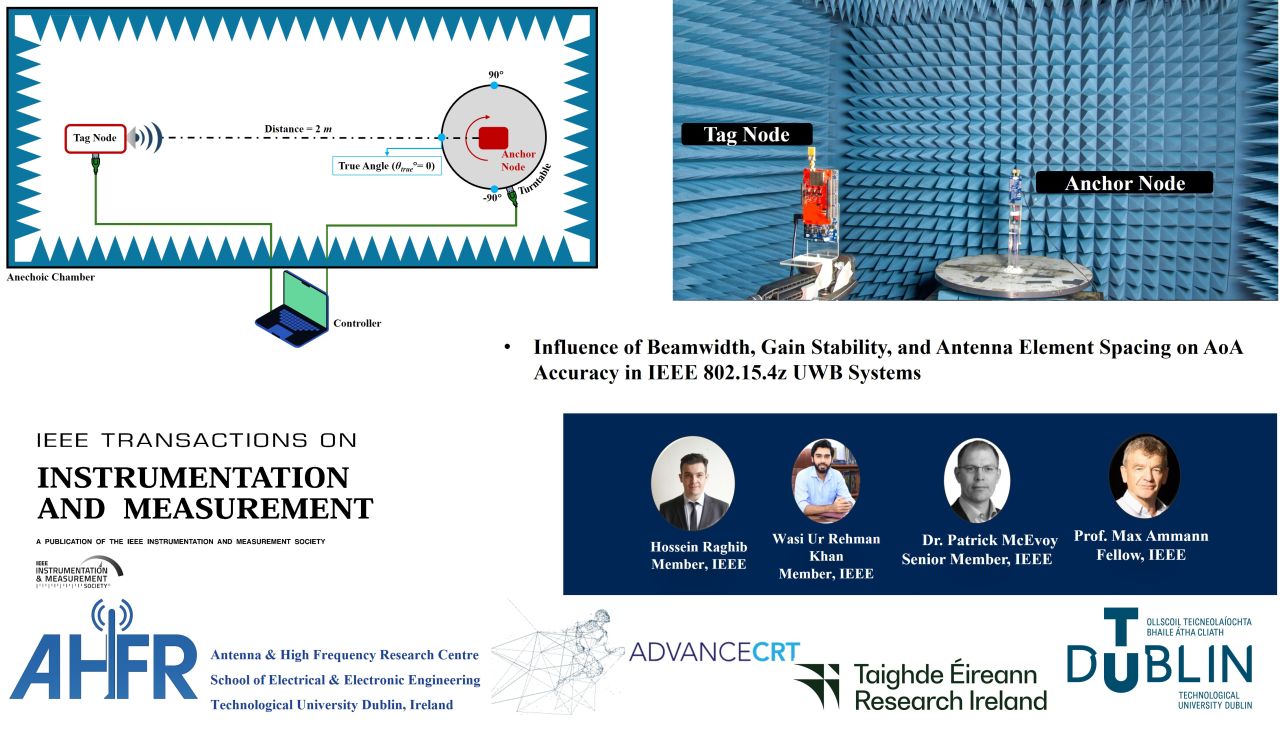
New research from TU Dublin’s Antenna and High Frequency Research Centre examines how antenna beamwidth, gain stability and element spacing affect the
Researchers at Technological University Dublin have published new findings that could support the development of more accurate Ultra-Wideband (UWB) indoor positioning systems.
The paper, “Influence of Beamwidth, Gain Stability, and Antenna Element Spacing on AoA Accuracy in IEEE 802.15.4z UWB Systems,” has been published in IEEE Transactions on Instrumentation and Measurement, a Q1 journal of the IEEE Instrumentation & Measurement Society with an Impact Factor of 7.0.
Accurate indoor positioning is increasingly important for applications including robotics, autonomous systems, industrial automation, asset tracking and smart environments. While much existing research focuses on localisation algorithms, this study investigates another important factor: how antenna design affects positioning accuracy.
The research presents a comprehensive hardware-based experimental evaluation of how antenna beamwidth, gain stability and antenna element spacing influence Angle-of-Arrival (AoA) estimation in IEEE 802.15.4z UWB systems.
The main contributions of the study include:
• Experimental validation using commercial IEEE 802.15.4z UWB hardware.
• Comparative analysis of multiple antenna designs using calibrated anechoic-chamber measurements.
• Practical design guidance showing that a wide and stable antenna beamwidth can have a greater influence on AoA accuracy than antenna isolation alone.
These findings provide valuable guidance for engineers and researchers developing future UWB localisation and wireless positioning systems.
The research was led by TU Dublin PhD researcher Hossein Raghib Hokmabadi, with supervisors Professor Max Ammann and Dr Pádraig McEvoy, and co-author Wasi Khan.
“This publication represents an important milestone in my PhD research. I am sincerely grateful to my supervisors, Professor Max Ammann and Dr Pádraig McEvoy, and to my co-author Wasi Khan for their guidance, collaboration and continued support throughout this work,” said Hossein.
The research was supported by Research Ireland through the ADVANCE Centre for Research Training programme.
The paper is available through IEEE Xplore: