
Nanolab Research Centre Spotlighted at TU Dublin Research Seminar
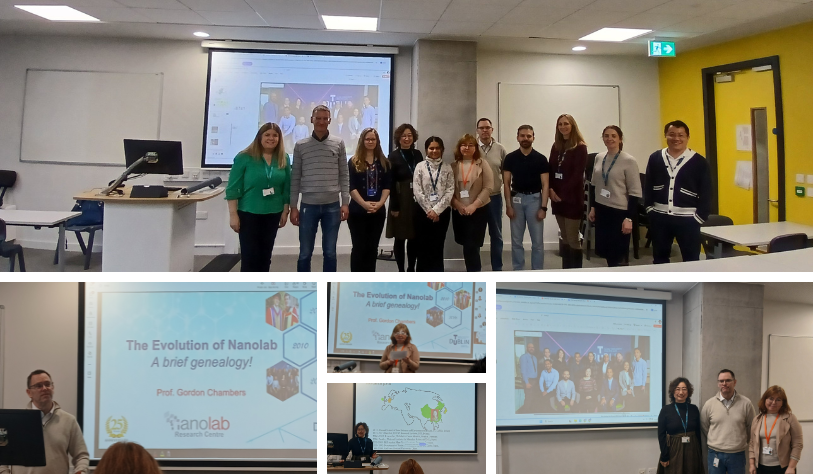
The Faculty of Sciences and Health Research Committee hosted the fourth Research Seminar of the 2025/2026 series on 24th February 2026 delivered in a hybrid format. The seminar focused on Research in the Nanolab Research Centre at TU Dublin and brought together staff and students from across the University. The seminar was chaired by Prof Izabela Naydenova, Head of Discipline, Physics and Clinical Measurement Science, School of Physics, Clinical and Optometric Sciences and Scientific Director & Principal Investigator at the Centre for Industrial and Engineering Optics.
The first speaker, Prof Gordon Chambers (School of Physics, Clinical and Optometric Sciences), reflected on his education and research journey, highlighting the early influences that shaped his academic career. He discussed the establishment and growth of the Nanolab Research Centre and the pivotal role played by the FOCAS Research Institute in enabling science research to expand and build capacity in a more strategic and impactful way.
Prof Chambers outlined how he and colleagues led the Nanolab Research Centre for many years, producing high-quality graduates, significant research outputs, and hosting national and international conferences. He emphasised that the centre’s projects and teams evolved in parallel with the infrastructure developed through FOCAS, and that this strong research ecosystem continues to thrive today.
The second speaker, Dr Furong Tian (School of Food Science and Environmental Health), is the current Director of the Nanolab Research Centre. She traced her international research journey prior to joining TU Dublin, where she became a full-time member of staff in 2015. Dr Tian showcased her extensive portfolio of collaborative projects across different schools and research hubs within the University. Her research strategy focuses on fostering collaboration under thematic areas where multidisciplinary teams can contribute effectively. This approach actively involves early career researchers alongside more experienced colleagues, as well as undergraduate and postgraduate students, strengthening research culture and capacity across the institution.
Both presentations were illustrated with photographs documenting Nanolab teams and activities over the years, offering a vivid insight into the centre’s development and its vibrant research community.
The seminar provided an engaging overview of the Nanolab Research Centre’s history, achievements and future direction, highlighting its central role in advancing interdisciplinary research at TU Dublin.