
TU Dublin researchers highlight new ways to reduce food waste for National Stop Food Waste Day
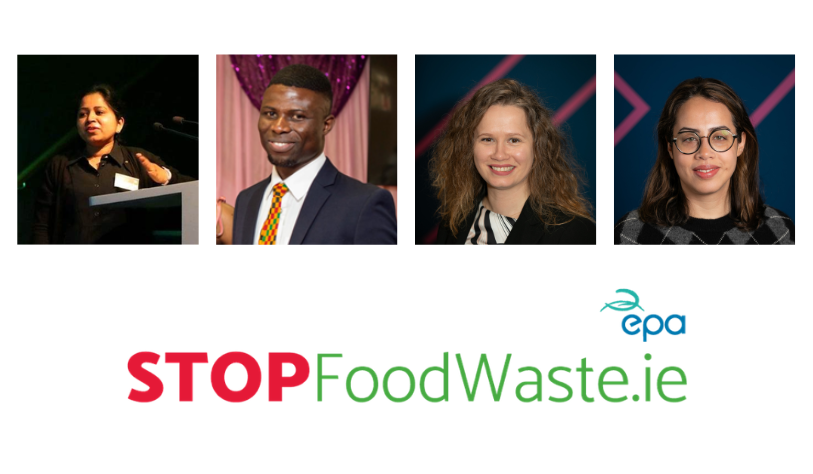
Sunday 1st of March marks National Stop Food Waste Day, the flagship awareness day of the Stop Food Waste programme, managed by the Environmental Protection Agency (EPA). Running from 1st – 7th March 2026, this year’s campaign focuses on one of the most wasted foods in Irish homes, bread, under the theme #SFWDay2026.
At TU Dublin, researchers are working on practical solutions and innovative ideas to help households and industry reduce waste, save money, and reduce environmental impacts.
Within TU Dublin’s EcoLOGIC Research Group – Dr Vaishali Thaore; Postdoctoral researcher and Courage Yaw Krah, 4th year PhD candidate are leading two complementary EPA funded projects addressing food waste from different angles.
Vaishali’s research project, FIX-ÉIRE (Food Waste Footprint Index for Ireland), delivers the first national, spatial assessment of household food waste generation across Ireland. The study produces both national and local estimates of food waste per person, identifies geographic “hotspots” of high waste generation, and links waste levels to key socioeconomic and demographic factors. This evidence base is designed to support more targeted food waste prevention policies and better-informed planning of waste management infrastructure.
At the core of the project is the development of a food waste footprint index (FIX) that quantifies the climate, environmental, and economic impacts of household food waste. The index captures spatiotemporal, occupational, demographic, seasonal, and socio-economic drivers of waste generation and connects these patterns to associated environmental and economic burdens. Vaishali applies expertise in process systems engineering and GIS-integrated optimisation to build integrated quantitative frameworks that combine demographic data, land-use datasets, transport networks, and environmental indicators. Using mixed-integer linear programming and GIS-based spatial analysis, she evaluates decentralised waste treatment scenarios under capacity, environmental, and policy constraints, providing robust evidence to guide future waste prevention strategies and infrastructure investment.
Courage’s project, FORWARD (Food Waste in Ireland - Assessment, Environmental & Economic Burden, and Mitigation Strategies), shows that food waste in Irish households is strongly behaviour driven. His research found average waste of 1,080g per household per week, with bread, fruit and vegetables accounting for the largest share. Four behavioural profiles were identified. High-Spending Disposers (39%) and General Bin Disposers generated the most waste; these households were mainly urban, followed omnivorous diets, spent more on groceries and made limited use of leftovers. In contrast, Practical Waste Separators (30%) and Time-Conscious Savers (17%) produced substantially less waste. These groups were more likely to include older adults and plant-based consumers, and demonstrated stronger habits around meal planning, consistent brown-bin use and lower grocery spending.
Food waste is not only about what is thrown away at home, it also includes food lost due to safety concerns. Dr Elena-Alexandra Alexa, Assistant Lecturer in Food Safety Management at TU Dublin, focuses on reducing waste caused by foodborne pathogens such as E. coli, Listeria monocytogenes and Salmonella. By improving understanding of contamination patterns in food processing environments, her research helps food businesses minimise recalls and product losses. This approach aligns with Ireland’s Food Vision 2030 by promoting evidence-based risk management that protects consumers while avoiding unnecessary waste.
Another route to reducing food waste is ensuring that by-products are not discarded but reused. Dr Azza Silotry Naik, PI (Food ingredients), Lecturer and Program Chair - Food Science, leads innovative projects that transform agro-industrial and marine by-products into high value ingredients for food, feed and cosmeceutical use. Her team is developing new ingredients from brewers’ and distillers’ grains, marine bycatch, and beetroot by-products, creating sustainable alternatives to synthetic additives and opening circular bioeconomy pathways. These initiatives show how materials once seen as ‘waste’ can become valuable resources.
TU Dublin’s researchers are demonstrating how science, behaviour analysis and innovation can work together to reduce food waste at every stage of the chain from production and processing to the kitchen table. As Ireland marks National Stop Food Waste Day, their work highlights how evidence-based solutions can help households waste less, save more and protect the environment.