Cold Atmospheric Plasma for Prostate Cancer Therapy
We want to congratulate the members of our group for publishing the review article entitled “Cold Atmospheric Plasma for Prostate Cancer Therapy—Potential for Clinical Translation” in Plasma Processes and Polymers (January 2026). This review critically examines the current research landscape of cold atmospheric plasma (CAP) as an emerging therapeutic modality for prostate cancer (PCa), with a particular emphasis on the key translational challenges that must be addressed to advance CAP from preclinical evidence toward clinical application.
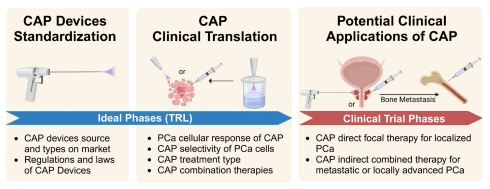
CAP is increasingly recognized as a promising anti-cancer tool due to its room-temperature biocompatibility, potential selectivity toward malignant cells, and the prospect of low side-effect profiles. In this review, we synthesize preclinical findings through the lens of PCa cellular responses and selectivity, compare direct CAP exposure with indirect approaches based on plasma-activated liquids, and evaluate the rationale for combination strategies aimed at improving therapeutic efficacy.
A key contribution of this work is its focus on device standardization and clinical translation as enabling requirements for real-world implementation. The review highlights how variability in CAP device configurations and treatment parameters remains a major barrier to reproducibility and regulatory approval and discusses recent progress toward standardizing performance evaluation for medical CAP systems intended for clinical use. Building on the available evidence, we further propose potential clinical application routes tailored to different disease stages, including focal direct CAP therapy for localized PCa and indirect or combination strategies for advanced or metastatic PCa.
Please cite this article as: Zhang, S., Wanigasekara, J., Boehm, D., Curtin, J. F., Bourke, P., Zhang, T., & Kinsella, G. K. Cold Atmospheric Plasma for Prostate Cancer Therapy—Potential for Clinical Translation. Plasma Processes and Polymers (2026), e70129. https://doi.org/10.1002/ppap.70129Digital Object Identifier (DOI)