
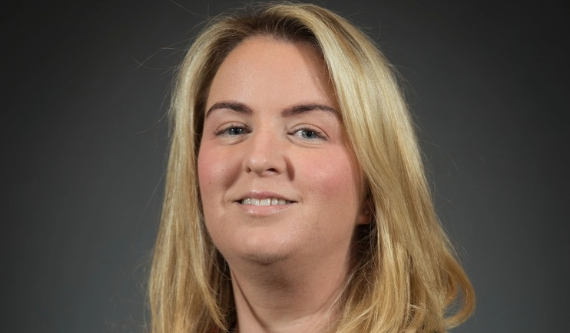
Aileen Bailey
A self-confessed planner, lifelong learner and people person, Aileen Bailey has spent her career helping others thrive. From balancing work, family life and postgraduate study at TU Dublin to supporting players and staff in elite rugby, her journey has been shaped by curiosity, resilience and a genuine passion for people.
In this interview, she reflects on leadership, lifelong learning and the realities of working in high-performance sport, while sharing a few personal insights, including her love of beach walks, family time and an unexpectedly strong 90s dance music playlist.
It is definitely tough to juggle work and study alongside family and life commitments. My study at that time looked very different to how I wanted it to, or what might be considered "ideal". There were a lot of early starts and late nights, and plenty of studying with children at my feet or on the go. It was all about fitting it in where I could.
What I remember most was really enjoying the experience. Taking that time away from work to focus on upskilling in employment law was hugely beneficial. You meet great people and discuss real-life examples, all of which are incredibly useful and rewarding.
There are times when you question why you signed up, because you have one hundred other things that need your time, but you will never regret a learning experience like that. For me, it is so important to continue to learn.
Work-wise, I am a planner and very organised. I like to get things done properly, and I do enjoy some colour-coded notes.
Student-wise, over the years I have been a mixture of organised and last minute, or at least feeling last minute and needing more time. This has often been dictated by how busy my role is at work, with projects and deadlines. Every Diploma I completed, and my Master's which I completed last year, has been part-time and fitted around work commitments, which can be challenging.
I do find it hard to switch off when I have study or projects to complete. I have not yet mastered the art of compartmentalising study. It tends to stay at the forefront of my mind until I am finished.
When I was 16 years old, I did some work experience and summer work in an insurance company where my dad worked. They placed me in their HR department for the summer and I absolutely loved every minute of it.
I was very much an assistant, of course, but I got to see behind the scenes how interviews worked, how change was managed and how HR administration processes operated. I did not realise it at the time, but I was seeing what a good HR department looked like, albeit for a very short period.
Everyone was so nice to me, very generous with their time and patient with my endless questions, no doubt. I was hooked. I was a chatterbox back then, so all this talking to people really appealed to me, as did the potential to make meaningful change. From then on, I knew HR was what I wanted to study and ultimately work in.
I have been lucky that my first role after graduating in 2004 was in Human Resources. I have definitely been very intentional about each move I have made. I think it is important to have a plan, build your network, maintain an awareness of the market and continue learning to keep your skills relevant and fresh.
I still love working in HR today. It can be very challenging at times, but working with people and within a people-focused organisation gives me great career satisfaction and energy.
I am not sure whether any of this will be surprising, and I will answer for both the playing and non-playing side of the business.
People in sport are incredibly hard-working, passionate and loyal. The season is long and there can be some very tough days. They give so much of themselves to the sport, and their role often forms a huge part of their identity. They are ambitious, driven and genuinely love what they do.
The highs are amazing, of course, but the lows can be very tough. Tough on the players and on all the staff who work for the province or the IRFU. Everyone plays their part.
The concern from an HR perspective is often what happens when it ends. Players face a major career transition, closing one chapter and starting over again. That can be a scary prospect for many. The IRFU and provinces work closely with the players' union (RPI) to support that transition phase of a player's career.
Working in sport is exciting and can be addictive. The time flies by and you become part of something very special. It is important to take time to enjoy the successes, both on and off the pitch, because things move on quickly and you need to be ready for the next challenge.
Working in sport is really rewarding but also quite intense. I believe it is incredibly important to make a conscious effort to build relationships with all staff. I need to be visible, accessible and truly listen to what is being said, as well as what is not being said.
It is important to be honest and realistic with people and to manage expectations around timelines and situations. Plans can change quickly in sport, so in HR we need to be patient and flexible with players, coaches and leadership teams.
I hope the focus on meaningful employee wellbeing continues across all organisations, and that hybrid working remains. A great balance can be achieved, although I recognise that this model does not work for every role or business.
I hope the "always on" culture can be left behind. Everyone needs time to switch off and reset. This includes feeling the need to respond instantly, attend every meeting or be online all the time. The focus should be on productivity.
Honesty, resilience, empathy - people who get back up and try again when they get a knock back.
Walking on the beach with my dog, Bella, and spending time with family and friends. I have a great group of friends who really help me switch off from everything.
My favourite way to unwind is spending time with my two boys and my husband.
I would tell my 25-year-old self to always have the courage to do what is right, speak up and stay true to the path I wanted to follow.
I would also tell myself that things will work out okay and to stop worrying so much. Enjoy the stage of life you are in, rather than always putting pressure on yourself about what comes next career-wise.
Tea or coffee during a crisis?
Neither. I do not like either. I drink hot water, but a Coke Zero definitely helps in a crisis 😊
One word your colleagues would use to describe you?
Friendly and empathetic.
Match day nerves: real or overrated?
Very real
A book, podcast or person that’s influenced you recently?
Simon Sinek
Most underrated skill in leadership?
Empathy
What would people be shocked to find in your Spotify playlist?
I love Snow Patrol, Amble, Picture This, Kingfisher and listening to acoustic covers of songs. However, what might surprise people is my endless collection of dance playlists from the 90s and 00s. I love dance music!