
Angela Brady OBE
.png)
Angela Brady OBE’s journey began in the studios of Bolton Street, where her passion for architecture first took shape. Today, alongside leading a global practice, she is giving back as a member of the TU Dublin Foundation Board, supporting students coming up behind her. In an industry shaped by deadlines, pressure and competing demands, her approach remains simple: pace yourself, be confident and do not over promise.
“Designing places for people to enjoy living, working or playing in, that’s what drew me to architecture.”
I always wanted to do something with art and creativity, but artists always seemed to struggle to make a living. A few friends were studying architecture and it seemed like the perfect fit. Designing places for people to enjoy living, working or playing in, and working with lots of people.
It was the great mix of people. Everyone was so friendly, and all the studios mixed because of the open plan layout, so you knew most of first, second and third years. You could even listen in on some of the design reviews.
I loved how people would just walk by your desk and start a discussion about your project.
We had a reunion online during Covid and managed to track down 70% of the class, which was brilliant, many of them overseas too.
Gerrie Dunne was in our class, and she became President of the Ontario Association of Architects around the same time I was President of the RIBA in 2012. I still see a handful of my pals from Bolton Street like Maria Kiernan and Paul Kearney, who set up in practice around the same time as us after graduating.
The tutors were amazing, in particular Des McMahon and Gerry Mitchel. They were also practising architects, which was a great influence on us. They were always very encouraging to try something new.
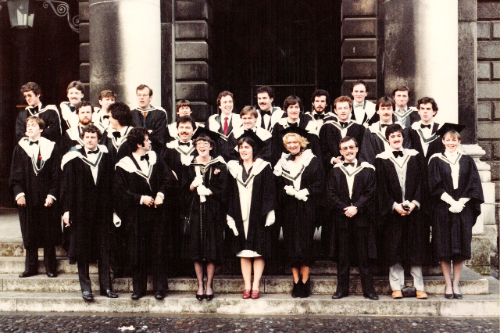
After graduating, I won a scholarship to study Danish housing at the Kunstakademie and stayed for 18 months studying Bofællesskaber co housing. I also worked in Toronto for Arthur Erickson. After a year in Canada, there was still no work in Dublin, and most architectural graduates were in London or overseas, so I decided to try London.
I gave myself 10 days sofa surfing with some pals, as there was a mini boom there in late 1983. I was offered four jobs in the first week and decided to stay for a while. That was 43 years ago.
“I gave myself 10 days in London and was offered four jobs in the first week.”
It was interesting that Irish architectural graduates were in much demand, particularly from Bolton Street, as we knew how to build the nuts and bolts of architecture. Many contractors are Irish and still form the backbone of the construction industry. Even today, 50% of our clients are Irish, from housing associations to developers.
“Irish graduates knew the nuts and bolts of architecture and were in real demand.”
We were all working for large practices then and soon came across the problem of our Bolton Street degrees not being recognised by ARCUK in the UK, even though the EU recognised the course. This meant we could not take the final Part 3 exam, were paid less and could not progress our careers.
A group of us got together and campaigned to overturn this. We formed IAGO, Irish Architectural Graduates Overseas, later to become the RIAI London Forum, with Shane Lincoln, Duncan O’Kelly, Mary Larkin and others. It became a strong network, still going today.
The campaign worked. The RIAI brought the Part 3 course to London with Irish tutors, so we could qualify in Ireland or the UK. I sat the Westminster Part 3 in 1986, and then set up Brady Mallalieu with my husband Robin in 1987. We are still married and still in practice today.
I really appreciated the recognition, because you spend a lot of voluntary time trying to make the profession better and bring more equality and diversity into it.
I had a good chat with the then Prince Charles, who was also promoting sustainable architecture.
The Irish are good at speaking up for the underdog and communicating ideas. I worked a lot with groups going into schools to encourage more women into architecture, and spent time on the global DiverseCity exhibition, which travelled to 34 cities when I chaired Women in Architecture at RIBA from 2000 to 2006. We even brought the exhibition to Palestine and included their group of women architects, and we are still in touch today.
A few years later, I received the Irish Presidential Distinguished Service Award, which was a real honour, to be recognised alongside so many Irish people around the world doing something for the Irish overseas.
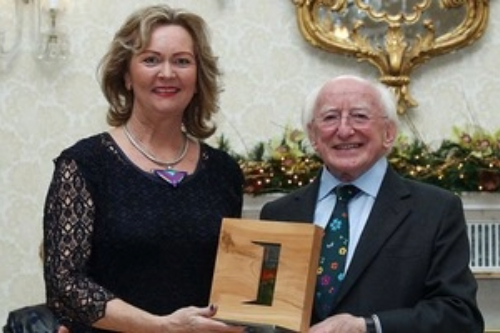
I have always stood up for what I believe is right, whether that is women in architecture, students or campaigns like Drop the Ban during my time as President of the RIBA.
As RIBA President I wanted all 55 project teams involved in the Olympic and Paralympic projects to be able to talk about their work, to show it on their websites and in exhibitions without having to pay to be a sponsor. The campaign eventually worked.
I have also found that speaking to the public on TV is a powerful way to promote Irish design and help people better understand architecture.
I really enjoyed making three prime time TV series, particularly Designing Ireland in 2015, the Year of Irish Design. Sandra O’Connell and I wrote and presented four one hour documentaries showcasing the very best of Irish design.
The Foyer Housing and Training project for Dublin City Council in 2004 stands out. We introduced a new idea to Ireland from overseas, combining housing with training for young people.
Also, designing the School of Architecture for North London Polytechnic, now the University of North London, was special. Creating a space that becomes a learning tool in itself, with exposed structure and services, lots of light and openness, was very rewarding.
Our largest project was Ballymore’s Phoenix Heights, 200 homes and 23 storeys high in London Docklands.
We have always enjoyed the variety, from large scale developments to smaller projects and interiors, like the Irish Embassy fit out which allowed me to bring in Irish craftspeople and include the first contemporary craft permanent exhibition in the Embassy.
I love the curiosity, that keenness to discover new ideas, materials and projects, and the freedom to let the imagination go.
I was invited to join the board and I like to give back what I can in this voluntary way. I’m proud to be a TU Dublin grad.
Do not worry, it will all work out. Just do not take no for an answer.
My artistic side comes out when I give it time. Every year since leaving school, I have done an evening course in something creative like etching, clay sculpture, art and crafts.
About 20 years ago, on an Open House visit, I wandered into a fused glass studio in Stoke Newington, near where I live, and immediately wanted to try it. I have continued ever since and absolutely love it, making large glass panels, portraits, bowls and jewellery as well as acrylic paintings. Most of our architectural projects include some of my art.
For 10 years, I have also curated a group of 10 master craftspeople in West Cork, 10 hands Crafts, and we have been invited to China Craft Week twice to represent Ireland.
Both of our children are creatives too.
A real highlight last year was my first solo exhibition at the Irish Embassy in London, bringing together glass and canvas work and many of the colleagues and collaborators I have worked with over the years.
'No time to slow down…….much still to do'.