
Chrissie Tiller
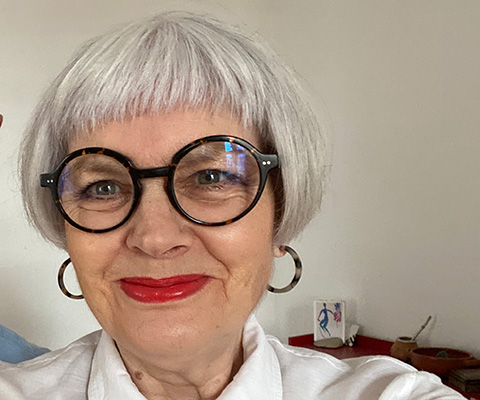
In October this year, we had the pleasure of meeting Dr Chrissie Tiller at our Autumn graduation ceremonies held on the Tallaght campus. It was an absolute inspiration to hear what inspired Chrissie to complete her PhD at the age of 75 - read on for more on her journey to this point, in her own words!
I undertook a PhD by Prior Publication with the Centre for Socially Engaged Practice and Research. My thesis focused on the ways gender, class and political activism influenced my role in shaping socially engaged arts practice and critical pedagogy in the UK. Because the PhD by prior publication focuses on the previous decade of your work which was only one decade of my fifty years of my praxis I took an autobiographical approach to the research and reflection. The final thesis is available here: https://arrow.tudublin.ie/appadoc/117/
I was incredibly fortunate to be invited to apply for the 2019 Val Bogan Scholarship. I was over 70 when I made the application, completed it when I was 74 and am now about to graduate officially at 75. I was inspired to undertake it because I am a working-class woman who was the first in her extended family to go to university, and although at one point I set up and led an MA at Goldsmiths College, London University and ran a theatre company, I felt there was not enough recognition of the role played by class and gender in the arts and academia and the impact of intersecting oppressions. Although my lived experience reflects a particular social history I began to realise how relevant it still is to working-class and women arts practitioners and academics who continue to face similar challenges today.
I undertook most of my PhD during Covid, which was particular in itself, I rarely visited TU Dublin. As everything opened up again I began to do most of my writing at the British Library in London and developed a kind of ritual of sitting at the same desk in Humanities 1 Reading Room. I loved the fact everyone in the Reading Room was sitting in total silence studying. It sometimes felt as if I could tap into a kind of shared brain power. What I valued most from TU Dublin were the Round Table sessions where we shared work in progress with our peers. It was incredibly important to get feedback from others struggling through the process as well as one’s supervisors. My fellow students definitely helped me get through those moments everyone doing a PhD seems to go through of thinking they have nothing useful or original to say and should just give up.
I also, unexpectedly, loved my Viva. Despite all the nerves I had two wonderful women examining me and it felt a privilege to be in conversation for an hour and a half with people who had not only read my whole thesis but were now asking me exciting questions and wanting me to talk about it. When it came to the end I was almost disappointed the time was up!
I am still working – as a critical friend or chair for a number of arts organisations but am no longer on a career journey. I have mostly been freelance and my work ranged from being a theatre director for young people, teaching at universities, initiating and running major international artist education programmes for those wanting to develop their socially engaged arts practice, advising funders, arts councils, cultural policymakers on access to culture, writing books and articles on sharing power. Much of that was global and I’ve worked all over the globe from the US to Japan, Palestine and Uganda as well as right across Europe and the former USSR. Doing the PhD at TU Dublin has meant I’m still reading, researching and critiquing current thinking around practice, pedagogy and policy in the arts and the reading I did for the PhD definitely contributes to the conversations I have with the people across the field.
Be prepared to follow your instincts and to take risks. Mine was never a structured career path – but by focusing on discovering the synergies, the connections between ideas, between people and places and wanting to work collaboratively across disciplines, cultures and national borders it is possible to frame your own pathway. It might mean there is less security and more ups and downs than joining an institution, but it might also prove more rewarding and fulfilling – and will always be something you can feel personally proud of.
I just hosted a public conversation with the amazing Irish activist Ailbhe Smyth as part of a conference called ‘When Words Fail’ in Liverpool. If I had one more day in Dublin I would now love to spend it in the company of some of those feminists and activists who fought to change the law on women’s right to abortion in Ireland, and in doing so brought these rights back to the table in different ways across the world. I’d always take a long walk around the city, find a good exhibition and go to the theatre if I had time, but most importantly I’d take the opportunity to spend time catching up with old friends over a great meal and good wine. After my Viva, we went to the wonderful Shelbourne Hotel for (one) celebratory drink! I’d like to make that a tradition.