
Oonagh Ryan
TU Dublin alumna Oonagh Ryan has built an impressive architectural career in Los Angeles, where she is founder and principal of Oonagh Ryan Architects. This year, she was elevated to the American Institute of Architects College of Fellows, one of the profession’s highest honours in the United States and a distinction held by fewer than 3% of AIA members.
Oonagh graduated from TU Dublin with First Class Honours in Architecture in 1994 before making the move to Los Angeles and establishing her own practice. Her work is rooted in thoughtful, carefully crafted design that responds to its environment and the people who use it.
We caught up with Oonagh to talk about her journey from Dublin to Los Angeles, building her own architectural practice, the experiences that have shaped her approach to design, and what this latest recognition means to her.
It means the world.
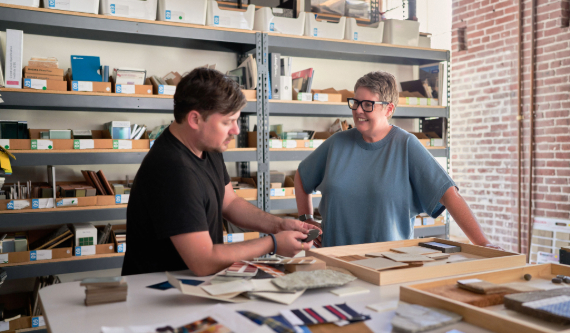
Looking back at the last 30 years; from my early days as a young architect at Frederick Fisher & Partners and Koning Eizenberg to founding my own studio, ORA, in 2011; it’s incredibly humbling. To be recognized by the AIA College of Fellows for elevating design, impact, and process affirms my belief that a small, nimble studio can model a more efficient path to excellence and make a meaningful mark on a massive city like Los Angeles.
My design journey actually began in rural Ireland. I grew up watching my grandfather, who was a woodworker teach me that something beautiful can be made from the simplest materials. That early lesson in craft became my foundation, and studying at Bolton Street was the perfect place to translate that hands-on, pragmatic approach into the discipline of architecture.
The rigor of my education still stands out to me today. I graduated in 1994, and the discipline I learned there helped shape the resourceful pragmatism that defines my practice today.
It taught me to find the best paths regardless of scale or finances.
I moved to LA right after graduating in 1994 because I won a green card in the Lottery. At the time Frank Gehry and Morphosis were blowing up. LA was the epicenter of post-modernism and I wanted to see what it was all about in person.
I never planned to stay this long, but LA is a fantastic city to practice architecture. It’s optimistic, irreverent and open to all design possibilities. This attitude clicked with my own approach to forward-looking design, and I've been building here ever since.
It gave me an approach grounded in authenticity; doing more with less, and making the most out of simple ideas. That pragmatic foundation translates perfectly to LA, where we constantly have to treat constraints, like tight budgets or narrow urban infill sites, as catalysts for design innovation.
Adapting to an entirely different construction, landscape and climate was a learning curve. I had to shift my understanding of the environment to be able to design and build in Southern California.
Over time, that’s evolved into a deep commitment to environmental care, using passive cooling strategies and designing for fire resilience. Today, that knowledge drives all of my work, including designing high-performing, all-electric, carbon-neutral, fire-resilient homes for victims of the LA wildfires.
Absolutely.
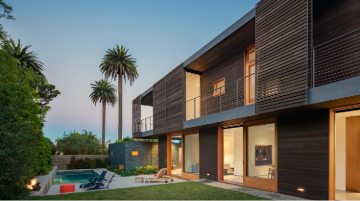
LA's climate completely shifted my focus toward dissolving the boundaries between indoors and out, which we did at Art Barn in Manhattan Beach.
It taught me how to make passive cooling strategies the primary architectural expression of a building, like we did with the Bookend House. It also taught me how to weave a sense of local ecology into a space, like at Uchi in West Hollywood, where we reclaimed fallen street trees from across the city to build the interior.
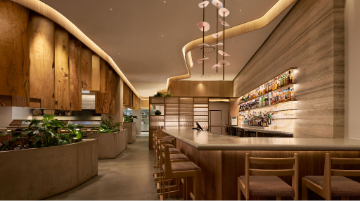
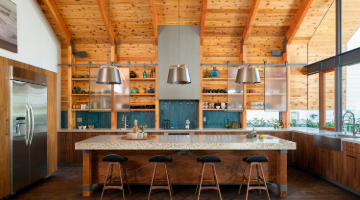
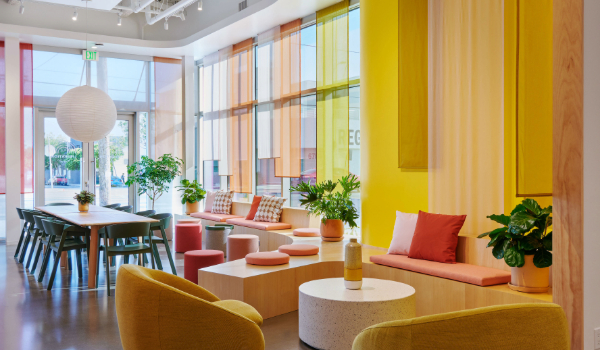
If I had to pick one, it would be Liberation Coffee House. We transformed a modest café space into the symbolic front door of the Los Angeles LGBT Center, creating a vibrant platform for community healing and workforce training. By repurposing leftover materials, we maximized our social and cultural impact, and it became a new model for LGBTQ+ centers around the world.
Go for it!
If you love what you do your enthusiasm will always shine through. Be curious, and always treat limitations as catalysts for innovation. Don't be afraid of the unknown or the constraints - whether it's a tight budget, a difficult site, or working in an unfamiliar city. Use those constraints to push your own creativity.
Also, find good mentors early and eventually become one yourself; sharing resources and cultivating emerging leaders is how you build a resilient, meaningful career.
Favourite building in Los Angeles? Without a doubt the VDL house in Silverlake by Richard Neutra. It’s a very special home that seamlessly blends modernist geometry with nature. Its expansive glass walls, reflecting pools, and interconnected spaces create a peaceful sanctuary in a chaotic city.
One place every visitor should see? If you only visit one spot in LA, make it LACMA. Standing among the glowing streetlamps of Chris Burden’s Urban Light at sunset is unforgettable. Inside, the incredible new galleries by Peter Zumthor physically float over Wilshire Boulevard, completely reimagining how you experience art. It’s amazing and
you can really feel LA’s creative energy when you're there.
What do you miss about Ireland? The craic! The long summer evenings, pubs spilling out onto the street, the people and the laughter.
Ireland or California... where does your heart belong? Both. Ireland gave me my foundational lesson in craft, and California gave me the canvas to build a forward-looking practice.