
Everyone Has a Story: Drama, Advocacy, and Inclusive Education at TU Dublin
In a society that thrives on diversity, championing social inclusion and confronting discrimination isn’t just a global goal that benefits people impacted by reduced inequalities, it’s a pathway to meaningful change for all. When people with disabilities participate fully and equally, society becomes richer, more vibrant, and is more inclusive.
Higher education institutions, like TU Dublin, must play their part to address barriers in inclusive education and lifelong learning opportunities for people with disabilities. Guided by the United Nations (UN) Sustainable Development Goal (SDG) 10: Reduced Inequalities, and SDG 16: Peace, Justice and Strong Institutions and by breaking down barriers and fostering understanding, higher education institutions are not just opening doors, they are working to build a sities as truly shared spaces for all learners, regardless of ability.
Everyone Has a Story to Share
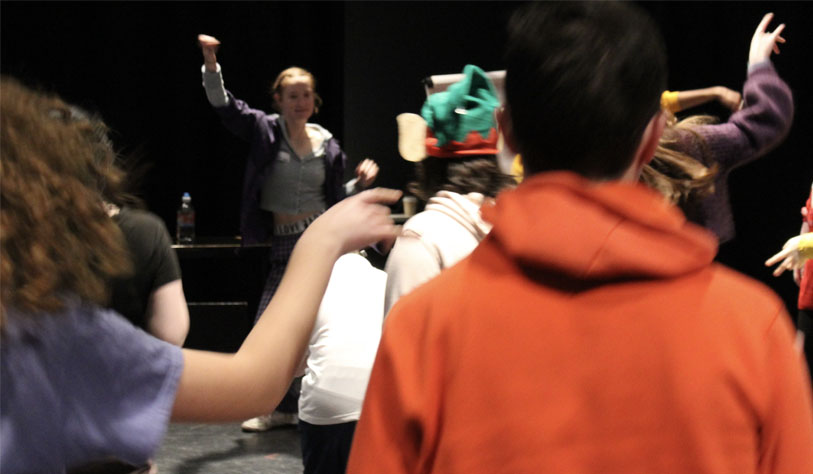
This project builds on 10 years of collaborations between the TU Dublin Conservatoire and services and clients. In Semester one of the 2025/2026 academic year, final year BA (Hons) in Drama (Performance) (TU962) students and Conservatoire lecturers, Charlotte Tiernan and Sarah Fitzgibbon, invited adults with intellectual disabilities to engage in four weeks of workshops at TU Dublin on the theme of ‘Drama and Advocacy’. The group worked with collaboration partners in WALK (Walkinstown Association for People with an Intellectual Disability), St John of God's Community Services, and St Michael's House Services.
The drama and advocacy project allowed TU Dublin students a firsthand experience of co-creating a creatively collaborative space with people who present with very specific individual needs. In this unique collaboration, students needed to facilitate the participants both as individuals and as a group. Most students will experience similar experiences as freelancer artists working on commission as part of a creative process or building a creative product.
Participants used drama to explore the concept of advocacy and to practice advocating for themselves and others. By using drama and hypothetical scenarios, participants can practice self-advocacy in various real-life situations, for example, addressing a partner who dismisses their needs in a relationship, standing up for themselves if a customer is disrespectful in a restaurant, or asserting themselves when being ignored in a shop.
This project creates the foundation for further collaborative engagement. All participants are invited back to engage with the Inclusive Arts Summer School every May to enjoy a week of drama workshops facilitated by Charlotte, Sarah and graduates from TU962. This summer school is supported by TU Dublin Conservatoire and the parents and friends of St. John of God's Community Services in partnership with National Museum of Ireland @ Collin's Barracks.
Shared Impact
By fostering inclusive, participatory learning experiences, the workshops helped to support the mental and emotional well-being of both university students and adults with intellectual disabilities. The creative environment empowered participants to express themselves, build confidence, and develop social-emotional skills. Simultaneously, the initiative promoted lifelong, inclusive, and equitable education by challenging traditional barriers to learning and broadening access to third-level educational spaces. In doing so, the project reimagines the role of universities as truly shared spaces for all learners, regardless of ability.
SDG Alignment:
This initiative strongly aligns with the United Nations Sustainable Development Goals:
-
SDG 10: Reduced Inequalities - Reduce inequality within and among countries
-
SDG 16: Peace, Justice and Strong Institutions - Promote peaceful and inclusive societies for sustainable development, provide access to justice for all and build effective, accountable and inclusive institutions at all levels
Each Sustainability Action Lab project is underpinned by:
-
SDG 4: Quality Education - Ensure inclusive and equitable quality education and promote lifelong learning opportunities for all
-
SDG 17: Partnership for the Goals - Strengthen the means of implementation and revitalize the Global Partnership for Sustainable Development
GreenComp Alignment
The project also aligns with specific competences from the e-framework "GreenComp sustainability competency framework including;
| Competency Area | Competency | Descriptor |
|---|---|---|
| Embodying sustainability values | Supporting fairness | To support equity and justice for current and future generations and learn from previous generations for sustainability. |
| Embracing complexity in sustainability | Critical thinking | To assess information and arguments, identify assumptions, challenge the status quo, and reflect on how personal, social and cultural backgrounds influence thinking and conclusions. |
| Envisioning sustainable futures | Exploratory thinking | To adopt a relational way of thinking by exploring and linking different disciplines, using creativity and experimentation with novel ideas or methods |
| Acting for sustainability | Collective action |
To act for change in collaboration with others |
This collaboration was supported by the Societal Engagement and Sustainability Education teams and through the Higher Education Authority’s Strategic Alignment of Teaching and Learning Enhancement (SATLE) fund.