
Green-Campus
The Green-Campus Programme is an international programme that encourages a partnership approach to environmental education, management, and action in third-level institutions. The programme primarily aims to ensure that members of a campus community can engage in a meaningful way to enhance sustainability on campus. In Ireland, the Green-Campus Programme is operated by An Taisce, the National Trust for Ireland.
Under the Green-Campus 7-Step programme structure, TU Dublin has a mission to:
- Establish a Green-Campus Committee incorporating students and staff
- Undertake environmental reviews for each theme
- Implement action plans
- Monitor and evaluate actions
- Embed sustainability within the curricula
- Inform and involve all within the TU Dublin Community
- Develop a Green Charter
Green Campus at TU Dublin
At TU Dublin, sustainability is at the heart of how we operate, learn, and grow as a university community. The Green-Campus programme brings students and staff together to make meaningful progress on environmental issues across our campuses, from energy and waste to biodiversity and sustainable travel, and climate action.
This is where ideas turn into action. Explore our initiatives, see what’s happening across our campuses, and find out how you can get involved in shaping a more sustainable future at TU Dublin.
In December 2023 TU Dublin became the first multi-campus University in Ireland to be awarded the prestigious Green Flag under a single application for all campus locations by An Taisce’s Green-Campus programme. During the three-year Green Campus cycle, the Green Campus Committee, together with the wider Green Team and over 50 external partners, progressed environmental action on campus under the major themes of Litter & Waste, and Energy, and minor themes of Transport & Travel and Biodiversity. As well as fostering a culture for pro-environmental behaviour, the committee were challenged to undertake an environmental review across five diverse locations, with 185 acres of campus grounds and 204,300 m² of accommodation in 47 buildings.
Achieving Green Flag accreditation was a strategic milestone for the University. Now as an official Green Campus institution, TU Dublin is delighted to join the many campuses nationwide who are already flying the Green Flag.
Become a member of TU Dublin's Green Campus Network!
At TU Dublin, the Green Campus programme is delivered through a structured governance model that connects community-led action with institutional leadership:
- A Green Campus university-wide Network open to all students and staff, enabling participation in sustainability initiatives across all campus locations.
- Campus based networks with Student/Staff Leads supporting local engagement and action.
- A central Green Campus Committee, which acts as the steering group for both the Green Campus Programme and the Green Campus Living Lab, coordinating activity, setting priorities, and ensuring alignment with the university's sustainability objectives.
Technological University Dublin participates in the An Taisce Green-Campus Programme through a whole‑community, partnership‑based approach. It brings students and staff together to advance environmental action and learning across all TU Dublin campuses. The TU Dublin Green Campus Committee leads the University’s engagement with the An Taisce Programme, coordinates the renewal of the Green Flag award, and monitors cross‑campus efforts across key focus areas including biodiversity, litter and waste, energy, water conservation, sustainable travel, green ICT, and climate justice. All Green Campus Committee activities are aligned with the university’s Strategic Intent, Climate Action Roadmap, and Sustainability Strategy ensuring coherence with TU Dublin’s long‑term sustainability ambitions. With its Co-Chairs on University Sustainability Council, the TU Dublin Green Campus Committee connects campus level actions with university level sustainability strategy, policy, planning and operations.
As the steering group of the TU Dublin Green Campus Living Lab, the Committee also enables our campuses to function as spaces for experimentation, collaboration, and evidence‑driven, sustainability-focussed innovation, gathering insights that inform decision‑making and operational improvement. Examples of Green Campus Solutions co-created and trialled through the Green Campus Living Lab are available on TU Dublin’s website. To support local action across TU Dublin’s campus locations, a Green‑Campus Network has been established and is open to all students and staff, including those in teaching, research, and operations.
Anyone can join the Network at any time by completing the online form available on our website, and feedback or queries can be sent to sustainability@tudublin.ie.
Green Campus
Green-Campus Open Call 2026
Students and staff are encouraged to apply to the Green Campus Open Call 2026 to secure micro-grant funding to develop innovative projects that create lasting environmental and social impact across our campuses. Deadline: Monday 16 November 2026
.jpg)
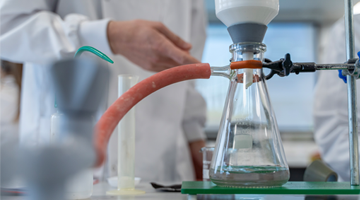
Green Labs
My Green Lab accreditation is being sought across a variety of TU Dublin lab spaces and 10 certifications have already been awarded.
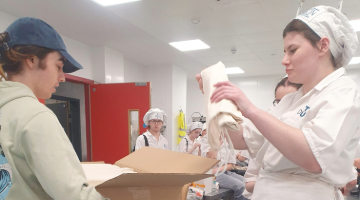
Green Campus Solutions
The Green-Campus Open Call helps to bring ideas to life by making micro-grants available to selected project ideas submitted in response to the open call. Read about the Green Campus solutions here.
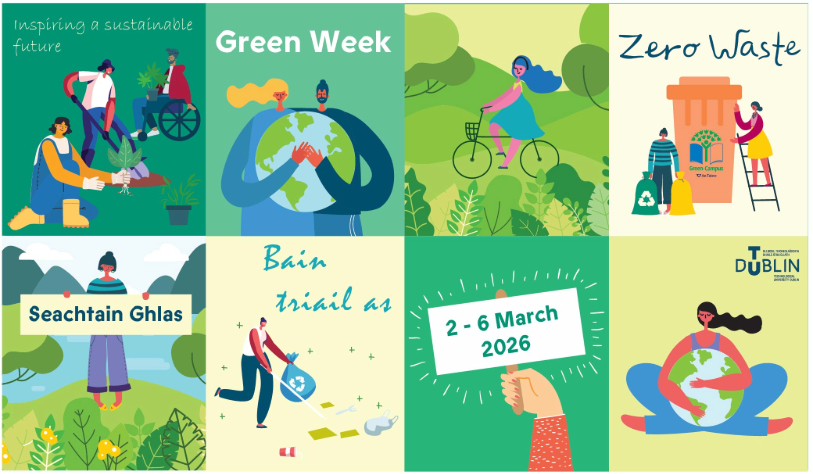
Green Week 2026
TU Dublin Green Week is an annual celebration of innovation and partnerships for environmental action and sustainability education.
Green-Campus Network Membership
Click here to join Green-Campus
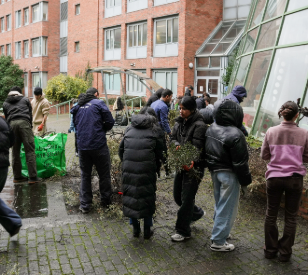
Nine Green-Campus Open Call 2025 projects funded
As part of Green-Campus Open Call 2025, nine projects were awarded micro grants to progress environmental and sustainability activities. Read more here.
Litter and waste generated on campus has a negative impact on our local environment. These impacts also effect neighbouring communities as well as contributing to national and global environmental degradation. Waste on campus can take the form of food waste, material waste, chemical waste, and electrical waste. Waste is not only an environmental issue, but also an economic one.
According to a recent EPA report, in 2020, the waste created generated by Ireland’s linear economy (make – take – use – dispose) increased to 16.2 million tonnes (3.25 tonnes per person), up from 12.7 million tonnes (2.77 tonnes per person) in 2012. The same report showed that our recycling rates were considerably below EU waste targets.
It is our ambition at TU Dublin to implement the principles of the circular economy by reducing waste, reusing, and repairing products and materials, and to recycle effectively.
Under the theme Litter and Waste, TU Dublin will:
- build awareness around the environmental impacts of litter and waste
- assess the impact of litter and waste on campus
- implement practical measures for preventing and minimising litter and waste
- promote a circular economy culture
Energy
Large institutions, such as TU Dublin, are energy intensive and run many different operations and functions for thousands of students and staff members. A high level of non-renewable energy production and consumption has a direct negative effect on the environment. The environmental problems directly related to energy production and consumption include the generation of greenhouse gas emissions (GHGs) which contribute towards poor air quality and climate change.
In Ireland in 2021, the EPA reported that the energy sector was the third largest contributor to overall emissions accounting for 16.7% of total GHG emissions. SEAI's Energy in Ireland 2022 report showed that Ireland’s total energy use in 2020 was down almost 9%, and energy related CO2 emissions fell also by 11.4% due largely to the impacts of the COVID-19 pandemic. The overall share of renewable energy however was just over 13%, falling short of the EU renewable energy target of 16%.
TU Dublin has a responsibility to support government policy for reducing energy consumption. Under the theme of Energy, TU Dublin will improve energy efficiency, in tandem with developing an ongoing engagement and awareness campaign to help students and staff to conserve energy on and off campus. Through practical measures, TU Dublin will mitigate the impact of energy related GHG emissions by reducing daily energy use on campus.
Under the theme of Energy, TU Dublin will:
- build awareness around the environmental impact of energy-use and carbon
- ease the pressure on the national electricity grid
- reduce indoor temperatures to 19 degrees as per government policy
- optimise the use of campus buildings
- reduce our reliance on imported fossil fuels
- reduce our overall energy costs by reducing energy consumption
Biodiversity
Biodiversity refers to the variety of living things on earth including animals, plants, fungi, and microorganisms like bacteria. Life on earth is supported by a delicate balance of eco-systems. Disruption to this balance, such as species and habitat loss, has serious negative impacts to biological systems and damage can sometimes be irreversible.
NPWS reported in a 2019 report, that almost half of the EU protected habitats and species in Ireland are in decline. The data revealed that over 60% of Ireland’s common birds are threatened, one third of wild bee species are becoming extinct and the number of rivers with pristine water quality has plummeted from 500 to 20 over the past 40 years. In 2023, Ireland will publish its 4th National Biodiversity Action Plan (NBAP) 2023-2027, and there is much work to be done nationally to halt biodiversity loss.
With 115 acres of land across Dublin city-centre and sub-urban landscapes, TU Dublin has an opportunity to protect biodiversity and enhance the local environment.
Under the theme of Biodiversity, TU Dublin will:
- build awareness around the value of protecting biodiversity and the natural world
- support the All-Ireland Pollinator Plan
- boost the diversity of native plant and animal life through conservation
- develop understanding of environmental and natural resource management
- constantly review land-use and landscaping practices in favour of protecting biodiversity
Transport & Mobility
Pollutants from transport-related emissions have a serious negative effect on human and environmental health. The air pollutant emissions generated from transport are a main contributor to air quality problems both in Ireland and globally. These pollutants can include particulate matter (PM), nitrogen oxides (NOx), unburnt hydrocarbons (HC) and carbon monoxide (CO).
In Ireland in 2021, the EPA reported that between 1990 and 2021, Transport shows the greatest overall increase of GHG emissions at 112.2%. Fuel combustion emissions from Transport accounted for 9.3% and 17.7% of total national GHG emissions in 1990 and 2021, respectively. Under the revised Climate Action Plan Ireland has new ambitious targets to transform how we travel over the coming seven years.
TU Dublin is uniquely positioned to support sustainable travel to each of its campus locations. Our recent TU Dublin Smarter Travel staff and Student Survey 2022 revealed that 83% of survey respondents agreed that they would like to use sustainable transport to reduce their impact on the environment.
Under the theme of Travel, TU Dublin will:
- build awareness around the environmental and health impacts of transport-related emissions
- foster a culture of active and sustainable travel to campus
- work together with the National Transport Authority and local authorities to improve sustainable travel to campus
- provide opportunities for healthier, equitable and more sustainable commutes
- provide infrastructure and facilities to support active travel