
Examining the Asian elephant feed at Dublin Zoo
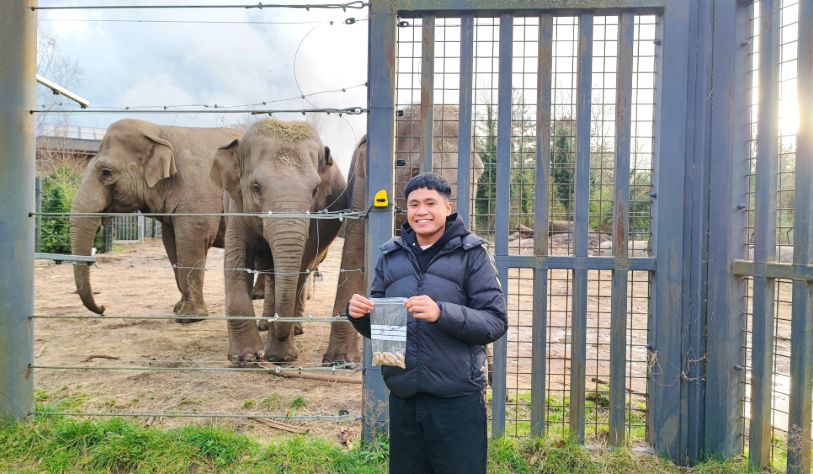
Variability in feed composition can impact animal health, welfare, and dietary management, highlighting the importance of reliable, evidence-based assessment. This collaboration with Dublin Zoo applied established analytical approaches to generate comparative nutritional profiles, supporting informed decision-making in animal nutrition and feed quality management.
This project centred the United Nations (UN) Sustainable Development Goals (SDGS), in particular SDG 3 (Good Health and Well-being), SDG 12 (Responsible Consumption and Production), and SDG 15 (Life on Land), by applying scientific analysis to improve animal nutrition, welfare, and sustainable feed management practices at Dublin Zoo.
Enhancing Nutrition and Welfare
In Semester 2 2026, Aaron Venas - a final year student from the BSc in Pharmaceutical Healthcare (TU875), conducted a research project as part of the Pharmaceutical Healthcare Project/Dissertation (TFPJ4004) module- examining the composition and consistency of selected Asian elephant feed materials at Dublin Zoo over a four-week period. The study focused on variations between different feed batches supplied for the elephants and explored aspects of quality consistency over time.
The collaboration was under the guidance of Dr Tao Zhang, lecturer at the Faculty of Sciences & Health, School of Food Science and Environmental Health, and Andrew Mooney from Dublin Zoo, and supported by TU Dublin’s Sustainability Action Lab programme.
.png)
Using established analytical approaches, Aaron Venas generated comparative profiles to support assessment of feed composition. The collaboration promoted co-learning by applying academic knowledge to a real-world setting. Outputs included a final-year dissertation and practical insights to support evidence-based decision-making in animal nutrition and feed quality management.
Aaron Venas said:
“As a student working with Dublin Zoo, this project has been a great opportunity to apply both my laboratory and analytical skills that I’ve learned in a real-world setting. By analysing the consistency and composition of elephant feed samples over time, I’ve been able to get a better understanding of how important diet quality is for animal health and well-being. It’s rewarding to know that this research can potentially help support the improvements in feeding practices that contribute to the ongoing care of the elephants.”
Andrew Mooney from Dublin Zoo said:
“We’re delighted to collaborate with TU Dublin on this project, which is examining the composition and consistency of our Asian elephant diets over time. By analysing how the nutritional profile of feed can vary, this work gives us valuable insights into maintaining a stable and balanced diet for our herd of elephants.
“Findings from the study will help inform our feeding practices and support our ongoing commitment to evidence-based animal management, providing the highest possible standards of animal care and welfare, and ensuring our elephants continue to thrive under expert care.”
Dr Tao Zhang, lecturer at the Faculty of Sciences & Health, School of Food Science and Environmental Health, said:
“From an academic perspective, this project provides a valuable platform for our Pharmaceutical Healthcare students to apply their laboratory and analytical training in a real-world context. It highlights the development of transferable skills, including analytical testing, data interpretation, and quality assessment, which are highly relevant across pharmaceutical, food, and wider healthcare settings.”
“This is exactly the kind of partnership that brings science to life - where student learning, applied research, and real-world impact come together in a truly tangible way.”
SDG Alignment:
This initiative strongly aligns with the United Nations Sustainable Development Goals:
- SDG 3: Good Health and Well-being - Ensure healthy lives and promote well-being for all at all ages
- SDG12: Responsible Consumption and Production - Ensure sustainable consumption and production patterns
- SDG15: Life on Land - Protect, restore and promote sustainable use of terrestrial ecosystems, sustainably manage forests, combat desertification, and halt and reverse land degradation and halt biodiversity loss
Each Sustainability Action Lab project is underpinned by:
- SDG 4: Quality Education - Ensure inclusive and equitable quality education and promote lifelong learning opportunities for all
- SDG 17: Partnership for the Goals - Strengthen the means of implementation and revitalize the Global Partnership for Sustainable Development
GreenComp Alignment
The project also aligns with specific competences from the GreenComp sustainability competency framework including
- Embodying Sustainability Values,
- Embracing Complexity in Sustainability,
- Envisioning Sustainable Futures.
|
Competency Area |
Competency |
Descriptor |
|
Embodying sustainability values |
Promoting Nature
|
To acknowledge that humans are part of nature; and to respect the needs and rights of other species and of nature itself in order to restore and regenerate healthy and resilient ecosystems. |
|
Embracing complexity in sustainability |
Systems thinking |
To approach a sustainability problem from all sides; to consider time, space and context in order to understand how elements interact within and between systems. |
|
Envisioning sustainable futures |
Futures Literacy
|
To envision alternative sustainable futures by imagining and developing alternative scenarios and identifying the steps needed to achieve a preferred sustainable future |
This collaboration was supported by the Societal Engagement and Sustainability Education teams and through the Higher Education Authority’s Strategic Alignment of Teaching and Learning Enhancement (SATLE) fund.