
Inside Disposable Tech: Exploring Material Circularity
Overview
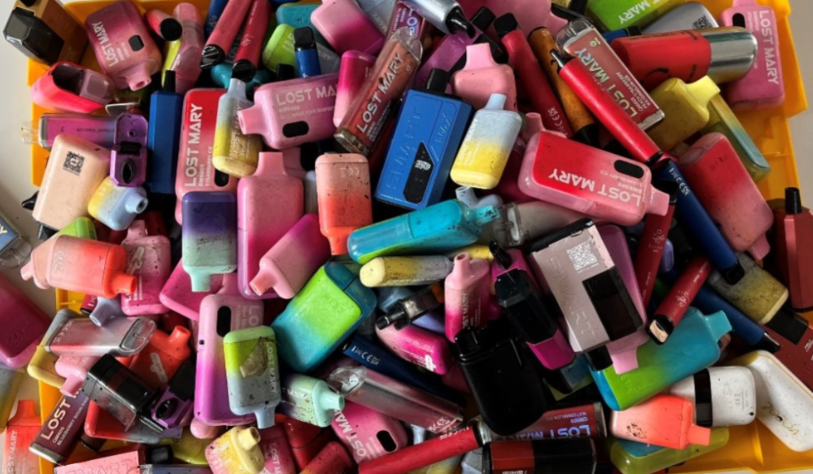
In Ireland, the rapid rise in the use of e‑cigarettes and disposable vapes has created a growing environmental concern, largely due to incorrect disposal. According to the WEEE Ireland Annual Environmental Report 2024, a reported 31 million vape and e-cigarette devices were sold in Ireland in 2024, of those just 1.1 million were returned for recycling.
These devices are classified as Waste Electrical and Electronic Equipment (WEEE) because they contain batteries, plastics, and electronic components, yet many are discarded in general waste or littered in public spaces. This improper disposal not only prevents valuable materials, such as lithium and metals, from being recovered, but also poses risks of environmental pollution and fire hazards in waste systems.
Inside Disposable Tech: Exploring Material Circularity
Inside Disposable Tech: Exploring Material Circularity is a cross‑disciplinary initiative led by Ceri Almrott and Keith Colton, lecturers from the School of Art and Design and the School of Mechanical Engineering at TU Dublin. The project explores the environmental impact and material complexity of single‑use electronic devices, with a particular focus on disposable and rechargeable vapes. Building on ongoing research within the Materials Intelligence Lab, the initiative combines education, creative practice and public engagement to turn electronic waste into a tool for learning and awareness.
The initiative was delivered during Green Week 2026 at TU Dublin’s Bolton Street campus and brought together a diverse group of stakeholders, including:
- TU Dublin Product Design programme and Societal Engagement
- South Dublin County Council (SDCC)
- The SDCC Junior Safety Forum and Escape the Vape initiative
- Five local primary schools and their teachers: Citywest & Saggart National School, St Ronan’s National School (Clondalkin), St Thomas Senior National School (Jobstown), Divine Mercy Senior National School (Balgaddy), and St Dominic’s Senior National School (Tallaght).
A total of 42 participants, including 36 sixth-class students and 6 teachers, took part in the workshop, bringing first-hand insights from their communities. The key objectives of the project were to:
- Increase awareness of e-waste and its environmental impact
- Explore the internal composition of everyday electronic devices
- Foster circular economy thinking through design and creativity
- Strengthen collaboration between university, schools, and local authorities
The project was rooted in community-identified challenges, as pupils from the Junior Safety Forum had previously highlighted the prevalence of discarded vapes during local activities.
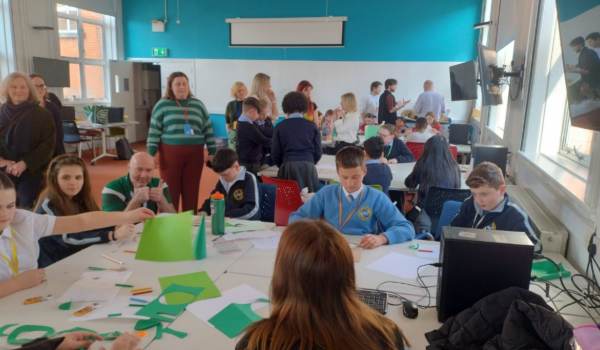
The workshop combined design, science, and co-creation through several key activities:
- Community knowledge exchange:
Students shared their observations and experiences of vaping-related waste in their local environments, ensuring the workshop was grounded in real-world issues. - Hands-on exploration and disassembly:
Participants examined and deconstructed discarded vape devices to understand their internal components and material composition. - Material circularity and lab engagement:
Activities were supported by TU Dublin’s Materials Intelligence Lab, where participants engaged with tools and processes for understanding and working with different material streams. - Co-creation and design ideation:
Participants collaborated with university staff and Product Design students to imagine how recovered materials could be transformed into new, useful objects. - Peer learning through facilitation:
Final-year Product Design students acted as facilitators, supporting younger participants and translating technical knowledge into engaging, accessible learning experiences.
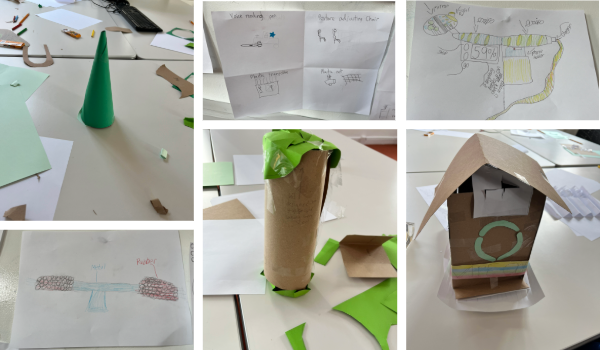
This approach positioned participants not just as learners, but as co-creators of solutions.
Evaluation and Reflection
The project generated strong impacts across education, engagement, and community collaboration:
- Participants developed a deeper understanding of e-waste, material circularity, and the environmental and material complexity of designed objects
- Young people were empowered to see their observations as valuable contributions to environmental problem-solving
- Product Design students gained experience in facilitation and communication
- The project created a model for future outreach workshops linking design education, local government, schools, and community partners, while strengthening connections with these stakeholders
This project showed us that circular economy thinking doesn't have to be complicated or abstract. When children identify a material problem in their own streets, disassemble it, and see it return as something useful in their classroom, the loop closes in a way that's understandable and meaningful to them and inspires future action. We want our communities to be able to make the things they need, and this project is a small step toward proving that they can.
Closing the Loop - From Recovery to Artefact: The final stage of the project is currently underway, with graduating Product Design students developing a series of artefacts from materials recovered during the workshop. Prototypes, including doorstops, hooks, and classroom pegs, are expected to be completed by the end of June and will be returned to participating schools for use within their classrooms. This completes the material loop that the project set out to demonstrate: waste identified by a community, recovered through collaboration, and returned as useful objects to the same community.
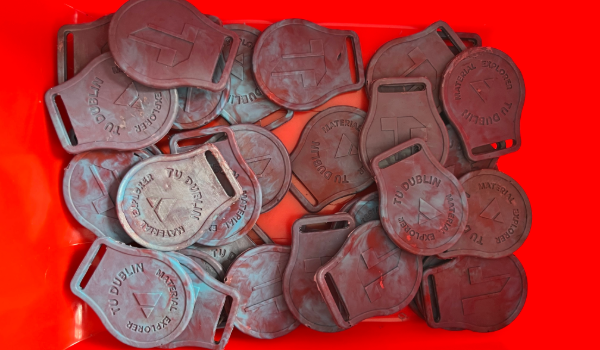
The project has shown scalability and adaptability, having been already adapted for degree-level Business students on exchange from Latvia.
Living Lab Approach and Alignment with SATLE Objectives
This project applies a Living Lab approach by bringing together multiple stakeholders (TU Dublin, South Dublin County Council, schools, and the Junior Safety Forum) to co-create solutions based on real community-identified challenges. The workshop model links design education with hands-on experimentation and civic engagement, enabling participants to explore material circularity in a practical setting.
It aligns with SATLE objectives by embedding sustainability into experiential learning, fostering collaboration across disciplines and sectors, and supporting innovative, community-engaged teaching practices.
In Semester 1 of the 2026-2027 academic year this Green Campus Solution will be considered by the Green Campus Committee for further iteration, replication or scaling up, and for publication in the TU Dublin Green Campus Living Lab community on Zenodo.
SDG and Green-Campus Alignment
This project addresses SDG 12: Responsible Consumption & Production and contributes to SDG 3: Good Health & Wellbeing and SDG 11: Sustainable Cities & Communities.
It aligns with the Green-Campus theme of Litter & Waste, demonstrating how participatory approaches can raise awareness and inspire action around emerging waste streams such as e-waste.