
Reconnect the Disconnected – Micro-Garden at Aungier St Campus
Overview
Urban campuses often have limited accessible green spaces, reducing everyday opportunities for students, staff and communities to connect with nature. This can affect biodiversity awareness, wellbeing, informal learning and the sense of belonging that shared outdoor spaces can help create.
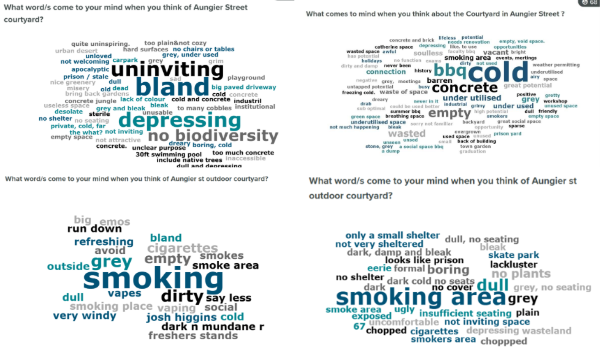
At TU Dublin’s Aungier Street campus, consultation with the campus community highlighted that the courtyard was often perceived as neglected, underused and uninspiring. Yet the same space also held potential: to become a place for biodiversity, outdoor learning, connection and care.
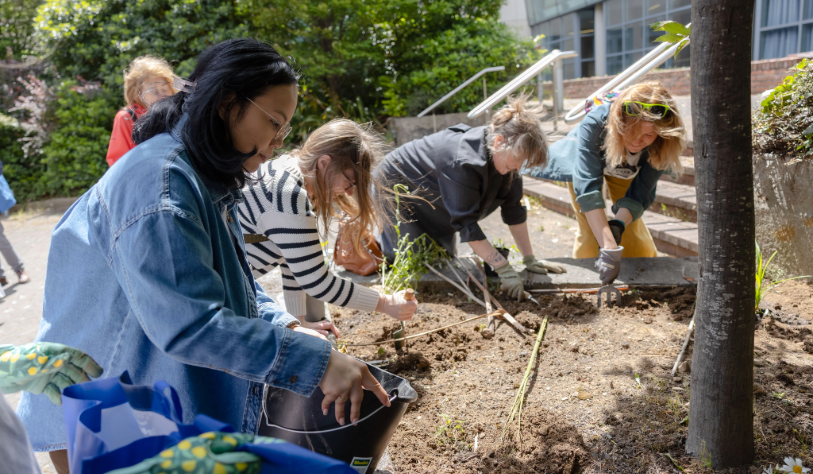
The Reconnect the Disconnected micro-garden project responded to this opportunity by transforming an overlooked courtyard into a living, shared space. The project aimed to increase biodiversity within a dense urban campus while reconnecting students, staff and community partners with nature and with each other through hands-on, place-based action.
Reconnect the Disconnected
The Reconnect the Disconnected micro-garden at Aungier Street is part of the wider Reconnect the Disconnected initiative, led by Dr Lucia Walsh, TU Dublin’s Sustainability Education and Innovation Lead. The project was co-led with Michelle Licciardi and Beta Bajgart through Dublin South City Partnership, and developed in collaboration with TU Dublin students and staff, Campus and Estates, social enterprises, environmental artists and local community partners.
The project’s key objectives were to:
- Enhance biodiversity within an urban campus
- Create a shared outdoor classroom for teaching, workshops and community events
- Provide a welcoming space for informal gatherings, conversation and wellbeing
As Dr Lucia Walsh reflected:
Working with Dublin South City Partnership has been one of the great joys of this project, demonstrating the power of collaboration to reconnect people, places and nature through shared action. What we are creating together holds many stories of care, creativity, generosity and collective effort. It is a place where we get our hands dirty and our hearts full, where ideas and relationships take root alongside plants, and where small actions can grow into a meaningful and lasting change.”
Aungier Street Micro-Garden: A Living Lab in Practice
The project followed a Living Lab approach, using the campus itself as a real-world learning environment. Rather than designing a solution in isolation, the team worked with students, staff and partners to understand the space, identify challenges, imagine possibilities and test practical interventions.
The process began with place-based analysis and user engagement. Students and staff contributed through surveys, sensory mapping and participatory tools that captured how the space looked, felt and functioned. Responses such as “uninspiring” and “neglected” helped define the design challenge and provided a clear rationale for intervention. The process also used creative urban design tools, including the "Pissing and Kissing Index[1]" to map areas of avoidance and attraction within the courtyard.
From there, the project moved into co-design and hands-on implementation. Gobnait Ní Neill from The Grassroot Guild developed an initial concept sketch that helped participants imagine what the space could become. This was followed by collaborative planning, clearing, planting, making and building. Over 60 volunteers were involved in preparing and transforming the space through clearing, planting, sanding, building and creating together.
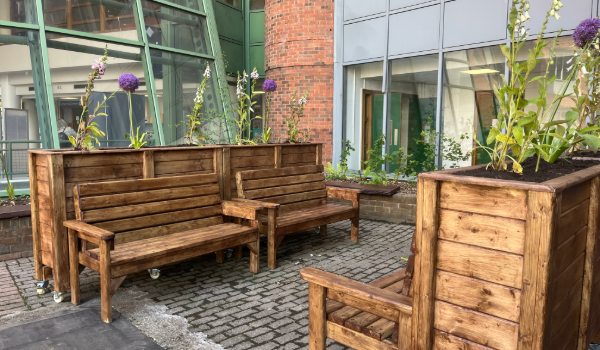
What may appear simple, planting beds, seating, habitats and planters, is the result of many connected contributions. The micro-garden includes:
- Over 100 native plants, shrubs and trees sourced from Pocket Forests
.png)
- Pollinator-supporting planting and biodiversity features
- Modular and moveable outdoor classroom that support outdoor learning, workshops and gathering built by Men’s Shed Walkinstown, supported through Dublin South City Partnership
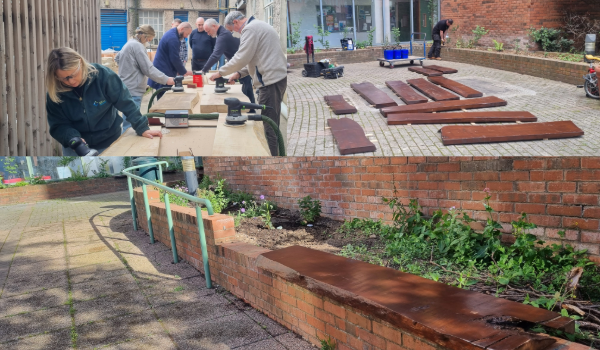
- Constructing additional reclaimed timber seating using wood salvaged from trees felled at the St. James’ Hospital site for the new Children’s Hospital. Led by Joseph Little and colleagues from School of Architecture, Building & Environment & School of Mechanical Engineering including David McDonnell, Andrew Farrington, Eric Bates, Thomas Lundy, Noel Whelan, Philip Gilmartin and Vincent Cronin and volunteers.
- A mini wildflower meadow
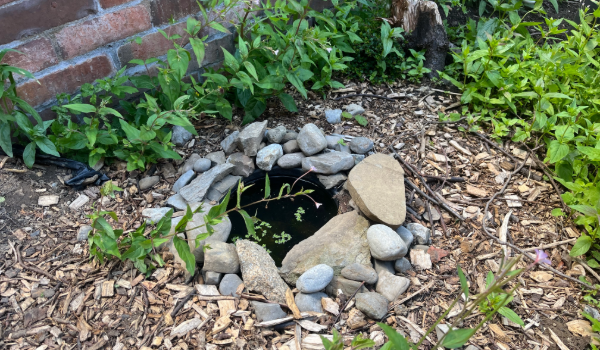
- A micro-pond created as part of a hands-on workshop with Gobnait Ní Néill from the Grassroot Guild
- Bee stones created by Plan Bee that will enable us to learn about different solitary bees
- Installation of an insect and pollinator habitat co-created by graduates and lecturers from the School of Architecture, Building and Environment.
For Beta Bajgart, project co-lead on behalf of Dublin South City Partnership, the project demonstrated the value of moving from conversation into practical shared action:
For me, this project reaffirmed that the first steps are the most difficult ones. Getting out of meeting rooms and boardrooms down to the ground and starting cleaning, planting, building, making mistakes as we go is not for the faint hearted. I'm proud that I was able to contribute by co-managing, documenting and getting my hands dirty.
Embedding Learning Through Action
The micro-garden has also become a platform for experiential learning. It creates opportunities for students to work with real spaces, real constraints and real communities, moving sustainability learning beyond the classroom and into lived campus experience.
Dr Sarah Rawe’s first-year Chemistry students designed and planted a medicinal herb garden with interactive features, creating a live learning resource that connects chemistry, plants, health, biodiversity and place. Dr Tara Rooney’s MSc in Digital Marketing students created digital content related to the garden, linking biodiversity action with communication, storytelling and public engagement.
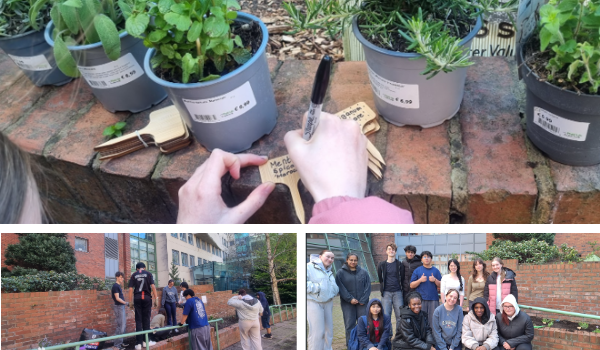
This kind of learning is practical, interdisciplinary and memorable. Students are not only learning about biodiversity, sustainability, science or communication in theory. They are working with soil, plants, people, materials, stories and place.
The micro-garden now provides a shared outdoor classroom, workshop space, meeting space and informal learning environment. It can support teaching, volunteering, wellbeing activities, creative workshops, research, reflection and everyday conversations.
Evaluation and Reflection
Although still evolving, the Aungier Street micro-garden has already delivered environmental, educational and social impact. It has:
- Increased biodiversity awareness and appreciation among students and staff
- Added native planting, pollinator habitats and biodiversity features to a dense urban campus
- Created a nature-based space that supports wellbeing, informal learning and connection
- Provided a platform for interdisciplinary teaching and experiential learning
- Strengthened collaboration between TU Dublin, Dublin South City Partnership, social enterprises and community partners
- Demonstrated how underused campus spaces can become meaningful shared places through co-creation and care
- Created a replicable model for biodiversity, outdoor learning and community engagement across other campuses
The project also shows that biodiversity work can be social, creative and deeply human. The micro-garden is a place shaped by conversations, ideas, labour, generosity and care.
Michelle Licciardi, Enterprise and Social Enterprise Manager with Dublin South City Partnership, described the collaboration as a way of building connection, confidence and collective action:
We reconnect the disconnected by creating spaces where nature, creativity and community remind us we are not facing the climate crisis alone. The gardens, stories, relationship building and shared experiences inspire us to believe we could be the GOOD ANCESTOR, leaving places, people and possibilities better than we found them.
On 12 June, the project community came together to celebrate and appreciate what had been co-created. It was a moment to pause, gather, plant, share food and conversation, and recognise the collective effort behind the space. Colleagues from other TU Dublin campuses also brought plants to share, creating a real moment of cross-pollination across campuses.
It is now a space where people can meet, learn, sit, plant, observe, teach, gather and reconnect.
What Comes Next
The Aungier Street micro-garden is still growing. Future plans include continued planting, further biodiversity enhancements, a pond, community and student-led workshops, storytelling activities, signage, volunteering opportunities and ongoing care for the space.
The invitation is simple: come outside, use the space creatively, bring a class, hold a meeting, sit in silence or conversation, and help the garden continue to grow. Hands dirty, hearts full.
Living Lab Approach and Alignment with SATLE Objectives
The project applies a Living Lab approach by transforming a real campus space through collaboration between students, staff, community partners and external collaborators. It enabled co-creation, experimentation, reflection and ongoing learning in a live setting.
It supports SATLE objectives by embedding sustainability into hands-on, interdisciplinary education and by creating opportunities for civic engagement, experiential learning and innovative teaching practice.
The micro-garden provides a live context for students to engage with sustainability challenges in practical ways. It connects biodiversity, design, science, communication, wellbeing, community development and social innovation within one shared space.
SDG and Green-Campus Alignment
The project aligns strongly with the Green Campus themes of Biodiversity and Litter and Waste, particularly through its focus on native planting, pollinator support, reuse of materials and collaborative care for place.
This project addresses SDG 3: Good Health & Wellbeing and contributes to and SDG 11: Sustainable Cities & Communities, SDG 4: Quality Education, SDG 12: Responsible Consumption and Production, SDG 13: Climate Action and SDG 15: Life on Land.
References:
[1] Gerritsma, R., Bouw, E., & Horgan, D. (2024). Place exploration & sense making tool (Vol. 04). Expertise Network Sustainable Urban Tourism (ENSUT). https://www.ensut.eu/knowledge/place-exploration-sense-making-tool/