
re:model
Overview
Within design and architecture education in Ireland, model-making is a core component of studio-based learning. However, this process often relies on large volumes of materials, such as cardboard, foam, plastics, and timber, that are frequently discarded at the end of each project or academic year.
This linear “take–make–dispose” approach contributes to unnecessary waste and increased demand for new materials, placing financial pressure on students while generating avoidable environmental impacts. At the same time, opportunities to reuse high-quality materials are often missed due to the absence of systems that support sharing and redistribution.
In this context, there is a growing need within higher education to embed circular economy principles into teaching and learning, enabling students to rethink material use and design more sustainably.
re:model
re:model is a student-led and student managed circular economy initiative developed within the School of Architecture, Building and Environment at TU Dublin, under the leadership of lecturer Laura Carroll. The project introduces a material sharing system that enables the reuse and redistribution of model-making materials within the school. The project’s key objectives are to:
- Reduce waste from architectural model-making
- Lower the cost of materials for students
- Embed circular economy principles into studio practice
- Foster collaboration and peer-to-peer sharing
The project followed a structured co-creation, user-centric approach, combining research, prototyping, and real-world implementation:
- Exploration and user research:
Student re:model ambassadors conducted peer-to-peer interviews to understand material use, waste patterns, and cost challenges among architecture students. Insights from this research informed the design of the solution. - Co-design and concept development:
Students developed design concepts, sketches, branding, and a social media campaign, ensuring the initiative was visible, accessible, and aligned with student needs.
- Prototyping and behavioural testing:
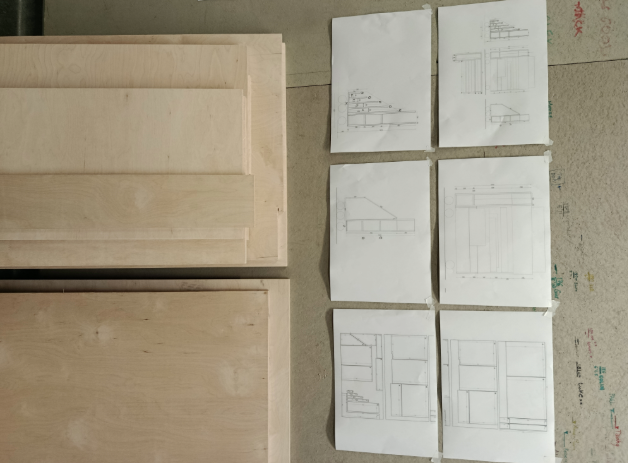
Cabinet designs were tested and refined with peers to ensure they would encourage behavioural change toward reuse and sharing.
- Fabrication and hands-on workshops:
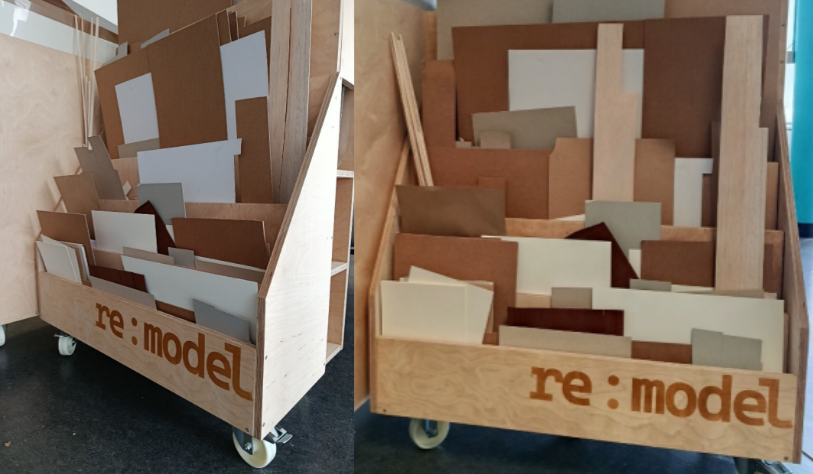
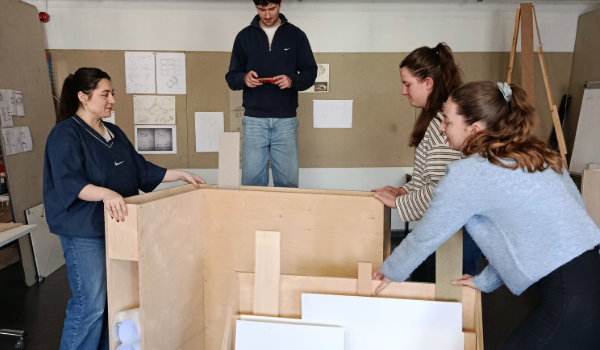
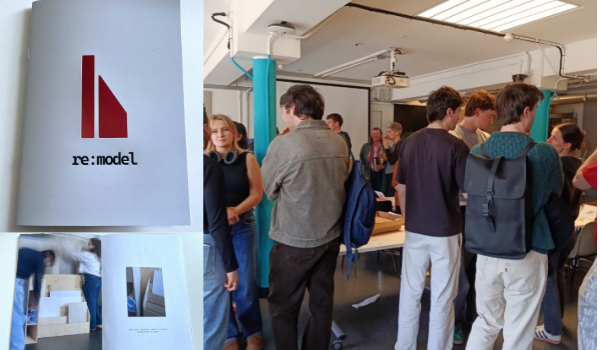
Students participated in collaborative fabrication workshops, constructing the material-sharing cabinets while gaining practical experience in Design for Disassembly and circular construction methods. The final outcome was a set of mobile storage cabinets, creating a free material-sharing library where students can drop off unused materials and collect resources for their own projects.
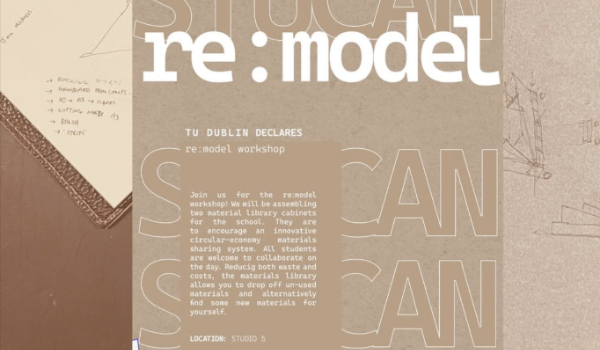
The initiative was launched through an event supported by a guide booklet and open-source toolkit, helping students understand how to use and contribute to the system.
Evaluation and Reflection
The project has delivered clear environmental, educational, and social benefits:
- Reduced waste from discarded model-making materials and lowered demand for new resources
- Improved affordability and accessibility for students by providing free material access
- Fostered a culture of sharing and collaboration between different year groups
- Enabled students to engage directly with circular economy principles in practice
- Generated learning and evidence to inform future circular economy initiatives within the Green Campus programme
- Provided a replicable and adaptable model for materials reuse that could be extended to other design focused programmes and campuses across TU Dublin
This approach embeds circularity directly into everyday studio practice, transforming how materials are sourced, used, and valued.
Importantly, the initiative demonstrates how behaviour change can be supported through well-designed infrastructure and peer-led engagement.
The project offers strong replication potential, with the material-sharing model adaptable to other design disciplines, campuses, and institutions.
Speaking about the project, Laura Carroll, who led the initiative, said:
Running the re:model project was an incredibly enjoyable experience. The support from the TU Dublin Green Campus programme was instrumental; it provided more than just the financial means for materials and fabrication. It gave us the license to turn ambitious concepts into tangible and functional outcomes. By integrating design-for-disassembly into hands-on design and construction workshops, we didn't just build material banks; we fostered a culture of shared responsibility that addresses the critical intersection of material waste and student affordability. It is genuinely inspiring to see the re:model units already filled with repurposed materials, signalling the immediate start of this new cycle of reuse among students. This project has demonstrated that given the opportunity, our students can actively reshape our school’s culture to be more equitable, collaborative, and circular.
Living Lab Approach and Alignment with SATLE Objectives
This project applies a Living Lab approach by embedding a circular economy solution within the real teaching environment of the architecture studio, where students co-designed, tested, and implemented the solution, based on the user needs.
It aligns with SATLE objectives by integrating sustainability into practice-based learning, supporting student leadership, and fostering innovative, collaborative approaches to teaching and learning.
In Semester 1 of the 2026-2027 academic year this Green Campus Solution will be considered by the Green Campus Committee for further iteration, replication or scaling up, and for publication in the TU Dublin Green Campus Living Lab community on Zenodo.
SDG and Green-Campus Alignment
This project addresses SDG 12: Responsible Consumption & Production and contributes to SDG 11: Sustainable Cities & Communities.
It aligns with the Green-Campus theme of Litter & Waste, demonstrating how participatory approaches can raise awareness and inspire action around emerging waste streams such as e-waste.