
Reusable Packaging for Bakery Students
Overview
Food and packaging waste are significant environmental challenges in Ireland, particularly within the food production and hospitality sectors. In practical teaching environments such as culinary and bakery education, large volumes of food and single-use packaging materials are generated daily due to high production levels, time constraints, and operational requirements.
At TU Dublin’s School of Culinary Arts & Food Technology (SCAFT), bakery and culinary teaching takes place across 17 active kitchens, bakeries, restaurants and food production spaces, contributing to both food waste and the use of disposable packaging such as paper bags, plastic wrap, and cardboard boxes. These practices not only increase environmental impact but also reinforce unsustainable habits among future professionals in the food industry. Addressing these challenges requires integrating sustainability into real teaching environments, where the school can model best practice and students can apply waste reduction practices in context rather than as abstract concepts.
Reusable Packaging for Bakery Students
The Reusable Packaging for Bakery Students project, led by Sheona Folley and Shannon Dickson, lecturers in the School of Culinary Arts & Food Technology, introduces a practical, behaviour-focused solution to reduce food and packaging waste by replacing single-use packaging with reusable alternatives. The project’ key objectives are to:
- Reduce single-use packaging waste in bakery teaching
- Improve food waste management and segregation practices
- Embed sustainability into culinary education
- Build long-term sustainable behaviours among students and staff
- Model best practice in practical culinary and bakery spaces
The project identified key issues, including low sustainability awareness, inconsistent waste practices, confusion over segregation of food and recycling and reliance on single-use packaging across multiple teaching kitchens. It followed an iterative approach, combining operational improvements, student engagement, and continuous feedback:
- Introduction of reusable packaging:
Students were provided with reusable carry bags, bread bags, and later cake transport boxes (as a result of feedback from students), enabling them to take baked goods from the production bakery without relying on disposable packaging. This intervention directly replaced previously used single-use bags and boxes.
.png)
- Sustainability workshops:
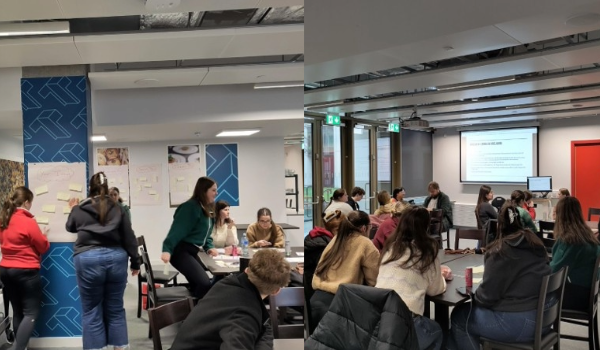
Interactive workshops were delivered to 37 first-year students (November 2025) and 33 second-year students (Green Week 2026), with third and fourth-year cohort engagements planned. Workshops combined short presentations on sustainability in bakery and culinary operations; group-based exercises, and feedback sessions on existing initiatives and practices. Based on student feedback, workshops were redesigned to be more interactive and less lecture-based, using discussion, group work, and collaborative brainstorming activity to increase engagement.
- Iterative feedback and refinement:
Student feedback directly influenced project development, including:- Students’ evaluation of kitchen and bakery operations
- Reusable bag format revisions
- Introduction of cake boxes
- Adjustments to workshop formats
- Plans for surveys and ongoing evaluation
- Identification of further opportunities (e.g. reducing cling film use)
Evaluation and Reflection
The project has generated measurable environmental and educational impact:
- Reduction in single-use packaging and food waste through the introduction of reusable bags and boxes
- Improved food waste awareness among students and staff
- Improved segregation of waste into food and recycling streams
- Increased engagement through workshops and practical learning activities
- Strengthened alignment between sustainability education and operational practice
Importantly, the project demonstrates that providing practical tools alongside education enables sustainable behaviour to become the default in high-pressure teaching environments.
The initiative has strong replication potential, with the model designed to expand across other culinary programmes, kitchens, and campuses.
Reflecting on the initiative, project co-lead Sheona Folley said:
We believe that involving students through collaborative and co-creative approaches, using a combination of workshops, demonstrations in practical lectures, and the opportunity for students to provide feedback, has been essential to delivering a meaningful and impactful project.
Future phases aim to introduce annual induction training for 1st years, dedicated training for lab technicians, standardise waste infrastructure across kitchens and explore further waste‑reduction initiatives, strengthening TU Dublin’s role as a leader in sustainable teaching and campus innovation.
Living Lab Approach and Alignment with SATLE Objectives
This project applies a Living Lab approach by using active teaching bakeries and kitchens as real-world environments , refine, and embed sustainable practices in collaboration with industry stakeholders Sodexo, TU Dublin’s Central Quad building management company, and Panda, the university’s waste management company.
It aligns with SATLE objectives by integrating sustainability into experiential learning, supporting collaboration across academic and operational teams, and enabling continuous improvement through feedback and data.
In Semester 1 of the 2026-2027 academic year this Green Campus Solution will be considered by the Green Campus Committee for further iteration, replication or scaling up, and for publication in the TU Dublin Green Campus Living Lab community on Zenodo.
SDG and Green-Campus Alignment
This project contributes to SDG 12: Responsible Consumption & Production and SDG 11: Sustainable Cities & Communities. In particular, SDG targets:
- 3: By 2030, halve per capita global food waste at the retail and consumer levels and reduce food losses along production and supply chains, including post-harvest losses
- 5: By 2030, substantially reduce waste generation through prevention, reduction, recycling and reuse
It aligns with the Green-Campus theme of Litter & Waste, demonstrating how participatory approaches can raise awareness and inspire action around waste streams, such as food waste.