
Speaking-Up! Empowerment, Inclusion and Professional Growth
Meaningful participation in society for people with disabilities is fully realised when they are in control of their own lives and choices.. The United Nations (UN) Convention on the Rights of Persons with Disabilities (UNCRPD) was adopted by the UN in 2006 and ratified by Ireland in March 2018. It is a global human rights treaty and framework to promote, protect and ensure the full and equal enjoyment of all human rights and freedoms by people with disabilities.
The individual needs and perspectives of people with disabilities, and their autonomy to make decisions to shape their futures according to their own preferences and rights are central to the UNCRPD. Others are to follow their lead, supporting and empowering them to live life on their terms.
WALK (Walkinstown Association for People with an Intellectual Disability) is an Irish charity whose work is underpinned by the UNCRPD. They support people with disabilities to access employment, training and community opportunities and to live self-determined lives. Their approach empowers people with disabilities to participate fully in an equal and inclusive society.
Speaking-Up! Co-Learning About Advocacy and Disability Rights
From September to December 2025, 40 second-year Social Care (TU96) students from Technological University Dublin’s School of Social Sciences, Law and Education took part in a community-based collaboration with WALK, supported by TU Dublin’s Sustainability Action Lab programme.
Led by academic staff Dr Niall Hanlon and Dr Margaret Fingleton, the initiative partnered with WALK and was represented by Kevin Barnes (Head of Practice Development), Vanessa Martin (Human Rights & Participation Practice Developer), and approximately 15 WALK service users.
This project supported students and participants to collaboratively engage with the United Nations (UN) Sustainable Development Goals (SDGS), bringing the learnings of Social Care into an applied community context. The learning outcomes and impact of the Speaking Up! project is aligned to SDG 3: Good Health and Wellbeing, SDG 8: Decent Work and Economic Growth and SDG 10: Reduced Inequalities.
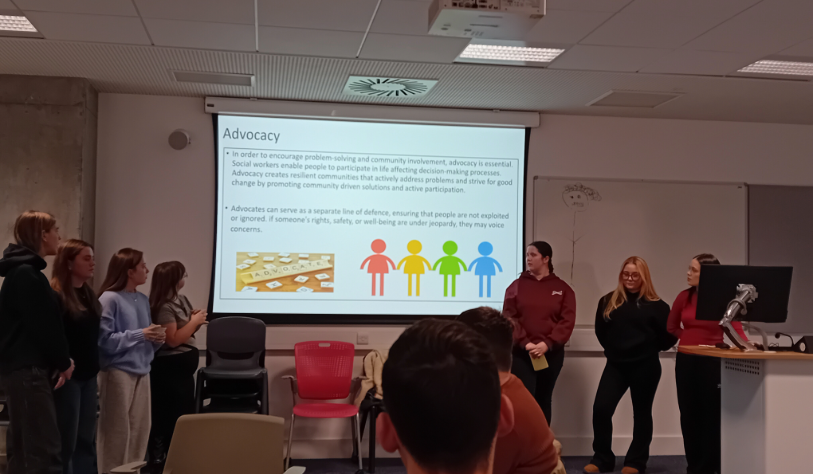
Designed as a co-learning experience grounded in relational pedagogy, small groups of students and WALK participants worked together on self-advocacy projects. Each group identified a human rights issue of personal importance to the service user and developed an advocacy presentation centred on that issue.
Projects explored themes such as accessibility (including accessible menu design and Dublin Bus schedules), social inclusion, community mapping and strengthening community connection.
The work was informed by the principles of the UNCRPD and incorporated sustainability competencies from the EU GreenComp framework, linking disability rights with inclusive citizenship and long-term social sustainability.
Empowerment, Inclusion and Professional Growth
The collaboration delivered shared value for both communities. For Walk participants, they said it strengthened their self-advocacy skills, gave them opportunities to have personal concerns recognised and developed into public advocacy messages, allowed them to have meaningful engagement on a university campus and provided social interaction with peers of a similar age group.
Matthew, one of the WALK participants, said:
“I loved it. It was my second time working with the team and they were very kind and helped me. We also came up with a lot of good ideas together.”
For TU Dublin Students, the collaboration provided practical experience and a deeper understanding of disability rights and advocacy."
Niall Hanlon, Lecturer at the School of Social Sciences, Law and Education, said:
“This partnership is helping to bridge the gap between theory and practice in social justice education. Participants are learning to think critically, develop caring relations, identify empowering objectives, and implement creative solutions to challenging problems. Moreover, it is inspiring me as an educator to rethink the rigid mindset of higher education as an exclusive domain, accessible only to some citizens and communities.”
SDG Alignment:
This initiative strongly aligns with the United Nations Sustainable Development Goals:
- SDG 3: Good Health and Wellbeing- Ensure healthy lives and promote well-being for all at all ages
- SDG 8: Decent Work and Economic Growth Promote sustained, inclusive and sustainable economic growth, full and productive employment and decent work for all.
- SDG 10: Reduced Inequalities.- Reduce inequality within and among countries
Each Sustainability Action Lab project is underpinned by:
- SDG 4: Quality Education - Ensure inclusive and equitable quality education and promote lifelong learning opportunities for all
- SDG 17: Partnership for the Goals - Strengthen the means of implementation and revitalize the Global Partnership for Sustainable Development
GreenComp Alignment
The project also aligns with specific competences from the e-framework "GreenComp sustainability competency framework including;
|
Competency Area |
Competency |
Descriptor |
|
Embodying sustainability values |
Supporting fairness |
To support equity and justice for current and future generations and learn from previous generations for sustainability. |
|
Embracing complexity in sustainability |
Critical thinking |
To assess information and arguments, identify assumptions, challenge the status quo, and reflect on how personal, social and cultural backgrounds influence thinking and conclusions. |
|
Envisioning sustainable futures |
Exploratory thinking |
To adopt a relational way of thinking by exploring and linking different disciplines, using creativity and experimentation with novel ideas or methods |
|
Acting for sustainability |
Collective action |
To act for change in collaboration with others |
This collaboration was supported by the Societal Engagement and Sustainability Education teams and through the Higher Education Authority’s Strategic Alignment of Teaching and Learning Enhancement (SATLE) fund.