
Story Mapping: Making Sustainable Development Goals Data More Accessible
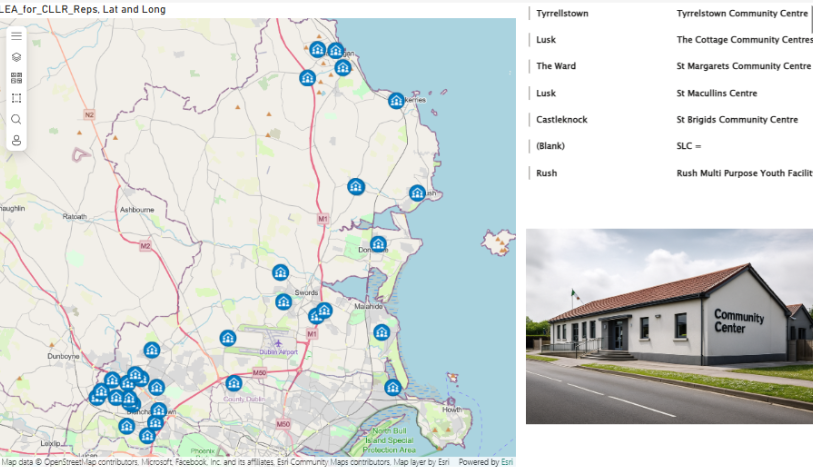
Local authorities such as Fingal County Council carry out significant work related to the United Nations Sustainable Development Goals (SDGs) and are encouraged to carry out Voluntary Local Reviews of progress made towards achieving the UN SDGs in their area. However, local information on the SDGs can be difficult for the public to access and understand. Recognising this challenge, Fingal County Council partnered with TU Dublin to explore how spatial data could help make SDG information clearer, more engaging, and more accessible to the public.
This project centred the United Nations (UN) Sustainable Development Goals (SDGS), by making Fingal County Council's SDG activities, particularly those related to SDG 3: Good Health and Well-being, SDG 7: Affordable and Clean Energy, and SDG 11: Sustainable Cities and Communities visible in an accessible, interactive format. This also aligned with broader council objectives related to SDG 13: Climate Action.
Storytelling to Enhance Engagement and Understanding
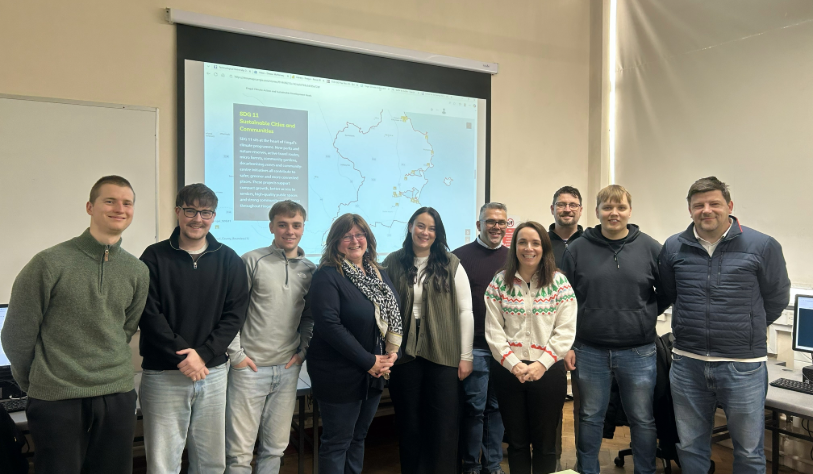
Final year students in the BSc Geospatial Surveying programme were given the opportunity to work directly with Fingal County Council as part of TU Dublin’s Sustainability Action Lab programme. The nine students first examined how the council currently records and manages its SDG-related activity within the county.
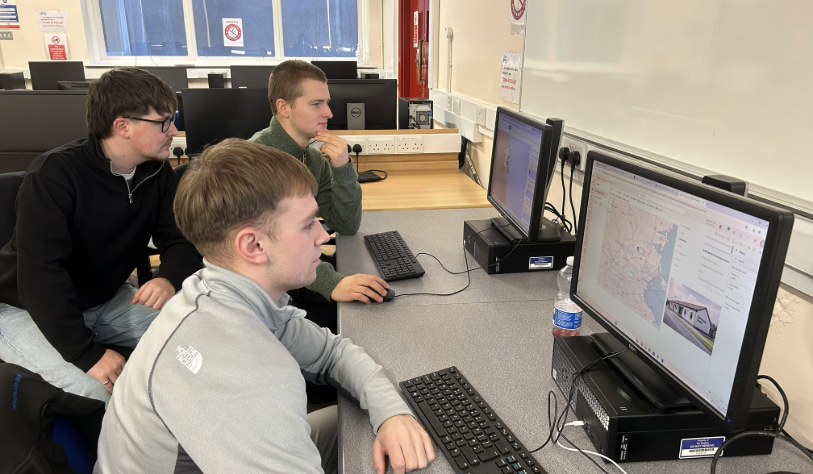
Working in two groups, under the guidance of Eimear McNerney, Lecturer at the School of Surveying and Construction Innovation, the students explored how spatial data and digital mapping tools could be used to communicate this information in a more accessible way. Using their geospatial expertise and software knowledge, they designed and developed a series of digital outputs that presented the data visually and interactively.
The students created a web map, dashboard, and story map that Fingal County Council could use to expand its reach and better communicate its sustainability activities. These tools allow information to be displayed geographically, helping the public understand where and how SDG initiatives are being implemented across the county.
For the students, the collaboration provided a valuable opportunity to work on a real-world project, applying their technical skills while receiving guidance from professionals within the council. It allowed them to consider how geospatial data can be used not just for analysis, but also for communication and public engagement.
Conor Brady, 4th year Geographical Science and Geospatial Surveying student, said:
“I loved working on this project. It was a great opportunity to work with Fingal County Council and to learn about the work they’re doing. It’s nice to know we’re doing something that benefits the community too and ensures everyone can access the data in a simple, engaging way.”
Ciaran Ciarey, 4th year Geographical Science and Geospatial Surveying student, added:
“It was a great opportunity for us to use our learning on GIS to build a real web map and visualisation. We were able to see clearly the areas that are doing well and the areas that may need more support.”
Anthony Karpovs, 4th year Geographical Science and Geospatial Surveying student, said:
“I enjoyed being able to use all that we learned in the module in a real-world situation – to improve our skills and be able to contribute something that was of real value to our community.”
For Fingal County Council, the collaboration delivered practical working outputs that can be shared with different departments within the organisation.
A representative from Fingal County Council said:
“We had working outputs that we can take back to the different departments within the council to help them better visualise the work currently being undertaken within the council. We also got a fresh perspective on how they could progress going forward.”
Eimear McNerney, Lecturer at the School of Surveying and Construction Innovation, said:
“The project offered students the opportunity to engage with real‑world data and experience the impact of their work through its adoption by the council. This is something that would not be possible in a traditional classroom setting without external collaboration.”
SDG Alignment
This initiative strongly aligns with the United Nations Sustainable Development Goals:
- SDG 3: Good Health and Well-being - Ensure healthy lives and promote well-being for all at all ages
- SDG 7: Affordable and Clean Energy - Ensure access to affordable, reliable, sustainable and modern energy for all
- SDG 11: Sustainable Cities and Communities - Make cities and human settlements inclusive, safe, resilient and sustainable
- SDG 13: Climate Action- Take urgent action to combat climate change and its impacts
Each Sustainability Action Lab project is underpinned by:
- SDG 4: Quality Education - Ensure inclusive and equitable quality education and promote lifelong learning opportunities for all
- SDG 17: Partnership for the Goals - Strengthen the means of implementation and revitalize the Global Partnership for Sustainable Development
GreenComp Framework
The project also aligns with specific competences from the "GreenComp sustainability competency framework including
- Embodying Sustainability Values,
- Embracing Complexity in Sustainability,
- Acting for Sustainability, and
- Envisioning Sustainable Futures.
|
Competency Area |
Competency |
Descriptor |
|
Embodying sustainability values |
Supporting fairness |
To support equity and justice for current and future generations and learn from previous generations for sustainability. |
|
Embracing complexity in sustainability |
Systems thinking |
To approach a sustainability problem from all sides; to consider time, space and context in order to understand how elements interact within and between systems. |
|
Envisioning sustainable futures |
Adaptability |
To manage transitions and challenges in complex sustainability situations and make decisions related to the future in the face of uncertainty, ambiguity and risk |
|
Acting for sustainability |
Collective action |
To act for change in collaboration with others |
This collaboration was supported by the Societal Engagement and Sustainability Education teams and through the Higher Education Authority’s Strategic Alignment of Teaching and Learning Enhancement (SATLE) fund.