
Sustainability Charters for Student Societies
Overview
Universities play an important role in shaping sustainable behaviours, however, much of student life and decision-making occurs outside the classroom, particularly through extracurricular activities such as student societies and clubs. These groups organise events, manage resources, and influence large peer networks, yet sustainability is often not formally embedded in their planning or governance.
While many societies already incorporate sustainable practices informally, there is often limited awareness, consistency, and accountability in how these practices are implemented. This creates a missed opportunity to harness student-led communities as drivers of meaningful climate action.
There is therefore a need for structured, yet flexible approaches that empower students to recognise, formalise, and scale sustainability practices within their own activities, while supporting behaviour change and peer-to-peer influence.
Sustainability Charters for Student Societies
Sustainability Charters for Student Societies is an initiative led Charlie Beaudelot, PTO for Sustainability at TU Dublin Student’s Union in collaboration with the Sustainability Team and Student Volunteering. The project introduces a co-created Sustainability Charter framework, supported by micro-grants, to embed sustainability into student societies. The project’s key objectives are to:
- Recognise and legitimise sustainable practices that student societies are already implementing, often without formally identifying them as such
- Raise awareness of sustainability in a fun and accessible way, enabling students to engage with and learn about sustainable practices naturally through their interests and activities
- Empower societies to lead by example, leveraging their influence within student life to drive peer-led climate action and positive behavioural change
The project followed a co-creation approach, combining workshops and funding mechanisms, with monitoring and reporting to ensure accountability and effectiveness:
- Workshops and participatory engagement:
Two Interactive workshops were delivered, one on Tallaght Campus, co-delivered by Carla Marina Soriano, Green Campus Living Lab Coordinator and Charlie Beaudelot, PTO for Sustainability at TU Dublin Student’s Union, and one on Grangegorman Campus, delivered Charlie Beaudelot. The workshops brought together 18 student societies to:- Build knowledge on sustainable event planning in alignment with TU Dublin’s Sustainable Events procedure;
- Identify existing sustainable practices within their activities, and
- Co-create tailored Sustainability Charters aligned with each society’s identity and operations.
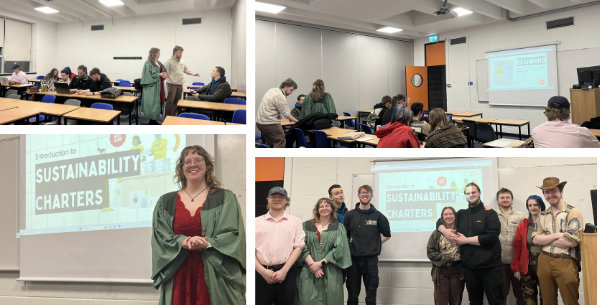
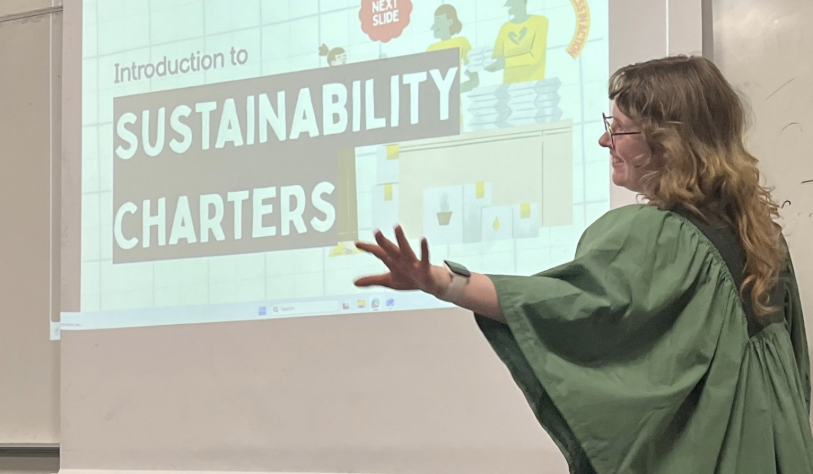
The workshops included a presentation offering practical tips and guidance on how to make events more sustainable, in line with TU Dublin’s Sustainable Events procedures. It also provided guidelines for developing a Sustainability Charter and highlighted sustainability practices already implemented by some societies. This was complemented by peer discussions on how sustainable practices could be further incorporated into society operations, as well as a hands-on activity in which participants began drafting their Society’s Sustainability Charter.
- Micro-grant system to support action:
Participating societies were given access to a micro-grant, enabling them to implement sustainable initiatives in line with their Sustainability Charter, and test new practices in real settings, linking funding directly to sustainability outcomes. - Monitoring and reporting tools:
A structured post-event reporting form will be distributed to societies to capture key indicators, including attendance, use of funds, stakeholder engagement, and other relevant data. This information will be complemented by existing records from the Societies portal, enabling cross-verification of metrics such as event participation.
This data-driven approach enables ongoing evaluation and continuous improvement.
Evaluation and Reflection
The project has generated meaningful impact in terms of awareness, engagement, and cultural change:
- Increased awareness of sustainable event practices among 18 student societies
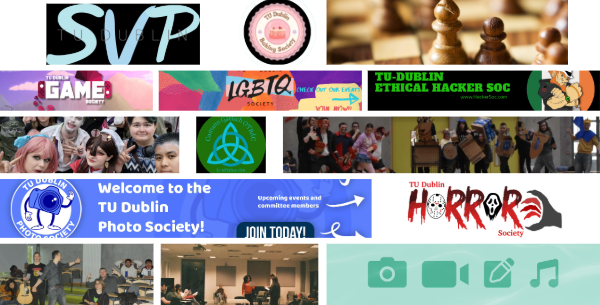
- Active engagement from 14 of the 18 societies (Game, Chess, SVP, Horror, Media, Arts and Media, Photo, Cumann na Gael, Drama, Nerd, Neurodivergent, Ethical Hackers, LGBTQ+, and Baking), all of whom have completed their Sustainability Charters to guide their future activities. These societies represent a total of 3,445 students, demonstrating significant potential to influence sustainable behaviours and empower students to act as agents of change within their own campuses and communities.
- Formal integration of sustainability into society governance structures, with some societies incorporating their charters into their constitutions, ensuring continuity beyond individual academic years
- Legitimisation and formalisation of existing sustainable actions, helping Societies recognise and build on practices they may already be undertaking unconsciously
- Creation of a scalable framework that can be adopted by additional Societies, sports clubs and campuses over time.
Importantly, the project demonstrates the effectiveness of peer-led, bottom-up approaches, where students are not just participants but co-creators of sustainability solutions.
View Chess Society Sustainability Charter
The model is highly replicable and scalable, with strong potential to expand to additional societies, sports clubs, and campuses.
Living Lab Approach and Alignment with SATLE Objectives
This project applies a Living Lab approach by using student societies as real-world environments where sustainability practices are co-created, tested, and refined through peer-led activities.
It aligns with SATLE objectives by embedding sustainability into informal learning, supporting student leadership, and fostering collaborative, practice-based approaches to education and engagement.
SDG and Green-Campus Alignment
This project addresses SDG 12: Responsible Consumption & Production and contributes to SDG 13: Climate Action.
This project is cross-cutting in nature, aligning with multiple Green-Campus themes, including Litter & Waste, Energy, and Climate Action, by embedding sustainability across diverse student-led activities and behaviours.