
Veganuary
Overview
Food systems are a significant contributor to global greenhouse gas emissions, with dietary choices playing an important role in climate action. Shifting towards more plant-based diets is increasingly recognised as a key strategy for reducing environmental impact, particularly within large institutions such as universities.
Despite this, plant-based food is often not fully integrated into institutional sustainability strategies and can be perceived as niche or less desirable compared to conventional options. At TU Dublin, this gap was identified through engagement with the University’s Climate Action Roadmap, highlighting the need to address food provision as part of a more holistic approach to sustainability.
There is therefore a need for initiatives that make plant-based food accessible, appealing, and relevant, while addressing misconceptions and encouraging behaviour change through positive and practical experiences.
Veganuary
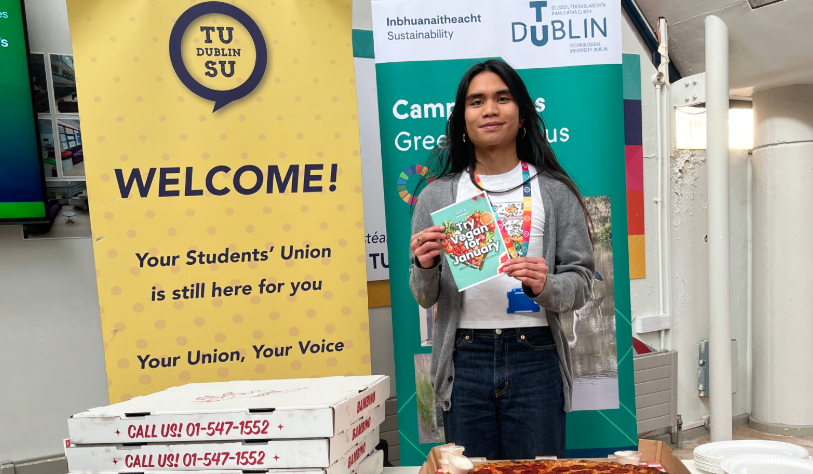
Veganuary is a sustainability and wellbeing campaign delivered across TU Dublin’s City Campus, led by Mina Eusebio, former City Campus VP and current President at TU Dublin Student’s Union in collaboration with TU Dublin Sustainability and the Societal Engagement team. The initiative aimed to introduce students and staff to plant-based food options through hands-on engagement, taste experiences and information sharing. The project’s key objectives were to:
- Raise awareness of the environmental, health, and financial benefits of plant-based diets
- Reduce stigma and barriers associated with plant-based food
- Encourage behaviour change through experiential engagement
- Support institutional change in campus food provision
The project followed a participatory, experience-led approach, combining direct engagement, local business support, and feedback mechanisms:
- Pop-up food stands and experiential engagement:
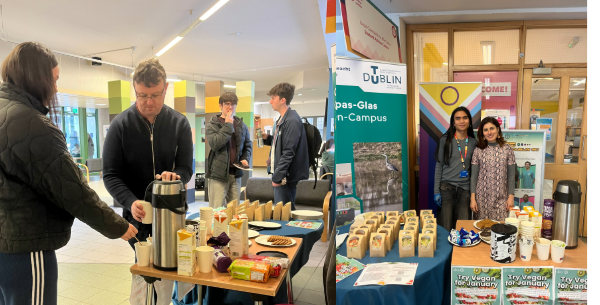
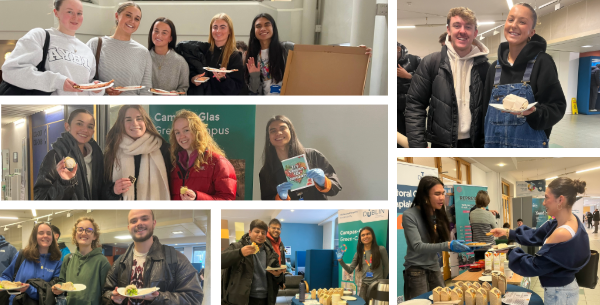
Over four days (26–29 January), pop-up stands were hosted across the City Campus offering free plant-based food samples. The focus was on a “try-first” approach, allowing participants to experience food before engaging with sustainability messaging.
- Local business support:
The initiative collaborated with local food providers, including Minor Figures, Cornucopia, Sweet Almond, and Bambinos, which supplied products such as oat milk, wraps, pastries, and pizza. Prioritising local businesses helped showcase the diversity, quality, and accessibility of plant-based food options available within the community. Several of these businesses further demonstrated their support for the initiative through in-kind contributions, including complimentary oat milk cartons from Minor Figures for distribution to the campus community, an additional pizza from Bambinos, and extra sandwiches provided by Cornucopia. These contributions not only enhanced the event experience but also reflected the strong community engagement and shared commitment to promoting sustainable food choices.
.png)
- Inclusive and accessible food offering:
A range of options, including gluten-free alternatives, ensured that a broad group of students could participate, reinforcing inclusivity within sustainability initiatives. - Student engagement and feedback tools:
Participants were invited to complete a QR-code survey, capturing data on awareness and perceptions of plant-based food; satisfaction with food provided, and interest in expanding plant-based options on campus. Survey results were used to inform a Students’ Union proposal advocating for increased plant-based food provision on campus. - Awareness and behaviour change strategy:
The project deliberately focused on informal engagement and positive experience, addressing initial hesitation by offering familiar foods (e.g. pizza, pastries) in plant-based formats to reduce resistance.
Evaluation and Reflection
The project delivered strong engagement and measurable impact:
- Approximately 300 students and staff participated, many trying plant-based food for the first time
- Survey feedback indicated high satisfaction and support for expanding plant-based options on campus
- The initiative directly informed a Students’ Union motion, which was unanimously approved, advocating for a 50% increase in plant-based food options
- The project contributed to discussions on integrating plant-based food into TU Dublin’s Climate Action Roadmap and catering strategy
- It enabled experiential learning, allowing students to engage with sustainability through everyday choices such as food
The project demonstrates strong replication potential, offering a scalable model for future campaigns across campuses and institutions.
Speaking about their experience in leading this campaign, Misa Eusebio said:
I am very grateful to the Societal Engagement team and the Sustainability department for funding our Veganuary initiative through the Green Campus Open Call. Through this funding, the students’ union were able progress practical and achievable sustainability action on an institutional level in hopes of leading the way to a more climate conscious future.
Living Lab Approach and Alignment with SATLE Objectives
This project applies a Living Lab approach by using the campus as a real-world environment where students and staff test and respond to plant-based food options through direct experience.
It aligns with SATLE objectives by embedding sustainability into everyday behaviour, supporting student leadership, and linking experiential learning with institutional change.
In Semester 1 of the 2026-2027 academic year this Green Campus Solution will be considered by the Green Campus Committee for further iteration, replication or scaling up, and for publication in the TU Dublin Green Campus Living Lab community on Zenodo.
SDG and Green-Campus Alignment
This project addresses SDG 12: Responsible Consumption & Production and contributes to SDG 13: Climate Action and SDG 3: Good Health & Wellbeing
It aligns with the Green-Campus theme of Climate Action by promoting plant-based dietary choices as a practical and accessible way to reduce carbon emissions associated with food consumption.
Quote from Mina: I am very grateful to the Societal Engagement team and the Sustainability department for funding our Veganuary initiative through the Green Campus Open Call. Through this funding, the students’ union were able progress practical and achievable sustainability action on an institutional level in hopes of leading the way to a more climate conscious future.