
Change Clothes: Promoting Conscious Consumer Behaviour
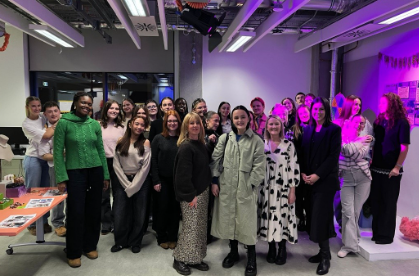
The fashion industry faces increasing scrutiny over its social and environmental impact, emphasising the need for sustainable practices. To address this, students from TU Dublin’s Visual Merchandising and Fashion and Retail Business programs collaborated with Change Clothes, a social enterprise promoting conscious consumer behaviour.
Sustainable Fashion
In Semester 1, 40 students from the Bachelor of Science (Honours) in Fashion and Retail Business TU 925A and Bachelor of Arts in Visual Merchandising & Display TU795 worked collaboratively to design an exhibition at the Grangegorman campus.
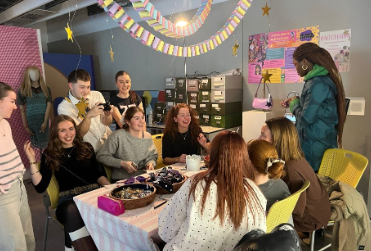
The exhibition was under the guidance of Jean Noonan, School of Business Technology, Retail, and Supply Chain and Michelle Lalor School of Art and Design , and in collaboration with Mary Fleming and Maria Verrecchia from Change Clothes. The collaboration was supported through TU Dublin’s Sustainability Action Lab programme.
The initiative promoted sustainable fashion through research, campaigns, and eco-conscious installations aligned with UN Sustainable Development Goals. There was a particular connection to SDG 12: Responsible Consumption and Production and SDG 13: Climate Action.
At the end of Semester 1, the students launched their collaborative projects at an exhibition at Change Clothes in the Digital Hub.
Impact
Students gain hands-on experience in research on textile sustainability, consumer behaviour, and design, while supporting Change Clothes’ mission to reduce textile waste and create circular economy practices. This project gave students the opportunity to collaborate and build their skills in teamwork and communication, while building their professional networks for their career in the fashion and retail industries.
This cross-disciplinary collaboration fosters mutual growth - students gain real-world experience with a social enterprise, while Change Clothes benefits from fresh insights and creative campaigns that enhance its mission to reduce textile waste and promote circular fashion practices.
One participating student involved said:
“One of my biggest takeaways from the Change Clothes project was learning how fashion sustainability can be made engaging through creativity and visual merchandising. It showed me that small changes, like reusing and restyling accessories, can have a real impact when presented in a way that connects with consumers and encourages more conscious shopping habits.”
Mary Fleming, Founder of Change Clothes said:
"It was amazing to see the ideas of the Visual Merchandising and Digital Marketing students from TU Dublin come to life. It's hard not to get bogged down in the everyday madness of running a social enterprise, seeing all this work from talented young people helps us dream of a bigger and better future."
SDG Alignment
This initiative strongly aligns with the United Nations Sustainable Development Goals:
- SDG 12: Responsible Consumption and Production - Ensure sustainable consumption and production patterns
- SDG 13: Climate Action - Take urgent action to combat climate change and its impacts
Each Sustainability Action Lab project is underpinned by:
- SDG 17: Partnership for the Goals - Strengthen the means of implementation and revitalise the Global Partnership for Sustainable Development
- SDG 4: Quality Education - Ensure inclusive and equitable quality education and promote lifelong learning opportunities for all
GreenComp Alignment
The project also aligns with specific competences from the "GreenComp sustainability competency framework including
- Embodying Sustainability Values
- Embracing Complexity in Sustainability
- Acting for Sustainability
|
Competency Area |
Competency |
Descriptor |
|
Embodying sustainability values |
Valuing sustainability |
To reflect on personal values; identify and explain how values vary among people and over time, while critically evaluating how they align with sustainability values. |
|
Embracing Complexity in Sustainability |
Problem Framing |
To formulate current or potential challenges as a sustainability problem in terms of difficulty, people involved, time and geographical scope, in order to identify suitable approaches to anticipating and preventing problems, and to mitigating and adapting to already existing problems |
|
Acting for sustainability |
Individual initiative |
To identify own potential for sustainability and to actively contribute to improving prospects for the community and the planet |
This collaboration was supported by the Societal Engagement and Sustainability Education teams and through the Higher Education Authority’s Strategic Alignment of Teaching and Learning Enhancement (SATLE) fund.