
Smart Energy Monitoring at Engineering Lab
Global shifts in climate and in political landscapes are forcing Ireland to accelerate efforts to transform how energy is generated and consumed. Greenhouse gas emissions are driving global temperatures higher, creating instability across environment, society, and economy. One of the ways to offset global temperature rise is to significantly reduce energy consumption. Increasing demand on the national grid and a need to create energy independence have compounded the need to rethink Ireland’s energy needs.
Universities, along with other bodies in the public sector are required to meet climate action targets to reduce energy use. One particularly high user of energy in university spaces are teaching laboratories.
Smart Energy Monitoring
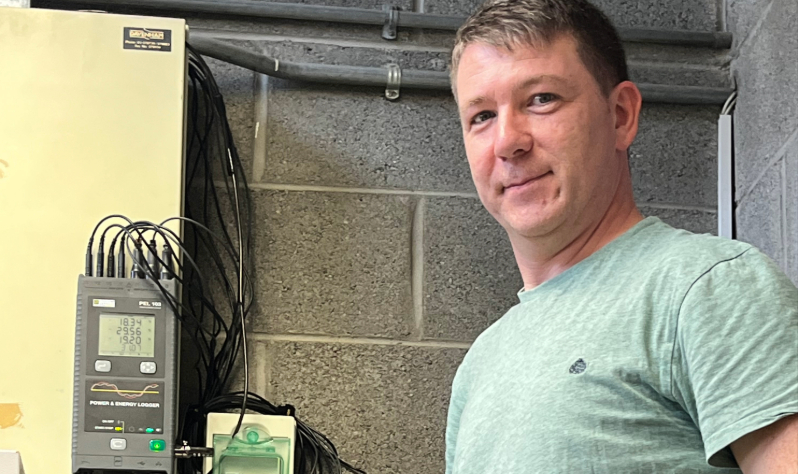
Until recently, little was known about where labs could cut energy use. To tackle this, staff and students at TU Dublin’s School of Electrical and Electronic Engineering, supported by TU Dublin’s Sustainability Intelligence team, developed a cost-effective smart monitoring system designed for deployment across multiple labs. The system was designed to provide real-time insight into energy consumption, to allow benchmarking of laboratory energy use and to quantify the impact of energy reduction strategies.
Students from the Master of Engineering in Sustainable Electrical Energy Systems (TU207) course will design and build a prototype smart energy monitor for Lab 217 on the Tallaght campus. This will be calibrated against a commercial device to test its accuracy, robustness, and suitability for continuous monitoring. The commercial device will provide high-quality baseline data offering valuable insights into energy consumption patterns within the lab. While commercial monitoring equipment is accurate, its high cost makes it unsuitable for widespread deployment across the university. For this reason, the commercial monitor is used as a reference point to guide the specification, calibration, and validation of the new low-cost, smart energy monitoring solution.
Evaluation and refinement of the students' prototype can allow the approach to move into a replication and scaling-up phase - where multiple smart energy monitoring devices can be deployed across more labs on campus. The idea is that in time, a network of devices can be integrated into a digital twin of the building, enabling real-time monitoring of energy consumption across teaching spaces, supporting benchmarking, and evaluating the impact of energy reduction strategies.
Speaking about the initiative Project Lead Damien Doheny says:
“By combining low-cost hardware, real-time analytics, and student-led innovation this project provides a scalable solution that not only helps manage energy more effectively but also provides students with practical experience in developing technologies that address urgent climate and energy challenges. This demonstrates our commitment to taking action to increase sustainability on campus”
Shared Impact
At TU Dublin we are committed to progressing the United Nations Sustainable Development Goals (SDGs) through collaboration and action. This project contributes to several Sustainable Development Goals (SDGs). Under SDG 7: Affordable and Clean Energy, it supports research focused on improving energy efficiency. It also aligns with SDG 9: Industry, Innovation and Infrastructure, particularly the goal of upgrading technological capabilities to boost resource efficiency. Additionally, the project addresses SDG12: Responsible Consumption and Production, by promoting the sustainable and efficient use of natural resources, reducing waste, and embedding sustainable practices throughout.
This project supports the implementation of TU Dublin’s Climate Action Roadmap by tackling performance and energy efficiency.
Green Campus Open Call
The Green-Campus Open Call can help bring ideas like these to life by making micro-grants available to selected project ideas submitted in response to the open call. The Green-Campus programme encourages a partnership approach to environmental education and management. To optimise the potential for impact, the Green-Campus Open Call programme encourages project proposals that can be implemented using the Living Lab approach and that include exploration, co-creation, experimentation and evaluation phases. You can read more about the TU Dublin Living Lab and access living lab planning templates here.