
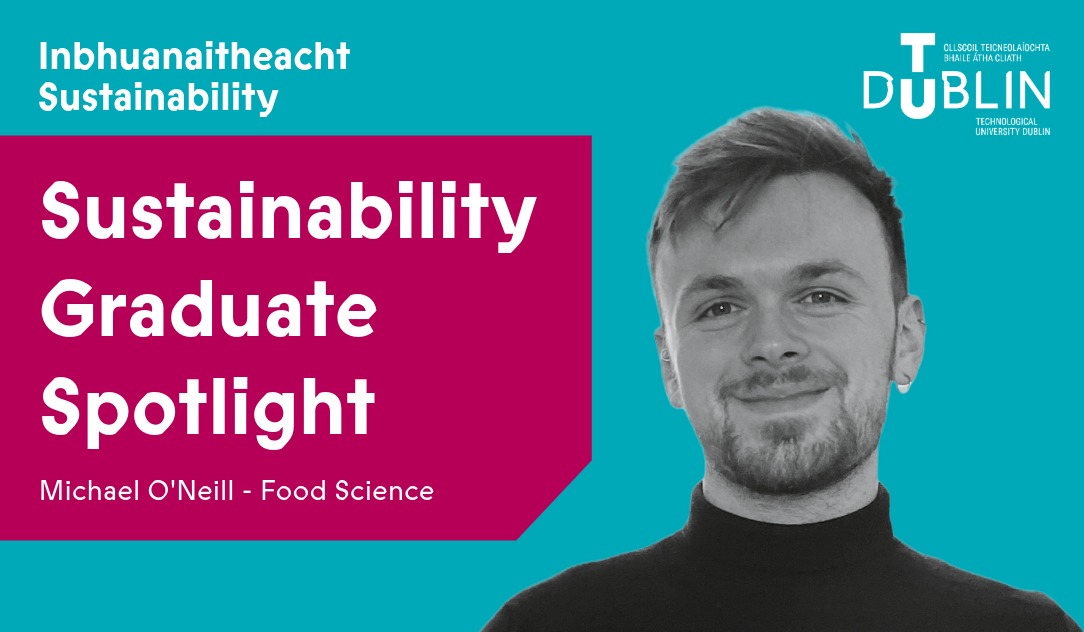
Sustainability Graduate Spotlight - Michael O'Neill
By the time food reaches our plates, it has already interacted with and impacted our air, water, and soil. Healthy soil and water are essential for supporting high yields of nutritious food. With food systems responsible for up to 30% of greenhouse gas emissions, there is an urgent need for more sustainable food production. Food production can cause environmental toll including degradation of soil and contamination of water sources. Europe, including Ireland is currently falling short of its targets for sustainable food production.
In this edition of the Sustainability Graduate Spotlight series, we are focusing on the United Nations Sustainable Development Goals (SDGs) SDG15:Life on Land and SDG3:Good Health & Wellbeing and shining a spotlight on Michael O’Neill and his career as a researcher into sustainable healthy diets for our population.
Michael O'Neill
Michael O'Neill is from Dun Laoghaire, County Dublin and is a recent graduate from TU Dublin’s Food Science degree (TU881), delivered by the School of Food Science & Environmental Health . Following from his role as a Research Assistant on the sustainability focused PLAN'EAT Project, Michael now works as a researcher at Co-Centre for Sustainable Food Systems project, based in University College Dublin’s Institute of Food and Health. The Co-Centre for Sustainable Food Systems project aims to provide innovative solutions to drive the societal and political change needed in the transition to climate neutrality by 2050. Michael’s research contributes to his PhD studies in addressing the challenges of sustainable diets and identifying opportunities to support it.
Michael’s role at the centre is to provide the evidence base and understanding of the challenges and implications of shifting to sustainable healthy diets. A significant piece of research he is working on is a large-scale household study (aiming to recruit 5000 participants from 1500 households across the island of Ireland) to collect data on sustainable eating. This data will provide deep knowledge for targeted interventions by the Co-Centre for Sustainable Food Systems, aimed at encouraging the uptake of healthy diets from sustainable sources and promoting positive behaviour change on the Island of Ireland. This study data will be used in conjunction with analysis from other Irish and European datasets on food consumption.
Michael recently had the opportunity to present his research findings at the Nutrition Society Summer Conference. He told us that he looks forward to a new challenge this year tutoring college students in food science and human nutrition. Michael is also due to publish his research that will contribute to the growing knowledge around sustainability and nutrition.
Educational Experience
Michael chose Food Science at TU Dublin (TU881) because it covered a broad range of topics and a strong work placement element, that he wanted to explore a wide range of career options, from industry to academia. Michael completed his work placement at the Food Safety Authority of Ireland’s Food Reformulation Taskforce, a taskforce set up with the aim of reducing calories, saturated fat, sugar and salt in food on offer to the Irish population.
Speaking about his placement Michael said ‘it was a highlight as it blended everything I learned about research and nutrition and mixed that with a real-life working environment – it really got me interested in research and opened the door to pursuing a PhD after my degree’.
Through the School of Food Science & Environmental Health, Michael had the opportunity to travel to Pamplona in Spain to participate in an Erasmus project (NEMOS). The project focussed on incorporating sustainability into third level teaching through community-based learning and work placements.
Applying New Skills & Knowledge
Michael shared that his laboratory training provided a strong foundation for his career. Through a diverse range of lab-based modules spanning microbiology, chemistry, biochemistry, and physics, he developed a comprehensive skill set. He explained that these practical skills, combined with a solid theoretical grounding, have been instrumental in his current research, particularly in handling and analysing human data samples.
What does #TUDublinSustainability mean to you?
#TUDublinSustainability to me means empowering students, staff, and alumni to actively integrate sustainability into their respective roles and fields. Doing this, TU Dublin not only practices and educates on sustainability, but also showcases it across diverse areas of work and study.