
Sustainable Shelter Sleep-out for Homelessness
- Module: Technical Design studio (TECH1106)
- Programme: Architectural Technology Undergraduate | Architectural Technology (TU831) | TU Dublin Year 1 Undergraduate (Core)
- Discipline: Architectural Technologies
- School: Architecture, Building and Environment
- Number of students: 70
- TLA Category: Client or Community based activity, Creation of an artefact,
- Field-trip; Design-based assignment; Event
- Find out more: Kirk McCormack (kirk.mccormack@tudublin.ie) , Stephen Richardson (stephen.richardson@tudublin.ie )
Sustainable Shelter Sleep-out for Homelessness
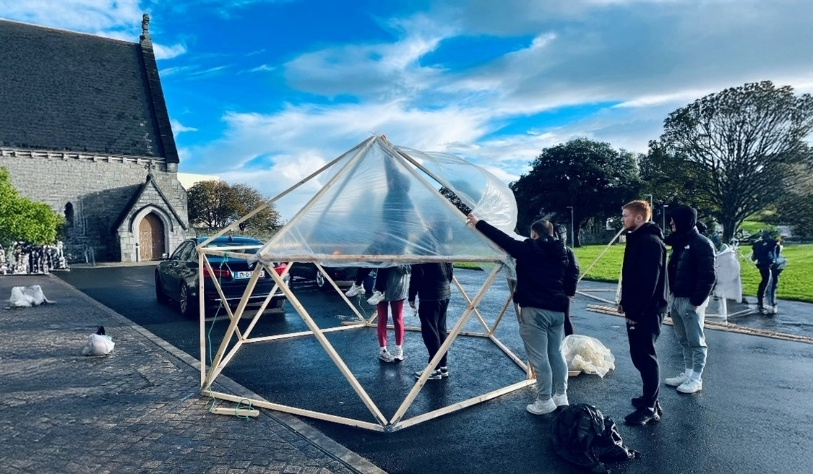
For the last four years, first-year students of the Architectural Technology course at TU Dublin have built and slept out in their own shelters to experience the effects of climate, consider sustainability in a visceral way, and raise awareness and funds for homelessness. They were challenged to create structures, with only a pallet of recycled materials, that could house them overnight, maintain 20 degrees internally, achieve 100 lux daylight levels, and stay dry. They travelled to their encampment, erected their shelters, and braved the elements to eventually raise over €10,000 for Focus Ireland’s Shine A Light charity. Crucially, there was an emphasis on precise measurement of carbon and the structures being de-constructable so components were reusable next year. What began as a fun class assignment to bring new college students together, has grown into a design project and public event that instils good learning outcomes for a good cause.
The Design Challenge
The design assignment runs in October of the academic year with first and second-year students of the BSc (Hons) in Architectural Technology at TU Dublin. The project has taken place over the last four years and has been refined and expanded to include over 100 students and thousands of interactions with the wider public. 12 groups of 10 students are tasked with designing and building a structure that can house their group at an open-air location on the central Grangegorman Campus in Dublin for a single night.
The assignment was originally conceived to introduce students to the basic concepts of architecture and shelter along with environmental and social sustainability to align with SDG 11; Sustainable Cities. However, a set of assessment criteria were used to elevate the project to a genuine design challenge. The idea of experiencing the act of transporting materials and assembling elements to create a simple shelter to house 10 people, meant that students would have real-world consequences for their design decisions. Students were required to dismantle the structures the next morning and carry them back to the college also for reuse for the following year. They therefore had to carefully weigh decisions of cost and comfort versus physical effort and aesthetics. This issue of people being disconnected from the impact of their decisions drove many aspects of the assignment. We continually asked the question “How can we demonstrate and reveal the chain of choices which lead to more sustainable outcomes?”.
Shine a Light for Homelessness
We identified at an early stage that the encampment the students would create could be an opportunity to raise public awareness and funds for housing and homelessness supports in Ireland, along with the students’ understanding of these issues. We therefore joined the initiative with Focus Ireland’s annual ‘Shine A Light’ Night charity as a channel for donations. Along with a complex design project that explores sustainability deeply, particularly Sustainable Development Goal (SDG) 10; Reduced Inequalities, the students and staff collected donations and publicised the initiative.
Connecting Design Decisions to Real-World Impact
A major part of this challenge involved understanding the environmental consequences of these choices and a core component of the learning involved quantifying the carbon impact of each structure. The students were encouraged to use waste materials and FSC certified timber elements and were guided to make use of local waste harvesting cooperatives that stock end-of-life materials, construction waste, dead stock, and production waste. The project required them to precisely schedule and measure embodied carbon for their structures by reference to the Inventory of Carbon and Energy and the Environmental Product Declarations database. Each group produced a “cradle to practical completion” total upfront carbon kgCO2e/sqm figure for their structures. This was verified by carrying out a count of all materials the next day after the challenge was completed and the structures disassembled and returned to the college. The students learned as groups that the average total embodied carbon for their tiny 10sqm structure was 90kgCO2e (9kgCO2e/ sqm). However, groups that used a high proportion of waste materials and certified timber achieved negative total values of as a low as -15kgCO2e due to sequestration, their awareness of SDG 12; Responsible Consumption and Production, now being much more refined.
This measurable impact was a powerful benchmark for the final stage of the project (and all subsequent typical design projects) and changed their viewpoint on construction and material specification. The final element of the initiative was a hypothetical housing design that, instead of being required to survive for only one night, would need to be durable enough to last for the long term (60 years).
The Outcome - how did the initiative work in practice?
When the groups moved on to the hypothetical house design element of the project and consideration of larger spaces and necessary modern conveniences like toilets, separate bedrooms, recreation spaces, and durable materials, they were shocked to see that the average “cradle to practical completion” upfront embodied carbon figure had drastically increased from 9kgCO2e/m2 (a LETI 2030 Design Target Upfront Embodied Carbon rating of A++) to over 1,650kgCO2e/m2 (a LETI 2030 Design Target Upfront Embodied Carbon rating of G). Once typical construction elements like foundations, masonry, and windows were introduced, groups found it very difficult to reduce their impact without drastic innovation. This meant students began to explore alternative technologies and to reduce their expectation of what modern conveniences are and consider SDG 9; Industry Innovation and Infrastructure, more carefully. The project was graded based on a range of factors including space quality/ character, durability (control of light [min. 100 lux], temperature [avg. 20 degrees over 12 hours], water [no. of leaks]), embodied upfront carbon and de-constructability.
What Next?
This initiative encouraged students to make balanced design decisions rather than typical aesthetic-driven approaches. They now have a clear memory of the difficulty of finding and transporting materials, the risk of assembling them in the wind and rain, the potential discomfort of heat loss and water ingress during that night, and the effort of dismantling components and storing them; all lessons that will hopefully translate into their careers and decision-making.
The students partaking in the project have raised over €10,000 for Focus Ireland’s Shine A Light homelessness charity in 2023 but have raised over €20,000 across 3 years.
We believe the format, which can be shared as an open educational resource can be used by any teaching provider or sector. The shelters, by their nature, are simple and can be built with little skill (by year 1 students in our case). Within the built environment sector, that we focus on, there is an emphasis on building fabric and energy use, but the project could be equally focused on issues of sustainability relating to cost, sanitary facilities, business and procurement, or any teaching that forms part of experiential learning.
Closing Notes
We believe that the initiative acts as a benchmark and inspiration for teaching and learning that is student-led, experiential, and sustainability-focussed. We have been invited to present the project at several teaching and learning symposia and authentic assessment showcases also. The initiative required both staff and students to go far beyond a typical classroom project’s requirement. The organisation of the initiative resulted in logistical complexity including health & safety considerations, transport planning, additional financial outlay to staff and the School, and braving the elements (with a storm occurring in 2022!), but we believe this resulted in a definite enhancement of teaching and learning outcomes.
State any academic references or industry sources or links that are absolutely essential to include in the online exemplar.
The Sustainable Shelter Sleep-out for Homelessness was commended in the Next Generation Learning and Skills Category of the prestigious EAUC Green Gown Awards held in Edinburgh in November 2024. Please see a video summary of the project created by the 2024 participating students with images, text, and animation available HERE: https://youtu.be/ouZ7Qc75frY
Impact for the SDG’s
- SDG 1: No Poverty
- SDG 9: Industry, Innovation and Infrastructure
- SDG 10: Reduced Inequalities
- SDG 11: Sustainable Cities and Communities
- SDG 12: Responsible Consumption and Production
- SDG 13: Climate Action
GreenComp competences framework
| Competence Area | Competence | Descriptor |
|---|---|---|
| Embodying sustainability values | Valuing sustainability | Reflect on personal values; identify and explain how values vary among people and over time, while critically evaluating how they align with sustainability values. |
| Embracing complexity in sustainability | Systems thinking | Approach a sustainability problem from all sides; consider time, space, and context to understand how elements interact within and between systems. |
| Critical thinking | Assess information and arguments, identify assumptions, challenge the status quo, and reflect on how personal, social, and cultural backgrounds influence thinking and conclusions. | |
| Problem framing | Formulate current or potential challenges as a sustainability problem in terms of difficulty, people involved, time, and geographical scope, to identify suitable approaches to anticipating and preventing problems, and to mitigating and adapting to already existing problems. | |
| Envisioning sustainable futures | Futures literacy | Envision alternative sustainable futures by imagining and developing alternative scenarios and identifying the steps needed to achieve a preferred sustainable future. |
| Adaptability | Manage transitions and challenges in complex sustainability situations and make decisions related to the future in the face of uncertainty, ambiguity, and risk. | |
| Acting for sustainability | Collective action | Act for change in collaboration with others. |