
TU Dublin Smarter Travel Survey 2024 Results
Technological University Dublin has published the results of its 2024 Smarter Travel Survey, offering fresh insights into commuting behaviours and travel preferences among students and staff across all five campuses. The findings from the TU Dublin TFI National Transport Authority TU Dublin Smarter Travel Survey 2024 report demonstrate a continued commitment to sustainable and active travel modes, while highlighting persistent challenges around accessibility, infrastructure, and housing.
Read the full report here
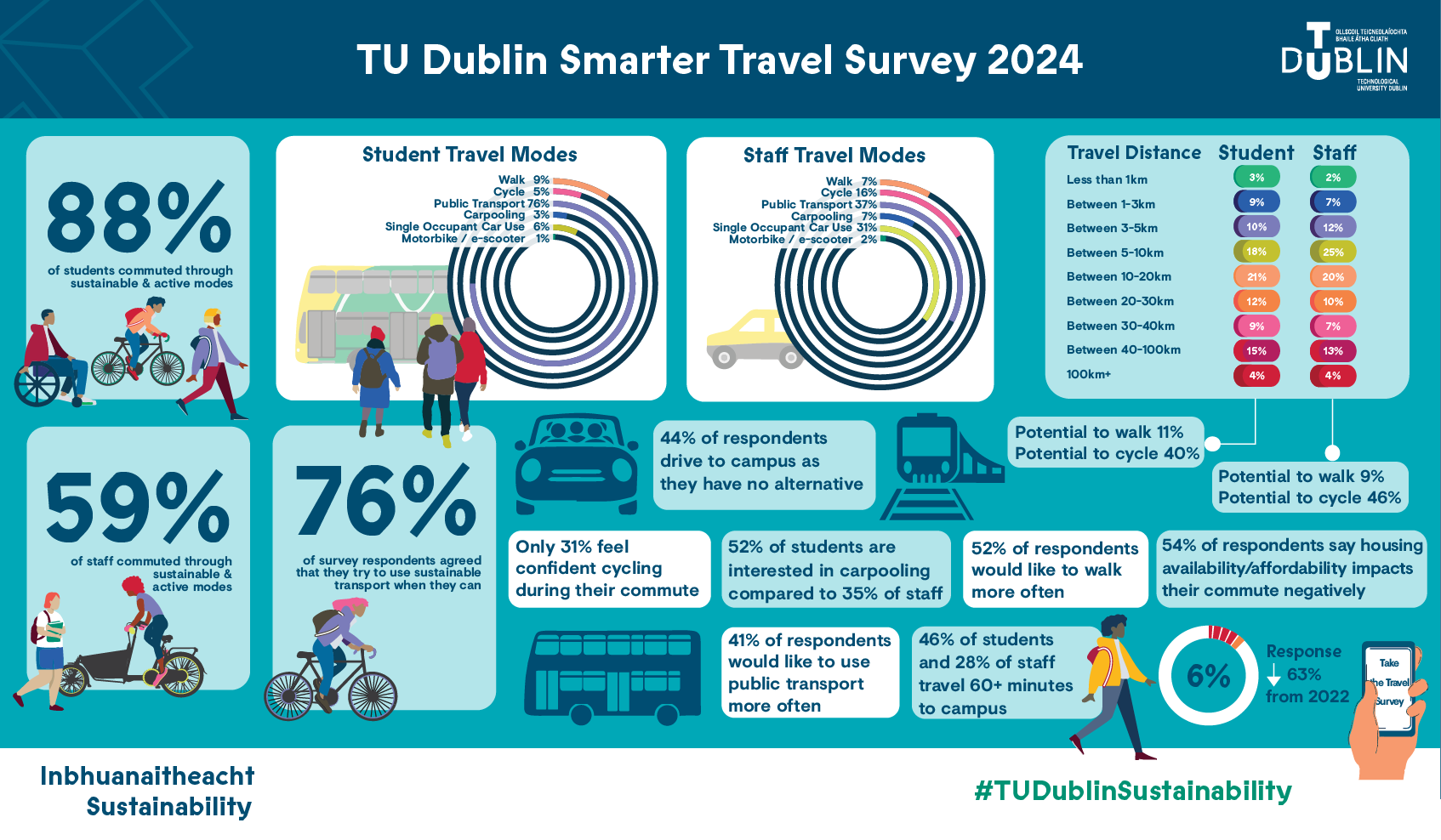
The 2024 survey reveals strong motivation among staff and students to travel actively and sustainably. While 76% of respondents reported using a sustainable or active mode as their primary form of commuting, many still expressed a desire to increase their use of these modes - with 52% wanting to walk more often, 44% wishing to cycle more frequently, 41% hoping to use public transport more often, and 28% expressing interest in carpooling.
This desire to travel more sustainably suggests a growing awareness of climate and health benefits among the University community. However, the data highlights clear and consistent barriers, particularly when it comes to distance, infrastructure, and confidence in alternative travel modes.
Speaking about the barriers to sustainable travel, TU Dublin Sustainability Lead Statistical Researcher, Rebecca Brady, said: “Despite strong motivation to travel more sustainably, many respondents face daily barriers that limit their options. 13% commute over 90 minutes, while 44% of drivers say they have no alternative to driving. Only 31% feel confident cycling, pointing to infrastructure and safety concerns. Meanwhile, over half of respondents (54%) say housing affordability and availability negatively impact their commute.”
While structural barriers persist, the data also suggests that with the right support, many commuters are open to change. More than half of respondents say they travel the way they do out of habit, highlighting the opportunity for targeted education, improved infrastructure, and supportive initiatives to help people re-evaluate their options and adopt more sustainable travel behaviours.
Rebecca Brady continued saying: “Over half of respondents (52%) agree that they commute the way they do out of habit, with speed (37%) and cost (14%) being the most common reasons for choosing a particular mode. So, it is important that we encourage and educate people about the changes they can make as well as advocate for safer and more accessible infrastructure for our staff and students commuting within the city and across the country.”
The survey also highlights support for practical changes that would help staff and students shift to more active and sustainable travel. For car users, top priorities included increased safety at public transport stops (29%), increased safety while on public transport (24%) and better walking links to public transport stops (17%). Cyclists and e-bike users called for better infrastructure, with 64% wanting secure, covered bike parking and 59% calling for more segregated cycle routes. Many also valued end-of-trip facilities like showers (34%), lockers (31%), and drying rooms (31%). These insights show the need for targeted, campus-specific interventions. TU Dublin Sustainability Office is actively working with Estates and Planning to implement projects that meet these needs and advocate for local authority projects to support the needs beyond the university gates.
TU Dublin's Student's Union President, Naomi Sebastine, said: "The survey findings make it clear that commuting has a significant impact on the day-to-day experience of students and staff at TU Dublin. Long and restrictive journeys are not just a transport issue; they directly affect participation and engagement. A striking 74% of students and 45% of staff said they would take part in more campus activities if their commute were less demanding. This highlights how distance, time, and limited transport options can create barriers to inclusion, community building, and overall student and staff wellbeing. Addressing these challenges through better infrastructure, flexible scheduling, and targeted supports could unlock greater involvement in campus life and contribute to a more connected and engaged University community.”
Next Steps
These findings will support TU Dublin’s ongoing efforts to advance active and sustainable transport and inclusive mobility across all campuses. This includes integration into the university’s climate action targets, transport planning, and accessibility initiatives. Informed by the 2024 Smarter Travel Survey data, TU Dublin Sustainability Office is now conducting targeted focus groups and walkability audits to better understand commuting challenges among underrepresented and mobility-impaired populations.
Sustainability Action Research & Innovation Lead, Dr Lorraine D'Arcy, said: “Our role was to reflect the realities of the commutes of TU Dublin staff and students through the data, and I hope the findings support broader conversations about mobility, access, and sustainability.”
Sustainability Events and Senior Media Coordinator and Smarter Travel Coordinator, Rebecca Flanagan said: “At TU Dublin, we’ are proud to see our community actively embracing more sustainable travel. Our involvement in the Smarter Travel for Campuses programme, through walking and cycling challenges, as well as student-led research projects in the Smarter Travel Student Awards, is helping to reshape commuting culture across our campuses. The start of a new academic year is an ideal time to explore a more sustainable way of getting to campus, whether that’s by walking, cycling, or using public transport - even for part of the journey. These small individual choices can lead to meaningful, lasting change for our health, our environment, and our shared future.”