
2026_Annual Research and Innovation Showcase School of Food Science and Environmental Health
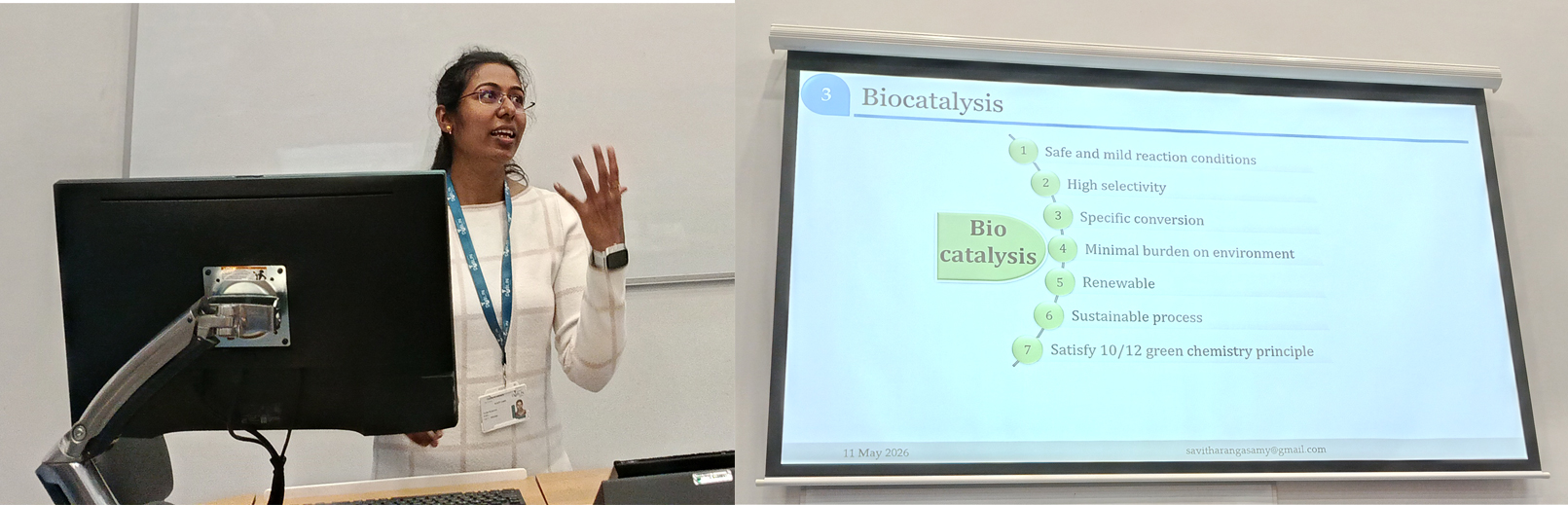
Representing GENESIS group, Savitha Rangasamy delivered a talk on "Non-interfacial activation of CALB"
Biocatalysis using a variety of enzymes is a key technology in the metrics of green chemistry and sustainable development. Despite the widespread industrial use of enzymes, a significant drawback is their poor stability and low activity under certain harsh reaction conditions. It is of great interests in understanding the activation of enzymes that improves reaction efficiency. Herein, the relationship between enzyme activation and activator structure was investigated using Candida antarctica Lipase B (CALB) as exemplar, an enzyme prominent for its biocatalytic industrial applications.
In this work, we report tetraalkyl-onium ions as a class of soluble activator molecules that hyperactivate CALB. At the outset, we show that choline activates CALB and that activation is largely due to its quaternary ammonium moiety. Structure-activity studies showed activation of CALB by diverse alkyl-onium compounds that was influenced by the hydrophobic corona surrounding the central cationic nitrogen/phosphorus. Surprisingly, increasing the alkyl-onium ion’s hydrophobicity by increasing alkyl chain length provided remarkable activation of CALB. For instance, the tetraoctylammonium ion (TOA+), at micromolar levels, activated CALB > 5-fold. We performed circular dichroism (CD), fluorescence spectroscopy and zeta potential measurements to get evidence of a plausible interaction of TOA+ with CALB. Thermal profiling of CALB with TOA+, showed that this compound improved thermal stability at 50 °C and preserved structural integrity up to 70 °C.
Overall, this work demonstrates that tetraalkyl-onium ions are small molecule activators of unusually high potency that can both activate and stabilise CALB. These compounds have the important benefit of being water soluble (up to certain level) and will be useful for biocatalytic activity enhancement. Moreover, this can be a soluble probe to investigate the mechanism of CALB activation. These insights into the mechanism of action of alkyl-onium will be useful in guiding the enhancement of enzymes for green biocatalysis applications.