
GENESIS at Emerald Isle Conference on Sustainable Chemistry & Engineering-2025
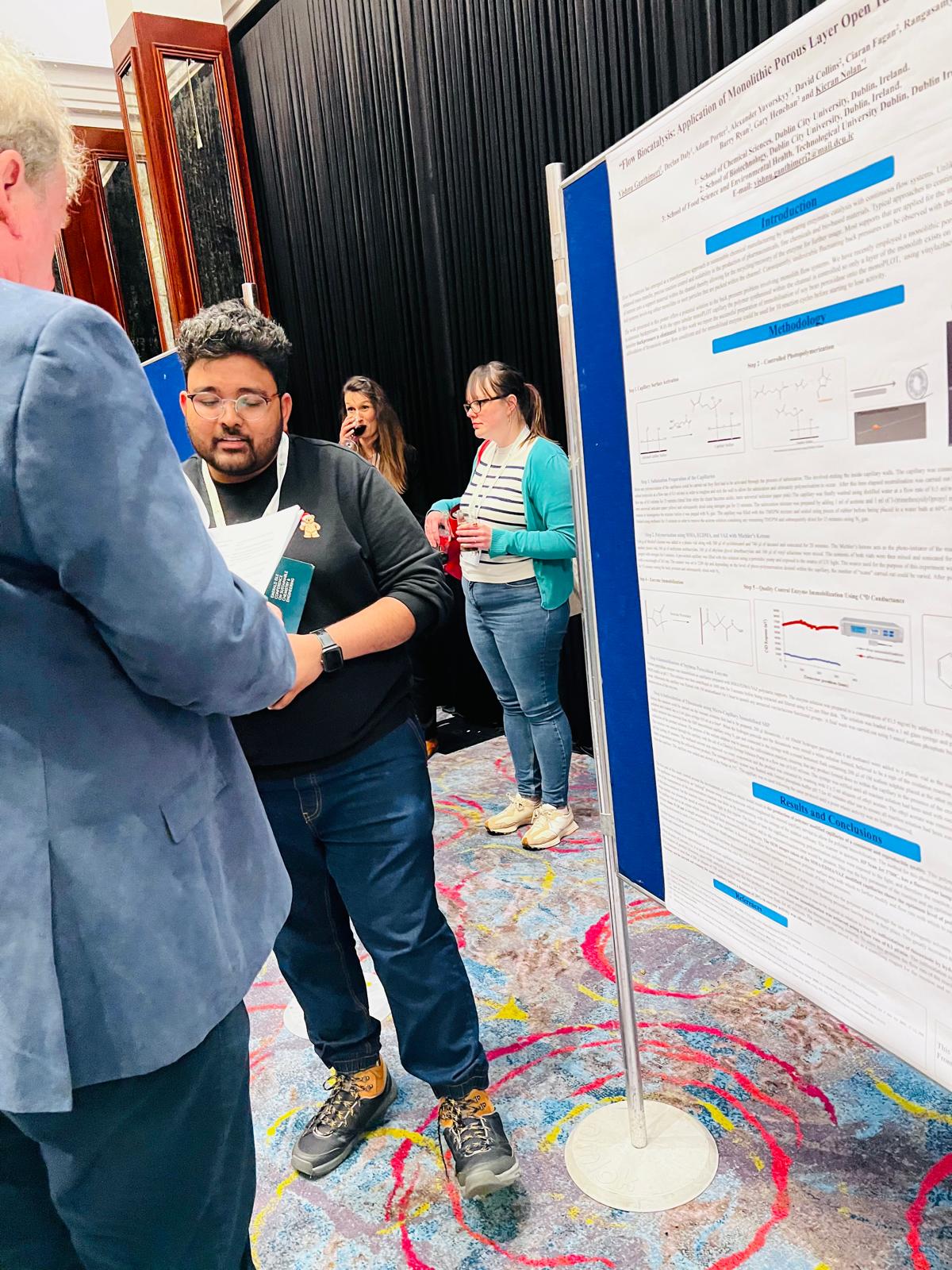
Representing GENESIS group, Vishnu Ganthimeri presented a Poster on "Flow Biocatalysis: Application of Monolithic Porous Open Tubular Capillary Reacto
Flow biocatalysis has emerged as a transformative approach in sustainable chemical
manufacturing by integrating enzymatic catalysis with continuous flow systems. Unlike
traditional biocatalytic batch processes, flow biocatalysis offers enhanced mass transfer,
precise reaction control and scalability in the production of pharmaceuticals, fine chemicals
and bio-based materials. Typical approaches to continuous flow biocatalysis involves the
immobilisation of the enzyme of interest onto a support material within the channel thereby
allowing for the recycling/recovery of the enzyme for further usage. Most supports that are
applied for the immobilisation of enzymes in continuous flow are typically packed bed
systems involving either monoliths or inert particles that are packed within the channel.
Consequently, undesirable fluctuating back pressures can be observed with these packed
channels.
The work presented in this poster offers a solution to the back pressure problem. We have
recently employed a monolithic porous layer open tubular (monoPLOT) capillary (100μm)
system to eliminate backpressure. With the monoPLOT capillary the polymer synthesised
within the channel is controlled so only a layer of the monolith exists on the walls of the
capillary leaving the centre of the capillary open, therefore backpressure is eliminated. In this
work we report the successful immobilisation of soy bean peroxidase onto the monoPLOT,
using vinyl azlactone as linker, and demonstrated complete sulfoxidation of thioanisole under
flow conditions and the immobilised enzyme could be used for 10 reaction cycles before
losing activity. We now envisage extending this technology to both lipases and glucosidases.