
Non-interfacial activation of CALB by soluble alkyl-onium ions: Structure activity relationships
CALB activation, small-molecule activators, tetraalkylammonium salts, tetraalkylphosphonium salts, thermal stabilisation, structure-activity relations
Research highlights
- Tetraalkyl-onium ions identified as novel, non-peptide small molecule activators.
- CALB activation achieved without interfacial effects.
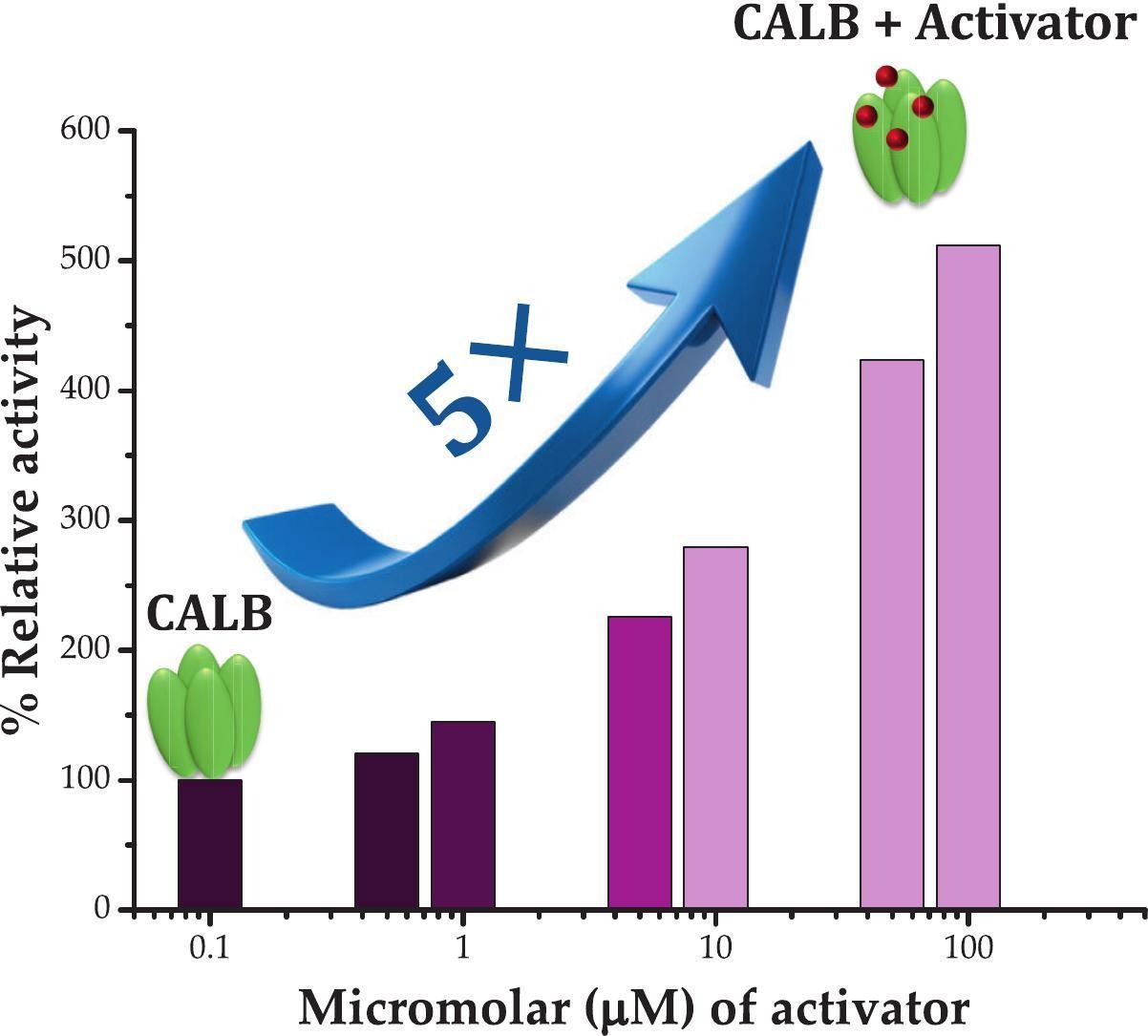
- First report on a five-fold hyperactivation at micromolar concentrations.
- CALB Activation is accompanied by marked thermal stabilisation.
- A soluble activator introduced as a mechanistic probe for CALB activation.
In biocatalysis, the activation of enzymes has the potential to greatly improve reaction efficiency. It is not clear, however, what fundamental factors underlie the activation of enzymes or what structural features define an activatory compound.Recently, activation by cholinium ions has been observed for different enzymes. Herein, using Candida antarctica Lipase B (CALB) as an exemplar, we investigated the relationship between activation and activator structure. We show that choline activates CALB and that activation is largely due to its quaternary ammonium moiety.
Structure-activity studies showed activation of CALB by diverse alkyl-onium compounds that was influenced by the hydrophobic corona surrounding the central cationic nitrogen/phosphorus. Surprisingly, increasing the alkyl-onium ion's hydrophobicity by increasing alkyl chain length provided remarkable activation of CALB. For instance, the tetraoctylammonium ion (TOA+), at low micromolar levels, activated CALB >5-fold. Circular dichroism (CD), fluorescence spectroscopy and zeta potential measurements provided evidence that TOA+ was binding to CALB through both electrostatic and hydrophobic interactions. Thermal profiling of CALB with TOA+, showed that this compound improved thermal stability at 50 °C and preserved structural integrity up to 70 °C.
Overall, this work demonstrates that tetraalkyl-onium ions appear to act as “capping agents” that bind to certain surface accessible negative charges on CALB. The central positive charge serves to orient the activator, and binding is enhanced by interactions with adjacent hydrophobic residues.
These insights into the mechanism of action of alkyl-onium ions explain the widespread nature of cholinium ion activation and will be useful in guiding the enhancement of enzymes for green biocatalysis applications.