
Exploring the Extent and Impact of Growth of an Invasive Laurel Species in a Woodland
Woodland ecosystems are increasingly under threat from the spread of an invasive laurel species. This dominance poses a significant risk to biodiversity, contributing to habitat loss, soil degradation, and the suppression of native woodland species. Understanding the extent of this issue, and its wider environmental implications, is critical to informing sustainable land management practices.
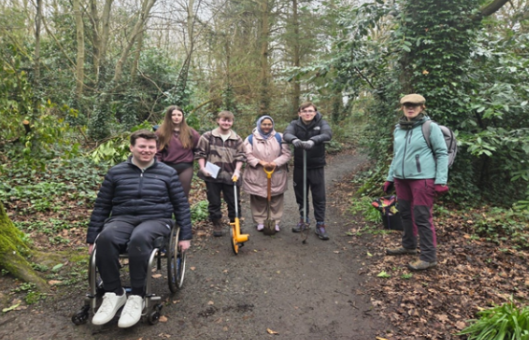
In response to this challenge, five students from the TU835 BSc (Hons) in Spatial Planning and Environmental Management degree at TU Dublin undertook a field-based investigation as part of their Soil Science module. The project was developed in collaboration with Fr David Kenneally, Regional Director of The Missionary Society of St Columban and guided by Lorraine Foley, lecturer at the School of Architecture, Building and Environment. The initiative was supported by TU Dublin’s Sustainability Action Lab programme.
Immersive Learning and Fieldwork
In March 2026, the five students visited The Missionary Society of St Columban to learn about their experience in environmental protection across the world and the negative implications of illegal logging, habitat loss, soil erosion, and farming income losses in economically and socially disadvantaged communities.
This project supported students in applying their knowledge of Soil Science to real world challenges. Their field work investigation aligned with SDG 10: Reduced Inequalities, SDG 13: Climate Action and SDG 15: Life on Land, connecting the global challenges to soil and habitats to the current issues of invasive species local habitats and communities in Ireland.
The students walked around the grounds and identified and recorded woodland issues, took soil samples and images and defined the problem of laurel dominance and risk of habitat loss. Following their visit, the students then tested the soil and compiled a report to share their findings with St Columban’s.
The collaboration gave students the opportunity to explore and learn in an immersive environment and to exchange information with local and global communities.
One participating student said:
“Working together on this project gave us a clearer understanding of the relationship between soil conditions, vegetation, and habitat quality at The Missionary Society of St Columban. Undertaking field observations and soil sampling on site enabled us to apply classroom theory in a practical and meaningful way.”
“By working on site, we developed a more applied understanding of woodland ecosystems and soil processes. Measuring pH, soil moisture, and temperature helped us see more clearly how soil conditions influence vegetation and habitat health.”
Lorraine Foley, lecturer at the School of Architecture, Building and Environment said:
“To be able to handle and observe soil conditions is active learning at its best!”
For The Missionary Society of St Columban, the collaboration gave them knowledge and insight into the laurel species, specifically that the leaves are poisonous. This means that once cutting of Ash for Dieback starts, St Columban’s will have to manage the spread of laurel at the same time. St Columban’s also gained an understanding and appreciation for the technical aspects of their sustainability project in Dalgan."
Fr David Kenneally from The Missionary Society of St Columban said:
“I initially thought this would be a one-sided approach to teaching about soil and sustainability. It turned out to be insightful on all our parts. I appreciate the sharing of the Columban experience around the world in saving forests and seeking sustainable eco-systems. I have learnt that partnership benefits both parties and I welcome more insights while the participants learn and help me understand the complexities.”
SDG Alignment:
This initiative strongly aligns with the United Nations Sustainable Development Goals:
SDG 10: Reduced Inequalities - Reduce inequality within and among countries
SDG 13: Climate Action- Take urgent action to combat climate change and its impacts
SDG 15: Life on Land - Protect, restore and promote sustainable use of terrestrial ecosystems, sustainably manage forests, combat desertification, and halt and reverse land degradation and halt biodiversity loss.
Each Sustainability Action Lab project is underpinned by:
- SDG 17: Partnership for the Goals - Strengthen the means of implementation and revitalize the Global Partnership for Sustainable Development
- SDG 4: Quality Education - Ensure inclusive and equitable quality education and promote lifelong learning opportunities for all
GreenComp Alignment
The project also aligns with specific competences from the GreenComp sustainability competency framework including
- Embodying sustainability values
- Embracing Complexity in Sustainability,
- Envisioning Sustainable Futures.
|
Competency Area |
Competency |
Descriptor |
|
Embodying sustainability values |
Promoting nature |
To acknowledge that humans are part of nature; and to respect the needs and rights of other species and of nature itself in order to restore and regenerate healthy and resilient ecosystems. |
|
Embracing Complexity in Sustainability |
Problem Framing |
To formulate current or potential challenges as a sustainability problem in terms of difficulty, people involved, time and geographical scope, in order to identify suitable approaches to anticipating and preventing problems, and to mitigating and adapting to already existing problems |
|
Envisioning sustainable futures |
Futures literacy |
To envision alternative sustainable futures by imagining and developing alternative scenarios and identifying the steps needed to achieve a preferred sustainable future |
This collaboration was supported by the Societal Engagement and Sustainability Education teams and through the Higher Education Authority’s Strategic Alignment of Teaching and Learning Enhancement (SATLE) fund.