Greener Bakery practices - Reducing Food and Packaging Waste
.jpg)
Globally, food systems contribute up to 30% of human-made greenhouse gas emissions, with food waste alone accounting for 8–10% (EPA, 2024). Packaging waste is also on the rise yet recycling rates lag. In Ireland, excessive consumption fuels this trend, while reliance on single-use plastics remains high. In this context, changing behaviour by modelling best practice is vital to addressing climate change at its roots.
One of the most promising paths forward is educating the next generation of culinary, bakery and food technology professionals to embed sustainability into every step of the food production journey. That’s exactly the approach of the School of Culinary Arts & Food Technology at Technological University Dublin, Ireland’s leading centre for culinary education, where sustainability is being served up alongside culinary skill and innovation.
Reducing Food and Packaging Waste in the School of Culinary Arts & Food Technology: Reusable Bread Bags towards Greener Bakery practices
At TU Dublin’s School of Culinary Arts & Food Technology (SCAFT), sustainability is integrated into the student experience—not just in theory, but in practice. In 2024, as part of a Green-Campus Open Call project, SCAFT lecturers Shannon Dickson and Sheona Foley launched a sustainability initiative that put bakery students at the centre of a real-world experiment in waste reduction.
Framed within the objectives of TU Dublin’s Climate Action Roadmap and using a Living Lab approach, the initiative used the bakery and teaching environment as a testbed for behaviour change and co-creation. Students participated in all stages—from identifying the problem, to implementing and evaluating sustainable solutions.
The project aimed to build student knowledge and influence behaviour change by introducing food waste initiatives across teaching environments, bakeries, and the bakery shop at the Central Quad, Grangegorman. Their key focus areas were to reduce single-use packaging; reduce food waste; build awareness and educate students; and foster pro-environmental behaviours within bakeries and the shop.
From Global Challenge to Local Solution
Bakery and culinary students participate in practical classes where they produce bakery products. Some of the produce is taken home by the students and some is sold in the student bakery shop on campus. These activities can lead to unnecessary food waste.
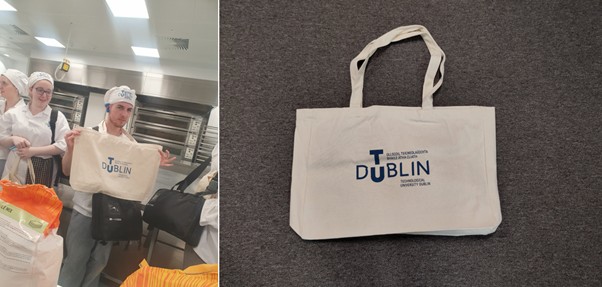
Third-year students from Baking & Pastry Arts Management (TU741) led a Green Week campaign promoting the use of reusable bread bags. During this time, they hosted sustainable baking workshops which were attended by 92 bakery students (years one to four) and 16 Transition Year students from local secondary schools including Mount Carmel, Stanhope Secondary School, St. Pauls CBS, and Mercy Inchicore. The reusable cotton and linen bags, designed for both transport and storage of fresh bread, were distributed during the workshops.
The storage bags helped extend the shelf life of bread, while the transport bags replaced cling film, paper bags and plastic boxes commonly used in classes.
Project Impact
Follow-up surveys showed that 100% of students used the reusable bags, and 68% reported greater awareness of their reliance on disposable items. Many expressed surprise at the environmental cost of materials like cling film, paper bags and boxes. Students Leanne Brady, Grey Halliday and Dakota Sanchez started their own research on cling film and shared their findings:
We became conscious that cling film takes almost 1,000 years to break down, and that approximately 36km of clingfilm is used in the School every year! This is enough to wrap Central Quad AND Academic Hub 47 times!
The feedback on the reusable bags from the students was positive, stating that the size of the bag was suitable for bread and pastry modules. Students proposed design improvements for future bags and suggested expanding the initiative to include reusable cake boxes for confectionery classes.
Later in the semester the students gathered feedback on how the bags were used and what impact they had. The results of this will be disseminated as part of 2025 induction for new and returning bakery students.
SCAFT lecturer Sheona Foley said:
“Changing behaviour and practice in a busy teaching bakery is always going to be challenging, but this pilot has successfully captured the interest of bakery staff and students, and allowed us to further embed sustainability into our bakery practices”
Learning about measures to reduce waste has taught both students and staff about the practical ways to reduce our harmful impacts on the environment. By embedding sustainable practices into learning it teaches a new generation of food professionals to be more conscious of unsustainable practices in their work. It also contributes to fostering a culture of environmental awareness in schools, on campus and within the local community.
Shared Impact
At TU Dublin we are committed to progressing the Sustainable Development Goals (SDGs) through collaboration and action. This Green-Campus Open Call project addresses SDG 4: Quality Education through inclusive life-long learning and SDG12: Responsible Production and Consumption.
This project aligns with the Green-Campus theme of Litter & Waste developing practical means for preventing, reducing and minimising the amount of waste produced on campus. As part of TU Dublin’s Climate Action Roadmap, the University must reduce food waste across all areas of operation and to target this through monitoring and measuring, and to cease using single use plastic items.
Green-Campus Open Call
This project was funded through SATLE, as part of the Green-Campus Open Call 2024, and was awarded a micro grant to progress the themes:
- Litter & Waste (Green-Campus themes)
- Waste (Climate Action Roadmap objectives)
The Green-Campus Open Call can help bring ideas like this project to life by making micro-grants available to selected project ideas. TU Dublin’s Green-Campus programme encourages a partnership approach to environmental education and management, and this aligns with the TU Dublin Living Lab.
This project builds on an earlier SATLE-funded food waste project within SCAFT. These projects are ongoing and will be further developed and ideally co-created with students, staff, Campus & Estates, and Central Quad building management (Sodexo).