
Developing a Post Occupancy Evaluation with Ava Housing
Re-imagining the semi-detached house for a changing society
Ireland is facing two interlinked challenges: a rapidly aging population and a chronic housing shortage. Many older adults live alone in under-occupied homes, while younger generations struggle to find affordable rental accommodation.
Ava Housing CLG, a not-for-profit organisation, offers an innovative response by supporting homeowners aged 60+ on low incomes to reconfigure their semi-detached homes in North Dublin. Their model enables older people to downsize to a self-contained ground-floor unit, while creating a new, independent rental unit upstairs, fostering multigenerational living without compromising privacy or autonomy.
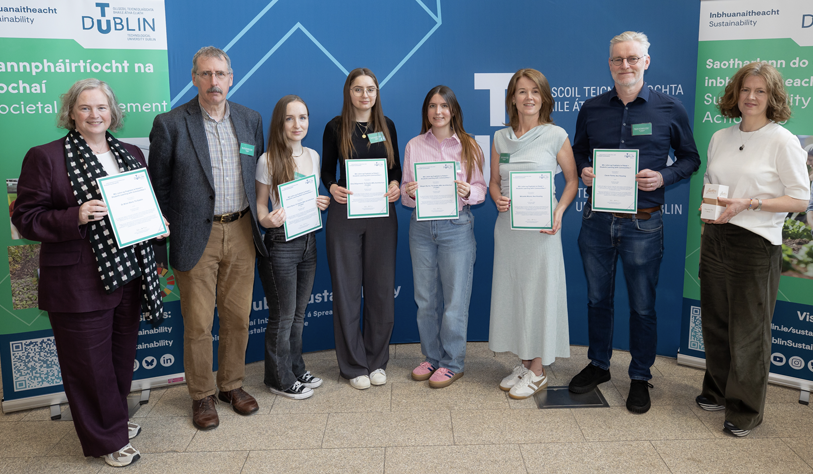
In semester two, four Masters of Architecture (TU282) students from TU Dublin’s School of Architecture, Building and Environment collaborated with Ava Housing through the Students Learning with Communities + (SLWC+) initiative, under the guidance of lecturer Dr Brian Ward and supported by Head of Societal Engagement, Helena Fitzgerald, and Sustainability Education Lead, Dr Ken Boyle. Their shared goal was to co-design a Post-Occupancy Evaluation (POE) methodology tailored to Ava Housing’s unique retrofitting model.
Evaluating Design Decisions
Despite growing awareness of the needs of older homeowners, many design decisions remain informed by assumptions rather than evidence. Post-Occupancy Evaluation is a structured method for assessing how buildings perform once occupied, focusing on real user experiences. The students’ POE framework provides a comprehensive framework to document findings related to spatial efficiency, lighting, acoustics, indoor climate, energy management, and building performance. It allows each category to be assessed for its impact on daily living with a human-centred lens.
Speaking of the collaboration, Ava Housing founder and CEO Michelle Moore said: “Thank you to TU Dublin's SLWC+ initiative and the very talented M. Arch students from the School of Architecture, Building and Environment for their enthusiasm, interest and engagement. It has been such a positive and enriching co-learning experience."
Better buildings, informed policy
Through their methodology, students have laid the groundwork for future colleagues to build on. Once implemented, their POE will provide insights into the performance of the buildings and allow architects to evaluate past design choices, helping Ava Housing understand how its homes perform in everyday life and how to improve future designs. Their methodology could also inform national housing policy, through Ava Housing’s ongoing engagement with the Department of Housing, Local Government and Heritage, and the Sustainability Energy Authority of Ireland (SEAI), amplifying the project’s impact far beyond North Dublin.
Shared Impact
This SLWC+ collaboration between TU Dublin and Ava Housing exemplifies how academic and societal partnerships can drive meaningful change.
For Ava Housing, the Post-Occupancy Evaluation developed by the students provides a vital tool to refine their retrofit model, ensuring homes are more comfortable, efficient, and responsive to the needs of older residents.
This project gave the students a valuable opportunity to apply classroom knowledge about Post Occupancy Evaluation to a real-world, socially engaged challenge. The benefit was mutual with students experiencing how their skill set could contribute to a real-world societal challenge, deepening their understanding of architecture’s role in addressing societal needs, particularly during the energy transition.
The project also highlighted the importance of adaptive reuse in tackling both environmental and social issues. It enabled them to contribute to the well-being of society, the planet and its inhabitants. The POE they developed will contribute to the efficient use of Ireland’s existing building stock (and its embodied carbon) while simultaneously tackling issues emerging around our aging population and a cross generational loneliness epidemic.
Together, their project supports United Nations (UN) Sustainable Development Goal (SDG 11): Sustainable Cities and Communities by promoting age-friendly, adaptable housing that strengthens community resilience. It also advances SDG 13: Climate Action by extending the life of existing buildings, reducing carbon emissions, and encouraging more sustainable use of Ireland’s housing stock. More than just a design project, their co-creation approach is a model for how education and community innovation can move in step toward a more inclusive and sustainable future.
Speaking of the project impact, Ava Housing Director Ciarán Ferrie said: The work that the students have done in tailoring a post-evaluation methodology to the specific context of our project has been invaluable and we look forward to building on that work in the future.