
Immersive Technologies for Education
Immersive technologies, including virtual reality (VR), offer exciting opportunities to create engaging, authentic learning experiences across all disciplines. The application of immersive technologies for teaching and learning aligns with TU Dublin's commitment to deliver practice-based learning that prepares students for future work environments.
To support staff in exploring these possibilities, Digital Education working with the Digital Education Futures Collective has developed a SATLE-funded phased professional learning programme designed to build confidence, develop practical skills and drive curriculum integration over three years. The programme is informed by the learning pathway proposed by Khukalenko et al. (2022), recognising that application of immersive technologies develops gradually through supported practice rather than one-off training.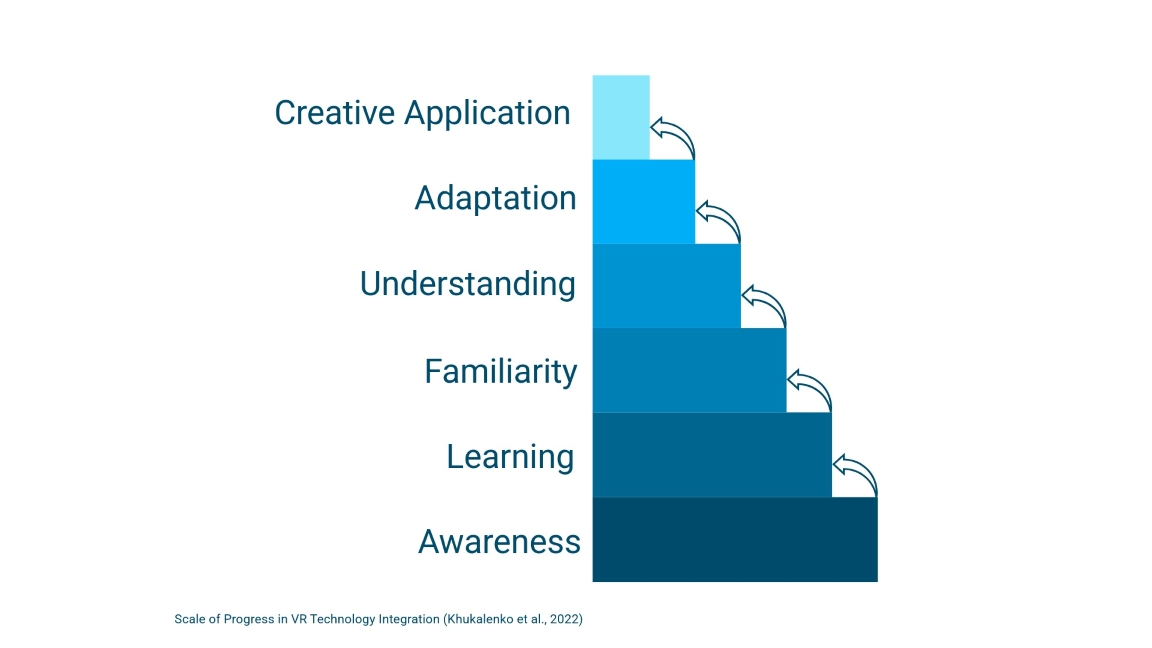
Although many academics are aware of VR, research shows that relatively few have had the opportunity to experience it themselves. Common barriers include limited training opportunities, lack of confidence, the cost of equipment, and uncertainty about how immersive technologies can support teaching and learning.
Our programme provides staff with a supportive environment in which to explore immersive technologies, gain hands-on experience with VR headsets and applications, and discuss effective pedagogical approaches with colleagues. The aim is to build confidence first, enabling informed decisions about how immersive technologies can enhance teaching practice.
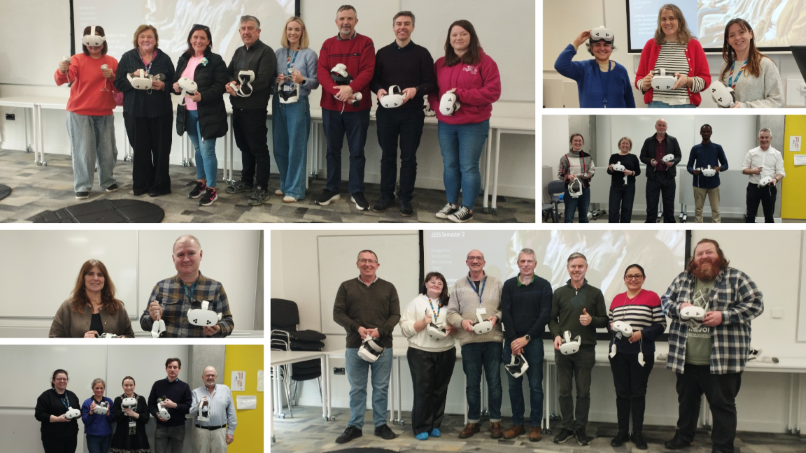
You can register for upcoming Staff VR Taster Sessions here.
Our professional learning programme is mapped to the six-stage staff development model described by Khukalenko et al. (2022), moving staff from awareness of immersive technologies to confident curriculum integration.
Phase 1: VR Taster Workshops (2026–2027)
The first phase introduced staff to VR through practical workshops using Meta Quest headsets. Participants explored examples of immersive learning, developed confidence using the technology and discussed potential applications within their own disciplines.
Following a successful rollout in Semester Two 2025/26, the VR Taster workshops will continue throughout the 2026/2027 academic year, providing opportunities for additional staff. This phase primarily supports progression through the Awareness, Learning, Understanding and Familiarity stages of the Khukalenko et al. (2022) framework.
Phase 2: Creating Immersive Learning with ThingLink (2026–2027)
Running alongside the continuing Taster workshops, the second phase introduces staff to immersive content creation using ThingLink. Participants who took part in the Taster sessions are invited to learn to design their own interactive VR learning experiences by creating scenes, embedding multimedia content, incorporating assessment activities and developing simple branching scenarios.
This phase enables staff to build on the first phase of training to design their own resources, supporting progression into the ‘Adaptation’ stage where VR becomes a viable instructional tool rather than simply a technology.
Phase 3: Creative Application of VR for Teaching and Learning
In the third phase we hope to focus on:
- Embedding immersive technologies within modules and programmes
- Advanced design of authentic learning activities
- Assisting feasible student engagement
- Sharing examples of effective practice across the university
By this stage, participants will be working towards the ‘Creative Application’ stage, where immersive technologies become an integrated element of teaching, learning and assessment.
The initial VR Taster programme achieved a number of goals during its first delivery.
Highlights include:
- 60 staff participated by the end of April 2026.
- The programme will continue during the 2026/2027 academic year.
- 100% of respondents expressed interest in progressing to Stage 2 authoring workshops.
- Staff generated a wide range of discipline-specific ideas for immersive learning.
- Strong support from Technology Services helped ensure successful delivery across three campuses.
Phase 2 is designed to help staff create their first immersive learning experience with confidence. Rather than beginning with an empty project, participants receive ready-made assets, templates and exemplar scenes that can be adapted for their own teaching contexts.
Across two practical workshops, participants will:
- create interactive 360° learning environments;
- add text, images, video, audio and 3D models;
- design quizzes and reflective activities;
- build simple branching scenarios using decision points and feedback;
- test their experiences in VR using Meta Quest headsets; and
- publish and refine resources that can be used with students.
This scaffolded approach ensures that every participant leaves with a working immersive learning resource while developing the skills and confidence to create future activities independently.