
Shining a Spotlight: Life on the Margins for Minorities in Modern Ireland
Class-based oppression, institutional neglect, and the pressures placed on young men in marginalised communities remain significant issues in modern Ireland. These challenges are often underrepresented, contributing to stigma and limited public engagement with the lived experiences of those affected.
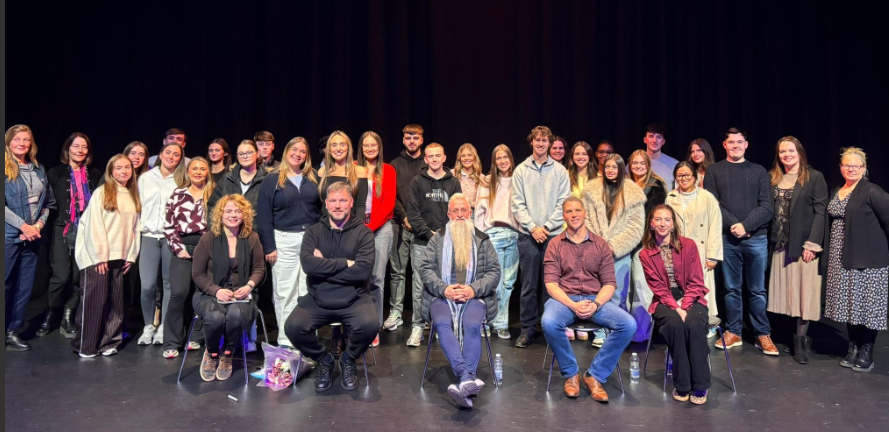
In response, 31 students from the TU787 Bachelor of Business in Marketing, TU923 Bachelor of Business (Hons) in Marketing Management, TU780 Bachelor of Arts in Advertising and Marketing Communications, and TU919 Bachelor of Arts (Hons) in Advertising and Marketing Communications programmes collaborated with Niamh Honer of the Civic Theatre, Tallaght.
The collaboration was delivered as part of the Event Management and Integrated Marketing Communications (IMC) module in Semester 1, under the academic leadership of Hilda Burton and Dr Trish Medcalf from the School of Marketing and Entrepreneurship, and supported by TU Dublin’s Sustainability Action Lab programme.
Amplifying the Voices of Marginalised Communities
As part of the module, students worked with the Civic Theatre to promote John Connor’s play, ‘Ireland’s Call’, and to curate a post-show panel discussion to consider issues raised in the play, including class-based oppression, institutional neglect and the pressures placed on young men in marginalised communities.
Through this project, students combined their knowledge of Event Management and Marketing Communications with the United Nations (UN) Sustainable Development Goals (SDGS) to build on the transformative impact of theatre. The social justice focus created a strong connection to SDG 10: Reduced Inequalities and SDG16: Peace, Justice and Strong Institutions.
Between September and November 2025, the students created promotional material and social media content, sold tickets, organised and hosted the panel for the post-show discussion, introduced the play and panel to the audience, and managed audience participants during the discussion. Students also participated in a workshop at the theatre, designed to build confidence and communication skills.
Through this experience, students developed an appreciation for the complexity of stakeholders involved in addressing these problems, including curating a panel of relevant experts and staging a play. They also had the opportunity to empathise with those who experience stigma, deepening their understanding of the social issues explored.
Students were given the opportunity to apply their academic learning to real world challenges and the Civic Theatre benefited from the students’ insights, research and expertise. The collaboration fostered a meaningful exchange between students, practitioners, and the wider community, amplifying important social issues through performance and dialogue.
In recognition of their teaching work on this impactful project, Hilda Burton, Trish Medcalf and Niamh Braiden won the Jennifer Burke Award for Innovation in Teaching and Learning 2026 from the Irish Learning Technology Association (ILTA).
This prestigious national award celebrates innovative and pioneering approaches to teaching and learning and is one of the most respected recognitions of educational innovation in the Irish higher education sector. The award honours the memory of Jennifer Burke and recognises initiatives that enhance the learning experience through creativity, originality and impact.
Dr Patricia Medcalf said the project exemplified TU Dublin's commitment to experiential learning and industry engagement.
"Experiential learning is at the heart of what we do at TU Dublin. This project gave students the opportunity to engage with a live industry brief, collaborate with external partners, and develop skills that cannot be fully replicated in a classroom setting. Seeing the students take ownership of the project and facilitate meaningful conversations around important social issues was incredibly rewarding."
The project was designed to give students the opportunity to apply their learning in a real-world setting while engaging with important social and cultural issues through the arts.
Commenting, Hilda Burton Lecturer said:
"This project provided students with the opportunity to showcase their abilities in a commercial setting. They genuinely became more than we could imagine through this learning experience, and it was fantastic to witness this as their lecturer".
Niamh Honer from the Civic Theatre said:
"I'm incredibly proud to share that my academic colleagues, Hilda Burton, Niamh Braiden, Patricia Medcalf and I are honoured to receive the prestigious Jennifer Burke Award. This project brought together two areas I am deeply passionate about: arts engagement and immersive, authentic student learning experiences."
"Together, we enabled students to co-create in a way that closely reflected contemporary creative industry practice, fostering autonomy, collaboration and meaningful professional learning."
SDG Alignment
This initiative strongly aligns with the United Nations Sustainable Development Goals:
SDG 10: Reduced Inequalities - Reduce inequality within and among countries
SDG 16: Peace, Justice and Strong Institutions - Promote peaceful and inclusive societies for sustainable development, provide access to justice for all and build effective, accountable and inclusive institutions at all levels.
Each Sustainability Action Lab project is underpinned by:
SDG 17: Partnership for the Goals - Strengthen the means of implementation and revitalize the Global Partnership for Sustainable Development
SDG 4: Quality Education - Ensure inclusive and equitable quality education and promote lifelong learning opportunities for all.
GreenComp Framework
The project also aligns with specific competences from the "GreenComp sustainability competency framework including
- Embodying Sustainability Values,
- Embracing Complexity in Sustainability,
- Acting for Sustainability, and
- Envisioning Sustainable Futures.
|
Competency Area |
Competency |
Descriptor |
|
Embodying sustainability values |
Supporting fairness |
To support equity and justice for current and future generations and learn from previous generations for sustainability. |
|
Embracing complexity in sustainability |
Critical thinking |
To assess information and arguments, identify assumptions, challenge the status quo, and reflect on how personal, social and cultural backgrounds influence thinking and conclusions. |
|
Envisioning sustainable futures |
Exploratory thinking |
To adopt a relational way of thinking by exploring and linking different disciplines, using creativity and experimentation with novel ideas or methods |
|
Acting for sustainability |
Political agency |
To navigate the political system, identify political responsibility and accountability for unsustainable behaviour, and demand effective policies for sustainability |
This collaboration was supported by the Societal Engagement and Sustainability Education teams and through the Higher Education Authority’s Strategic Alignment of Teaching and Learning Enhancement (SATLE) fund.