
Tackling Food Waste and Food Poverty: Launching the Food Pantry on Tallaght Campus
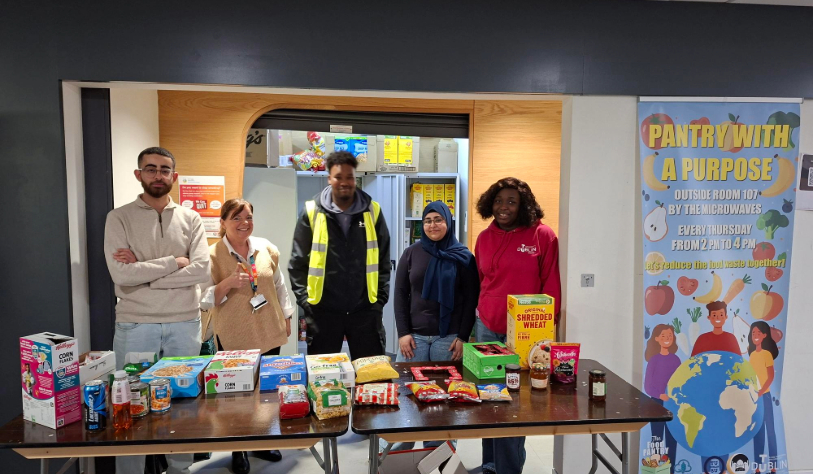
Food waste and food poverty are growing challenges for students at TU Dublin. While significant quantities of edible food are regularly discarded, many students face financial pressures that impact their access to basic food supplies. Addressing both issues requires coordinated action, awareness, and sustainable solutions.
In response, 25 students from the TU787 Bachelor of Business in Marketing, TU923 Bachelor of Business (Hons) in Marketing Management, TU780 Bachelor of Arts in Advertising and Marketing Communications, and TU919 Bachelor of Arts (Hons) in Advertising and Marketing Communications programmes collaborated with Jacqueline Kelleher, Tallaght Campus Chaplain, to brand and launch the campus’s first food bank, the Food Pantry.
The collaboration was delivered as part of the Event Management and Integrated Marketing Communications (IMC) module in Semester 1, under the academic leadership of Hilda Burton and Dr Trish Medcalf from the School of Marketing and Entrepreneurship, and supported by TU Dublin’s Sustainability Action Lab programme.
This project empowered students to combine their knowledge of Event Management and Marketing Communications with the United Nations (UN) Sustainable Development Goals (SDGS) to expand the impact of the Food Pantry. The impact this project had on the issues of food insecurity and food waste aligns with the interconnected SDGS of SDG1: No Poverty, SDG2: Zero Hunger, SDG 10: Reduced Inequalities and SDG 12: Responsible Consumption and Production.
Developing the Brand
In collaboration with a social enterprise FoodCloud that tackles climate change and food insecurity by connecting businesses that have surplus food to communities that can use it, the weekly Food Pantry was established to redistribute food staples that would otherwise be destined for landfill. Between September and November 2025, students worked collaboratively to develop the Tallaght Campus Food Pantry brand, ensuring it resonated with the student community.
They also designed and ran a raffle campaign to raise awareness and funds, and organised and staged a launch event to coincide with the second week of Food Pantry operations. This hands-on experience enabled students to apply their academic learning to a real-world initiative with direct social impact.
Impact
Through their involvement, students gained insight into the prevalence and impact of food waste and food poverty among their peers. They developed an appreciation for the complexity of stakeholders involved in addressing these issues, including social enterprises, campus services, and the student body.
This collaboration created shared value for both students and the Food Pantry initiative. Students benefited from applying their knowledge in a practical setting, while the Food Pantry gained from the students’ insights, research, and expertise in branding, marketing, and event delivery.
Louise O’Gallagher from Food Cloud said:
“The TU Dublin Pantry demonstrates the power of working with students and University staff to create practical, community-driven solutions. It not only provides vital access to food but also acts as a space for learning, connection and engaging in sustainability in a meaningful, hands-on way."
SDG Alignment
This initiative strongly aligns with the United Nations Sustainable Development Goals:
SDG 1: No Poverty - End poverty in all its forms everywhere
SDG 2: Zero Hunger - End hunger, achieve food security and improved nutrition and promote sustainable agriculture
SDG 10: Reduced Inequalities - Reduce inequality within and among countries
SDG 12: Responsible Consumption and Production - Ensure sustainable consumption and production patterns
Each Sustainability Action Lab project is underpinned by:
SDG 17: Partnership for the Goals - Strengthen the means of implementation and revitalize the Global Partnership for Sustainable Development
SDG 4: Quality Education - Ensure inclusive and equitable quality education and promote lifelong learning opportunities for all
GreenComp Alignment
The project also aligns with specific competences from the "GreenComp sustainability competency framework including:
- Embodying Sustainability Values,
- Embracing Complexity in Sustainability,
- Acting for Sustainability, and
- Envisioning Sustainable Futures.
|
Competency Area |
Competency |
Descriptor |
|
Embodying sustainability values |
Supporting fairness |
To support equity and justice for current and future generations and learn from previous generations for sustainability. |
|
Embracing complexity in sustainability |
Systems thinking |
To approach a sustainability problem from all sides; to consider time, space and context in order to understand how elements interact within and between systems. |
|
Envisioning sustainable futures |
Exploratory thinking |
To adopt a relational way of thinking by exploring and linking different disciplines, using creativity and experimentation with novel ideas or methods |
|
Acting for sustainability |
Collective action |
To act for change in collaboration with others |
This collaboration was supported by the Societal Engagement and Sustainability Education teams and through the Higher Education Authority’s Strategic Alignment of Teaching and Learning Enhancement (SATLE) fund.