
Assessment Types
Selecting Assessment Types and Methods
Effective assessment design begins with clarity about what students are expected to learn and how that learning should be evidenced, before selecting assessment methods or types. This page distinguishes between assessment types, which describe the purpose and role of assessment in relation to learning, and assessment methods, which describe how students demonstrate their learning.
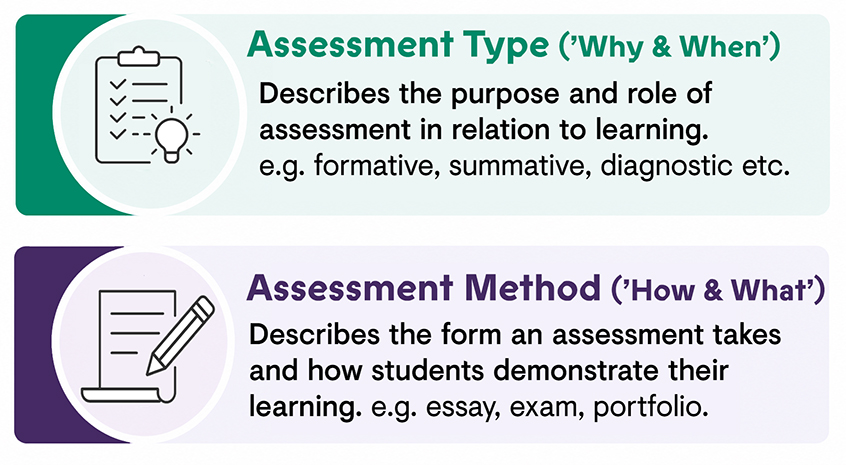
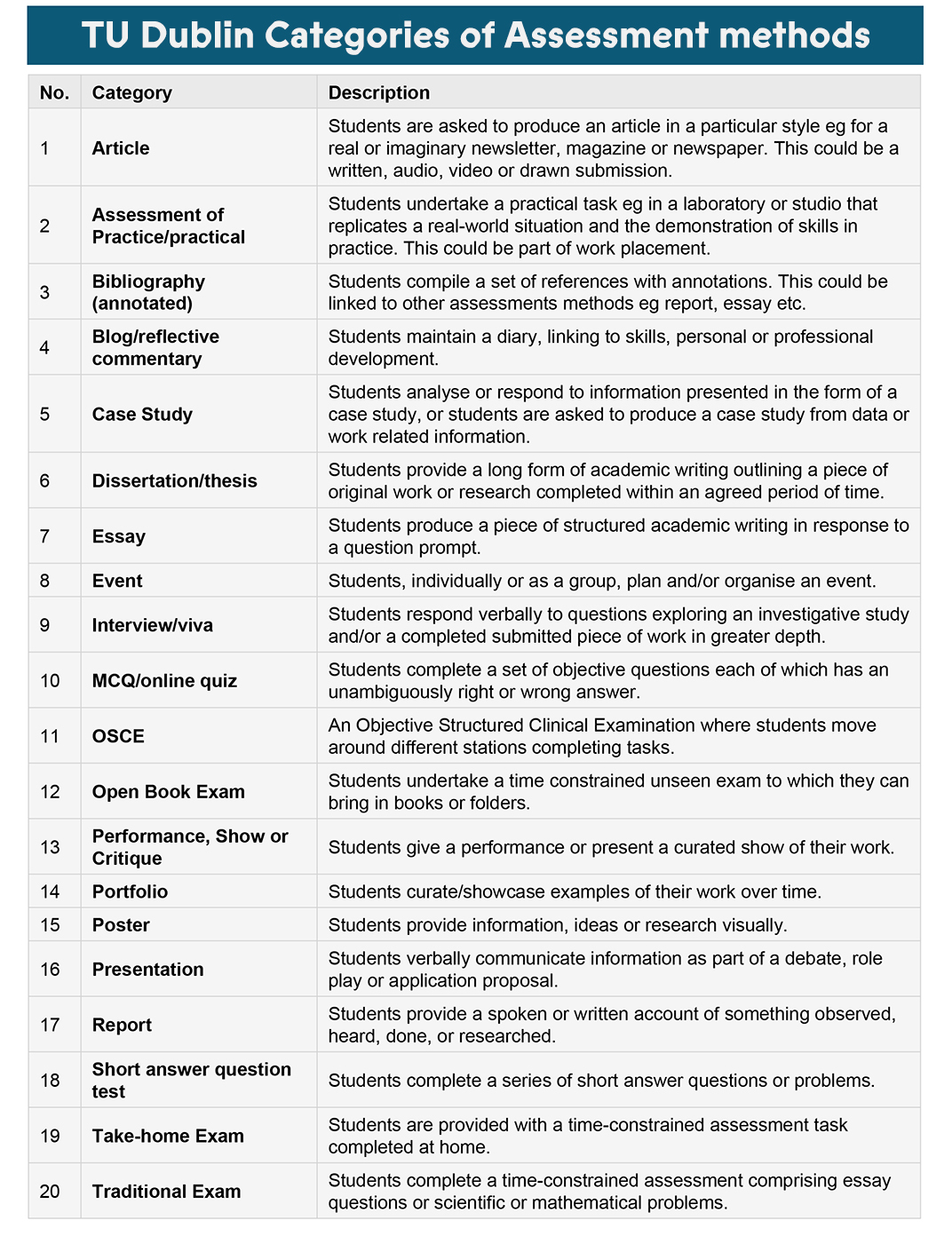
The information below provides a range of assessment methods to help you explore options and identify approaches appropriate to your context. It introduces the assessment method categories used in TU Dublin’s programme and module catalogue (Akari), alongside a compendium of assessment methods co-created with TU Dublin students. Together, these provide examples of different ways students can demonstrate their learning and a common framework for describing assessment, rather than an exhaustive list of possibilities. Assessment tasks may vary significantly in form and design within and across categories, depending on the specific learning context and intended outcomes.
The page also offers guidance on selecting assessment methods that are fit for purpose and appropriate to your context. It explores how assessment can be 'constructively aligned' with intended learning outcomes and informed by principles of good assessment practice, while considering factors such as authenticity, inclusivity, generative AI resilience and integration, and 'practicability' (workload and feasibility).
Note: The processes for making changes to approved modules at TU Dublin, including amending assessment methods, can be found on this page.
Reflect:
As you read through this page, use a current assessment as a reference point. Consider how well the assessment method(s) provide valid evidence of the intended learning outcomes and support the assessment's purpose. You might also reflect on whether alternative approaches could offer different opportunities for students to demonstrate their learning.
- Why am I assessing?
- What role should this assessment play in the learning process?
- When should the assessment occur?
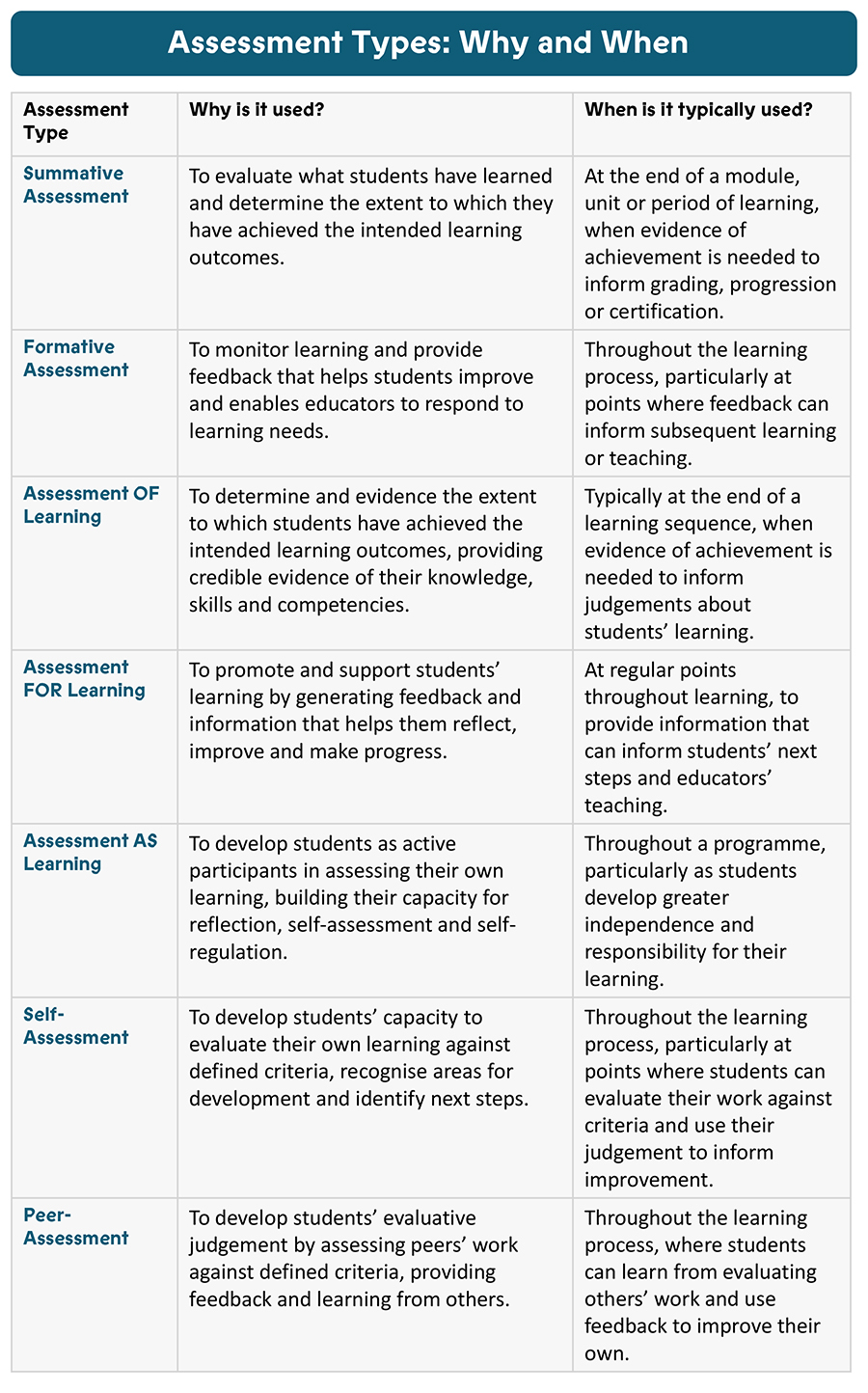
Reviewing this table, use a current assessment as a reference point and consider:
- Why are you assessing?
- When does the assessment take place in the learning process?
- What do you want students to learn from the assessment experience?
- Which assessment type(s) best matches that purpose
Read our guidance on Assessment Of, For, and AS Learning here.
Diversifying and Aligning Assessment
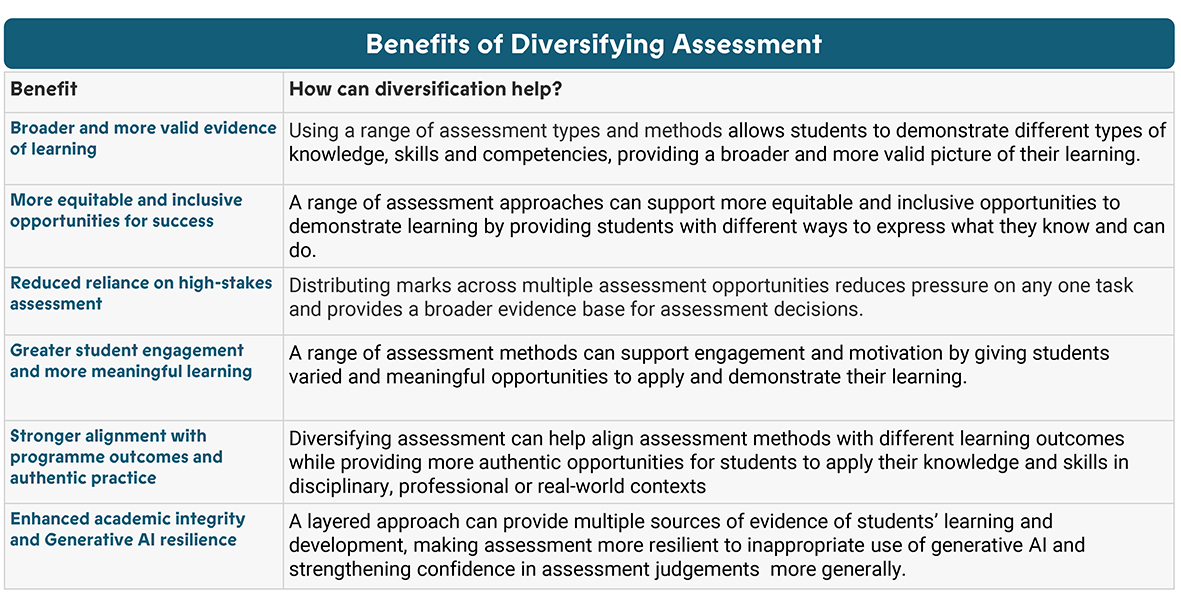
While diversifying assessment broadens the ways in which students can demonstrate learning, it is also useful to consider how different assessment activities work together to provide a richer picture of achievement. Sometimes described as a layered or ‘Swiss cheese’ approach, this involves students demonstrating their learning through multiple, connected assessments, each providing evidence of different aspects of knowledge, skills, or competence. Rather than relying on a single assessment task, a layered approach combines multiple sources of evidence to create a more complete picture of learning. In addition to strengthening validity, it can support academic integrity and increase resilience to inappropriate uses of generative AI by requiring students to demonstrate learning across different stages, formats, or contexts. Expand the Layered Assessment section below to learn more.
Diversification, however, is not an end in itself. The value of any assessment strategy depends on how effectively it supports and evidences the intended learning outcomes. This is where constructive alignment becomes important. Constructive alignment involves deliberately aligning learning outcomes, teaching and learning activities, and assessment tasks so that students have meaningful opportunities to develop and demonstrate the intended knowledge, skills, and competencies (Biggs & Tang, 2011).
Constructive alignment provides a framework for selecting assessment types and methods purposefully, and ensuring that assessment choices are driven by learning outcomes rather than by variety alone. Expand the Constructive Alignment section below to explore how this approach can support effective assessment design.
'Constructive alignment’, a concept from curriculum design, involves deliberately connecting intended learning outcomes, learning and teaching activities, and assessment, so that students have meaningful opportunities to develop and demonstrate the knowledge, skills, and competencies that matter most. From this perspective, assessment design starts with the learning students are expected to achieve, with assessment types and methods selected to provide appropriate evidence of those outcomes and support valued learning.
The goal is not simply to increase the range of assessment methods or innovate for its own sake, but to make deliberate choices about how students can best demonstrate their learning. Constructive alignment provides an important foundation for these decisions, but should be considered alongside broader principles of good assessment design. As outlined in our LTA Assessment Principles, assessment should be meaningful, educational, developmental, inclusive, trustworthy, and sustainable: supporting important learning, feedback and learner agency; providing equitable opportunities to demonstrate achievement; generating credible evidence; and remaining manageable for students and staff.
Together, constructive alignment and these principles provide a framework for purposeful assessment design, helping programme and module teams consider not only whether assessment aligns with learning outcomes, but also how well it supports meaningful learning, development, inclusion, academic integrity, and a sustainable learning experience. But coming back to the point:
What is 'Constructive Alignment'?
'In constructive alignment we systematically align the teaching/learning activities, as well as the assessment tasks, to the intended learning outcomes. This is done by requiring the students to engage the learning activities required in the outcomes' (Biggs and Tang, 2007, p. 11).
In simple terms, constructive alignment means making sure that what students are asked to do in their learning activities and assessments directly supports what they are supposed to learn. When designing assessment, constructive alignment implies that every assessment task should directly measure the intended learning outcomes and require students to demonstrate the knowledge or skills those outcomes describe. In other words, assessments should be purposefully designed to align with and support the learning you want students to achieve. 'Alignment' is a key concept in curriculum and instructional design that refers to the deliberate and coherent connection of learning outcomes, teaching methods, and assessments to facilitate effective student learning.
Reflection:
Thinking about the assessment strategy for one of your modules, consider:
- Are all learning outcomes being assessed appropriately, or are some over- or under-assessed?
- Do the assessment types and methods provide valid and meaningful evidence of your learning outcomes?
- Could other assessment types or methods enable students to demonstrate those outcomes more effectively?
- Do the assessments collectively provide a balanced and comprehensive picture of student achievement?
As you reflect, remember that constructive alignment is not about matching individual assessments to learning outcomes in a mechanical way. Rather, it involves considering how the assessment strategy as a whole supports meaningful learning and provides credible evidence that students have achieved the intended outcomes.
Misalignment Between Outcomes and Assessment
- The learning outcomes require learners to analyse, evaluate, or create, but the assessment tasks primarily test factual recall or reproduction of information.
-
An assessment task measures a narrow subset of the learning outcomes, leaving some important knowledge, skills, or competencies unassessed.
-
The learning outcomes emphasise practical or applied skills, but assessment relies exclusively on written examinations or essays.
-
Learners are expected to work collaboratively to complete an assessment task, but teamwork, collaboration, or group-working skills are not explicitly referenced in the learning outcomes.
-
Assessment places considerable emphasis on presentation, design, or technical skills that are not reflected in the learning outcomes or assessment criteria.
-
The assessment strategy includes multiple tasks that repeatedly assess the same outcome, while other outcomes receive little or no assessment attention.
Misalignment of Assessments and 'Teaching and Learning Activities'
It is worth remembering that misalignment is not always a problem of assessment tasks failing to match learning outcomes. Constructive alignment emphasises the relationship between learning outcomes, teaching and learning activities, and assessment, reminding us that students need meaningful opportunities to develop the knowledge, skills, and competencies that assessment subsequently asks them to demonstrate.
In practice, misalignment can occur when learners are assessed on forms of performance that they have had limited opportunity to develop, practise, or receive feedback on during the module. For example, students may be expected to undertake critical evaluation, professional judgement, collaboration, or authentic problem-solving in assessment, despite most learning activities focusing on content transmission or knowledge acquisition.
Reflection
Thinking about a the same module, consider the following:
-
How well do the teaching, learning activities, and assessment work together to support achievement of the learning outcomes?
- Do students have sufficient opportunities to develop and practise the knowledge, skills, and competencies that assessment requires them to demonstrate?
-
Are the teaching and learning activities (for example, lectures, discussions, workshops, labs, tutorials, projects, practice exercises, or other learning tasks students undertake) aligned with the kinds of thinking, performance, or application expected in the assessments?
-
Where do students receive feedback, guidance, or opportunities to improve before summative assessment?
Text
O’Neill, G., & Padden, L. (2022) Diversifying assessment methods:
Barriers, benefits and enablers, Innovations in Education and Teaching International, 59:4,
398-409, DOI: 10.1080/14703297.2021.1880462
Biggs, J., & Tang, C. (2011). Teaching for quality learning at university (4th;4; ed.). Open University Press (Tu Dublin Library ebook; see also 2022 5th edition physical copy)