
Principles of Good Assessment
Assessment is inherently complex and context-dependent. It serves multiple purposes that can sometimes pull in different directions, and no single model, theory, or framework can account for the diversity of disciplines, cohorts, and contexts found across a university like TU Dublin. That’s why our approach should be guided by principles, and not prescriptions.
A principle, in general terms, articulates fundamental ideas or values that guide judgement and decision-making, rather than specifying particular actions or methods. Assessment principles work in the same way: rather than prescribing a one-size-fits-all approach, they offer a flexible, evidence-informed framework for making sound educational judgments, keeping sight of the underlying purposes and values of assessment.
Drawing on contemporary scholarship and the insights, perspectives, and practices of those who teach, assess, and support learning across TU Dublin, TU Dublin has developed six principles to guide assessment and feedback.
Principles should not be considered a checklist to apply mechanically, or a prescription for how assessment must be designed. Instead, think of them as a shared language and reference point: something to support your professional judgement as you make thoughtful, context-sensitive decisions about what works best for your learners and your discipline. In practice, good assessment design means balancing principles in ways that suit the purpose of your assessment and the needs of your students.
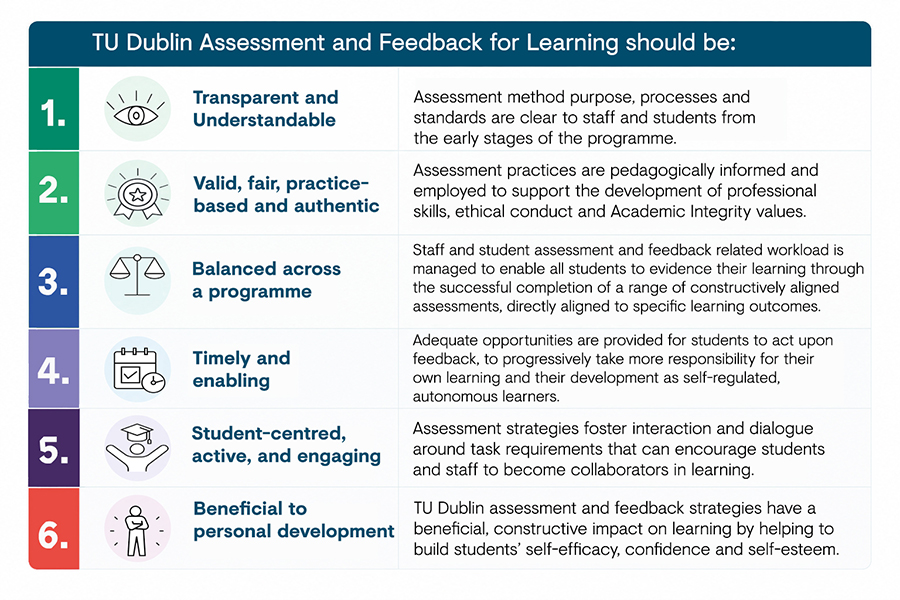
TU Dublin's principles of assessment and feedback for learning are:
- Transparent and understandable: Assessment method purpose, processes and standards are clear to staff and students from the early stages of the programme;
- Valid, fair, practice- based and authentic: Assessment practices are pedagogically informed and employed to support the development of professional skills, ethical conduct and Academic Integrity values;
- Balanced across a programme: Staff and student assessment and feedback related workload is managed to enable all students to evidence their learning through the successful completion of a range of constructively aligned assessments, directly aligned to specific learning outcomes;
- Timely and enabling: Adequate opportunities are provided for students to act upon feedback, to progressively take more responsibility for their own learning and their development as self-regulated, autonomous learners;
- Student centred, active and engaging: Assessment strategies foster interaction and dialogue around task requirements that can encourage students and staff to become collaborators in learning;
- Beneficial to personal development: TU Dublin assessment and feedback strategies have a beneficial, constructive impact on learning by helping to build students’ self-efficacy, confidence and self-esteem;
Use this self-check tool (TU Dublin Assessment Principles Reflection Activity) to reflect on an existing assessment against TU Dublin's six Assessment and Feedback Principles. It's not an audit; no assessment needs to embody every principle, and some may need balancing against others depending on your discipline, students, and learning outcomes. Work through the guiding questions and 'look-fors' for each principle, rating your assessment as strong, developing, or needing attention, then use your reflections to identify one or two priorities to focus on when you next review or redesign it.
- Wiliam, D. (2011). What is assessment for learning? Studies in Educational Evaluation, 37(1), 3-14. https://doi.org/10.1016/j.stueduc.2011.03.001
- Bloxham, S., & Boyd, P. (2007). Developing effective assessment in higher education: A practical guide. Open Univ Press. (Physical Book: TU Dublin Library)
- Technological University Dublin. (n.d.). Assessment principles. Retrieved August 1, 2026, from https://www.tudublin.ie/explore/about-the-university/academic-affairs/assessment-regulations/assessment-principles/
To explore Assessment and Feedback in more depth, sign up for our Assessment and Feedback micro-credential.