
Constructive Alignment
The concept of constructive alignment was developed by Professor John Biggs in the 1990’s. It is outlined in detail in his book Teaching for Quality Learning at University. Biggs explains that the constructive alignment concept was drawn from ideas proposed by Tyler (1949) who identified four key questions to prompt us to consider our practice as educators. These are (paraphrased):
- What educational purposes do we seek to attain?
- What educational experiences can be provided to attain these purposes?
- How can the educational experiences be effectively organised?
- How can we determine whether these purposes have been attained?
Constructive alignment is essentially a principle for teaching, learning and assessment that helps to operationalise the questions above and in so doing, helps us to improve our teaching, learning and assessment approach and the overall quality of students’ learning experience.
Before looking in a little more detail at constructive alignment in action, it is helpful to briefly explain its two components: Constructive and Alignment.
Constructive relates to constructivist theory which underpins this approach to designing learning. A constructivist approach to learning places a focus on what the student is doing to construct their knowledge and skills. As educators, this means that we are working to encourage students to be active participants in their learning, to make meaning from their learning and to connect what they are learning with their existing knowledge.
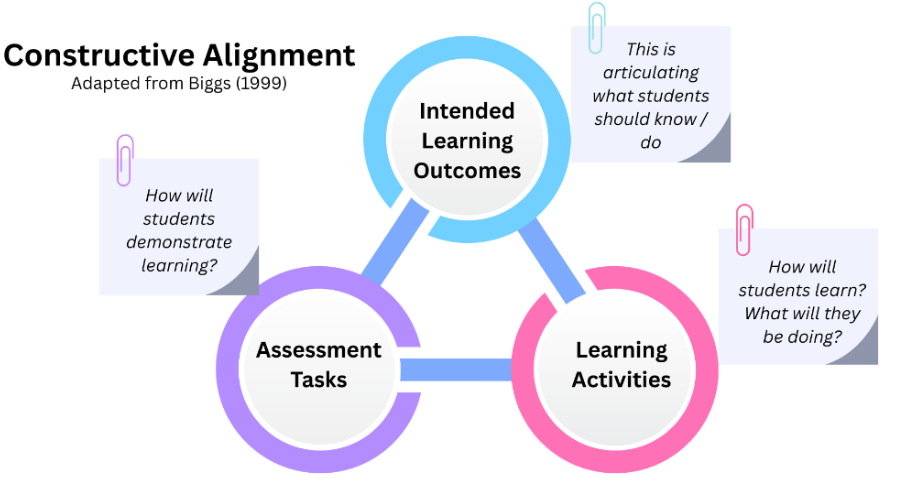
Alignment refers to a conscious effort to create clear connections between the intended learning outcomes with the assessment tasks and the learning activities within a programme or module. By enhancing alignment between the stated learning outcomes, the assessment tasks and learning materials and activities, we create a more integrated curriculum which can improve student engagement and learning.
The following diagram helps explain how the alignment is essentially about creating a deliberate and explicit relationship between the module’s learning outcomes, the delivery of the module and how it is assessed.
Biggs (2014) explains that constructive alignment is:
"a design for teaching in which what it is intended students should learn, and how they should express their learning, is clearly stated before teaching takes place".
There are a few phrases to pick out of Biggs’ quote here that provide useful insights into constructive alignment and how it applies to teaching in higher education.
"Design for teaching"
This sets out the expectation of deliberate planning of the learning that happens in a module. It means that the lecturer makes a conscious effort to specify clear learning outcomes and puts in place a plan for teaching and learning materials and activities to achieve these goals. Assessment is also part of the design, and the lecturer will consider how the student can demonstrate their achievement of the learning outcomes as part of the module design.
"What it is intended students should learn"
This reaffirms the importance of clearly defined and measurable intentions about what the student should learn. Biggs uses the term of Intended Learning Outcomes which should be set out for each module and then aligned to the assessment tasks and learning activities that take place. As part of Quality Assurance in universities, it is a requirement that all programmes and modules stipulate a set of intended learning outcomes (see also Learning Outcomes).
"Express their learning"
This essentially means how students demonstrate what they have learned and this is reflected in both formative and summative assessment tasks. The assessment tasks should align to the intended learning outcomes of the module, and students should be clear on how their assessment task(s) relate to the achievement of the learning outcomes.
"Clearly stated"
This is an important point that can often be partially neglected. The learning outcomes should be clearly set out as part of the design of the module, but they should be also clearly articulated and discussed with students. A key aspect of constructive alignment relates to improving transparency and clarity. Explaining learning outcomes and related assessment objectives and criteria helps students to navigate their learning and helps them optimise their chances of achieving the learning outcomes.
"Before teaching takes place"
This point loops back to the first note about intentional design and planning. Constructive alignment necessitates a pre-planning of modules. As a lecturer, it is good practice to be clear (before teaching takes place) about how you are connecting the intended learning outcomes, assessment tasks and the teaching & learning activities for your module ensuring that they relate to each other and support each other.
Alignment beyond the module
While the focus of constructive alignment is concerned with alignment between intended learning outcomes, assessment and learning activities, it is also good practice, as part of your advance planning and design, to consider alignment beyond the module confines too. This includes thinking about alignment to the programme learning outcomes, additional institutional frameworks (e.g. Graduate Attributes) and external standards such as the National Framework of Qualifications.
Leber et al. (2018) argue that a well-aligned learning environment fosters greater engagement and understanding among student while a course that is poorly aligned will result in diminished understanding a greater level of frustration.
With constructive alignment, the processes of teaching, learning and assessment are tied together and work in support of each other to deliver well-structured, coherent and meaningful modules.
Additional efforts to attend to constructive alignment can enhance the effectiveness of teaching, learning and assessment and ultimately support student success.
Biggs, John B. & Tang, Catherine (2011). Teaching for quality learning at university: What the student does. McGraw-Hill.
Biggs, John (2014). Constructive alignment in university teaching. HERDSA Review of Higher Education. 1: 5–22.
Leber, J., Renkl, A., Nückles, M., & Wäschle, K. (2018). When the type of assessment counteracts teaching for understanding. Learning: Research and Practice, 4(2), 161-179.
Tyler, R.W. (1949). Basic principles of curriculum and instruction. University of Chicago Press.
To explore Curriculum Design in more depth, sign up for our Curriculum Design micro-credential.
If you now designing a programmes, find out about our Programme Validation and Review workshops.