
What is Generative Artificial Intelligence (GenAI)
Teaching and Learning with AI: Making Informed Decisions
Over the past few years, academic staff in higher education have been exploring different ways of engaging with GenAI in teaching and learning. The SAMR model (Puentedura, 2006; ref. 2021) provides one useful lens for considering these different levels of engagement, from substitution, where technology replaces an existing practice with little change, through augmentation and modification, to redefinition, where technology enables new approaches that would not otherwise be possible. Across disciplines, a wide range of practices and experiences have emerged, with varying outcomes and implications for learning.
Emerging research (OECD, 2026) highlights a critical tension in the use of GenAI for teaching and learning. On the one hand, GenAI can enable and enhance learning experiences, for example through scaffolding, feedback, explanation and interactive learning activities. On the other, its use may encourage cognitive offloading and, when poorly designed or over-relied upon, may limit opportunities for students to develop critical thinking, reasoning, problem-solving and creativity. The educational value of GenAI therefore depends not simply on what the technology can do, but on how, why and in what context it is used. Used thoughtfully, it may support learning; used without sufficient consideration, it may undermine some of the very cognitive and creative capacities that education seeks to develop. This makes critical evaluation and pedagogical judgement essential when deciding whether and how GenAI should be used.
Making informed decisions about using GenAI within each discipline is a continuous process of evaluating, adapting and, where appropriate, endorsing practice, rather than a one-way decision. It is a flexible, responsive and evolving process, informed by evidence, context and experience.
On this page, we will explore how to:
- Critically evaluate and apply structured, GenAI-informed teaching and learning approaches that support disciplinary pedagogy
- Design and justify evidence-informed approaches to engaging with GenAI within your discipline.
- Reflect on and evaluate the impact of GenAI on teaching and disciplinary practice from ethical, responsible and environmental perspectives.
Any decision about whether and how to use GenAI in teaching and learning should begin with pedagogy and disciplinary context rather than the technology itself. Consideration of GenAI should be grounded in a clear understanding of what students are expected to learn, the needs of learners, and the kinds of knowledge, skills, and ways of thinking that the discipline seeks to develop. From this starting point, educators can evaluate whether GenAI has the potential to meaningfully support learning, enrich the student experience, or help achieve intended learning outcomes. When its use is pedagogically justified, GenAI should be integrated through thoughtful learning design and aligned with established educational principles. Where this rationale is unclear, its use may offer limited educational value and, in some cases, reduce opportunities for students to engage in the cognitive and creative processes that support learning.
A critical aspect of engaging with GenAI in teaching and learning is the deliberate design of authentic contexts, scenarios and disciplinary challenges aligned with the intended learning outcomes. These contexts can deepen reasoning and require students to identify, interpret and evaluate nuance, applying their knowledge in meaningful situations. In doing so, they reinforce the importance of human thinking and judgement, capacities that AI tools cannot fully replicate.
It is also important to distinguish between successful task completion and evidence of learning. Emerging research suggests that strong performance with AI support does not necessarily demonstrate learning (OECD, 2026). Students may complete a task, receive convincing explanations or feel more confident while having had limited opportunities for independent reasoning, reflection or knowledge construction.
When considering GenAI, ask not only
- Does it help students complete the task?
but
- Does it help students develop what they need to learn?
This keeps pedagogical and disciplinary purpose at the centre of decisions about when and how GenAI is used.
Bloom's Taxonomy Revisited
A useful starting point for considering the role of GenAI in teaching and learning is Bloom's Taxonomy, a framework that categorises learning according to increasing levels of cognitive complexity, from remembering and understanding through to analysing, evaluating, and creating. Drawing on this framework, Oregon State University has developed an adapted model that distinguishes AI capabilities from human skills, helping educators identify where GenAI may support learning and where student engagement in cognitive processes remains important. The model can be used to evaluate the alignment between intended learning outcomes, disciplinary expectations, and decisions about engaging with GenAI.
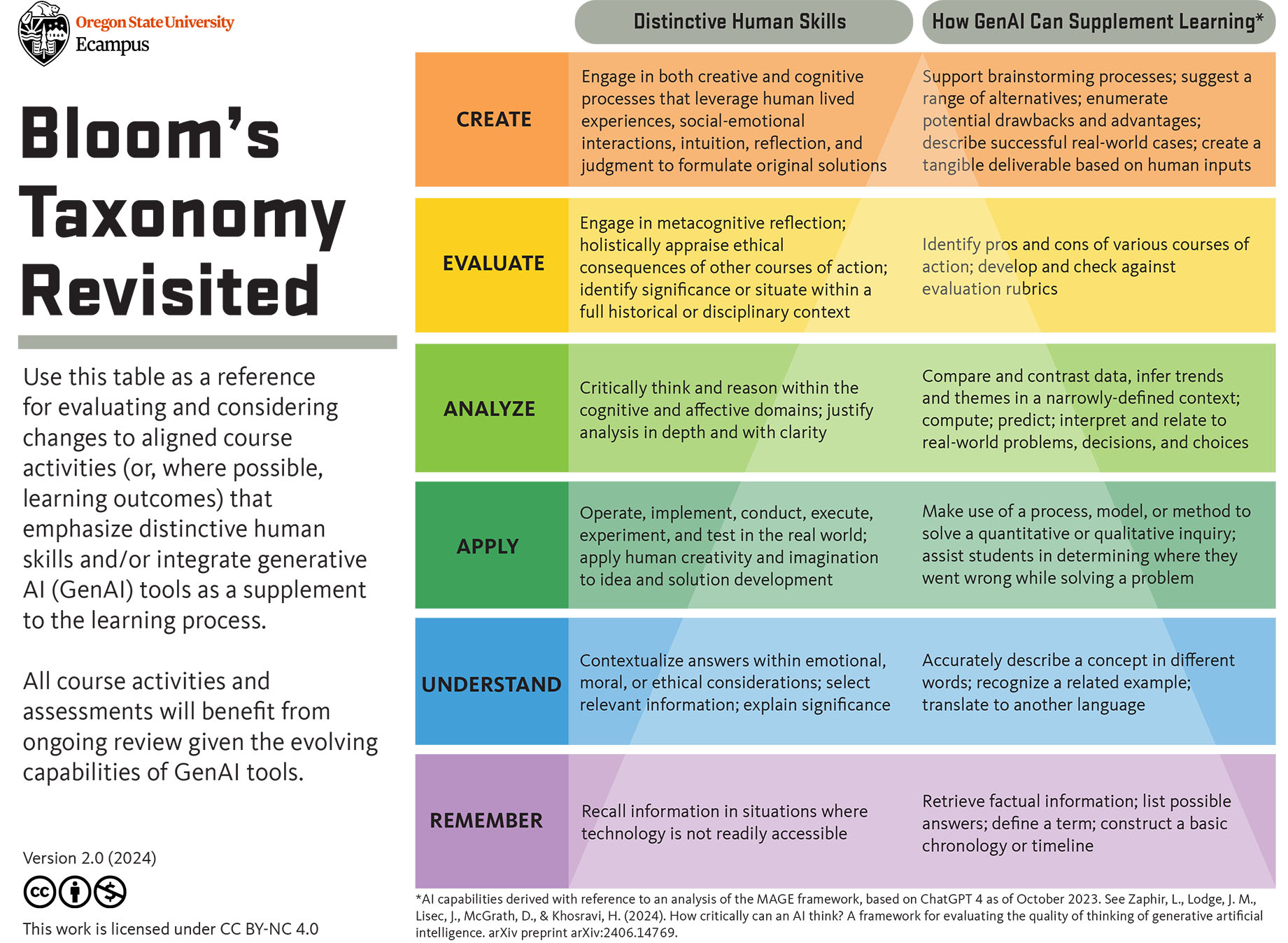
Bloom's Taxonomy Revisited. Oregon State University Ecampus. Licensed under CC BY-NC 4.0 (https://creativecommons.org/licenses/by-nc/4.0/). Used with attribution.
Oregon State University’s Bloom’s Taxonomy Revisited offers a useful starting point for thinking about how GenAI may change the relationship between learning activities, assessment and the skills we want students to develop. This also provides an opportunity to revisit alignment: are our learning outcomes, learning activities and assessments working together to support the learning we value? Explore our Assessment Guidance and Curriculum Design Guidance for ideas and practical approaches to designing learning experiences and assessment that keep learning at the centre.
While frameworks such as Bloom's Taxonomy can help academics consider where and how GenAI may support learning, decisions about its use cannot be separated from disciplinary context. Different disciplines value different forms of knowledge, ways of thinking, professional practices, and approaches to inquiry. As a result, the educational opportunities, risks, and appropriate uses of GenAI are likely to vary across fields of study.
When planning a teaching and learning experience, it is important to consider how learning outcomes, students’ needs and disciplinary requirements align. This is particularly important when considering the role of GenAI, as each discipline has its own ways of understanding and explaining the world. Disciplines develop distinctive forms of knowledge, inquiry and professional identity, shaped by their conceptual, epistemological, social, material and moral dimensions (Quinlan, 2021). A discipline-contextualised approach therefore provides an important basis for considering whether, when and how GenAI might be used. Its potential benefits, risks and appropriate uses will vary according to the knowledge, practices, challenges and goals of different disciplines. There is, therefore, no single framework or approach that will work equally well across all disciplines.
Academic staff are encouraged to explore, experiment, evaluate and make informed decisions about what is appropriate within their disciplinary context, and what is not. These decisions should be revisited periodically as technologies, practices and our understanding of their impact continue to evolve. This ongoing, collaborative approach can also help address a concern identified by the QAA (2026): that uneven and inconsistent use of GenAI within the same programme can undermine quality, trust and the student learning experience.
For this reason, ongoing, reflective conversations within schools and programmes are essential. The LTA team can support these conversations through tailored workshops exploring the opportunities, challenges and appropriate uses of GenAI in your disciplinary and teaching context.
If you would like to explore a workshop for your school or programme, please get in touch with ana.schalk@tudublin.ie.
Whatever the discipline, it is important to recognise that GenAI tools such as ChatGPT, Gemini and Copilot are not designed specifically for academic or educational contexts. Their outputs are not inherently fact-checked or reliable, and may contain inaccuracies, omissions or biases arising from their training data. Academic staff and students should therefore critically evaluate AI-generated content and use trusted, discipline-specific sources to verify information.
The HEA national policy framework positions AI use in higher education as a matter of:
- pedagogical and professional judgement, rather than simply technical capability,
- academic freedom, disciplinary context, and educator agency.
Across disciplines, the focus should remain on what students are expected to know, understand and be able to do. GenAI can support students in developing these capabilities, but should not replace the thinking, practice and learning needed to achieve them.
The SAMR model (substitution, augmentation, modification and redefinition) (Puentedura, 2006) provides one way of considering levels of technology engagement. In the context of GenAI, this can be used flexibly to consider not only what the technology enables, but its impact on learning processes such as reasoning, critical thinking and creativity. Emerging work also suggests considering a second dimension: whether the impact of GenAI on learning is positive, supporting critical thinking, learner agency, human connection and creativity, or negative, through cognitive offloading, isolation or standardisation (Saraf et al., 2026).
Academic staff are encouraged to use reflective practice to consider why, when and whether to engage with GenAI, grounding decisions in both pedagogical principles and disciplinary knowledge.
TU Dublin’s Guidelines on the Responsible Use of GenAI in Teaching and Learning recommend the AI Assessment Scale (AIAS) as a useful framework for communicating and clarifying expectations around GenAI use in assessment. However, the AIAS is one of many frameworks available to support thoughtful engagement with GenAI in education.
The frameworks below offer different perspectives and practical approaches, from supporting intentional AI use and reducing cognitive offloading to developing AI fluency and exploring creative applications in teaching. They can be used as starting points for reflection and discussion, helping you consider what might be useful and appropriate within your own disciplinary and educational context.
- PAIR (Problem, AI, Interaction, Reflection) Framework , which promotes an intentional and right balance that is required to provide students with guidance and structure on how to use AI through a flexible and adaptable structure that facilitates informed decisions through disciplinary critical thinking.
- Resistance as a Framework for Combating Cognitive Offload (Furze, L.), which encourages students to self-regulate their learning, or teaching staff to apply positive friction to trigger student engagement and motivation.
- 4 D AI Fluency Framework (Dakan & Feller). This framework facilitates the development of four key AI Literacy skills: Delegation, Description, Discernment, and Diligence in academic staff and students for ethical and responsible use of GenAI.
- 13 ways to integrate AI in your teaching (Compton, M), offers creative ways of using AI to support your teaching practice in an ethical and responsible manner.
Building on these pedagogically and discipline-grounded approaches, the ideas below offer practical ways to design teaching and learning experiences with GenAI.
Underpin your engagement with GenAI with Learning Theories:
Learning Design is critical to achieve positive impacts of GenAI in teaching and learning. Theories such as social constructivism can underpin the reconceptualisation of GenAI as an active co-learner (Fang & Zhou, 2025) or the Sociocultural learning theory (Vygotsky) to develop a framework to facilitate students effective task allocation with GenAI based on Zone of Proximal Development and Metacognition (SCAN, Tsim & Gutoreva. 2026).
Plan interactive teaching and learning methods:
Artificial Intelligence and GenAI improve engagement and learning only when embedded in interactive teaching methods such as flipped classrooms, and Problem-Based Learning among others (Long et al., 2026).
When used Scaffolding and Socratic models to interact with GenAI tools as tutor or co-designer, not as an autonomous instructor (Abedin, et al., 2026) enable and enrich learning experiences and outcomes.
Design your learning experiences in a way that the learning is mediated by the teacher and not the tool itself.
GenAI and Universal Learning Design (UDL)
GenAI can be used to generate different ways of representation of the same content (visual, audio, text), increasing inclusion, and student engagement. Moreover, GenAI integrated into other Digital Learning Tools increases avenues and opportunities for student engagement, representation, action, and expression (Rappa & Nonis, 2026)
CAST has developed their 5 principles to support intentional use of GenAI through UDL and the SEE Framework Mindsets as detailed below:
- Be intentional
- Stay Critical
- Be Transparent
- Act Responsibly
- Keep Learning
Even if these principles are in the context of Universal Design Learning, it is evident that each of them is key for all academic staff and students.
Ideas to Use GenAI in your teaching and learning practices:
Below are listed some common uses of GenAI that may support academic staff in their practice:
- Taking notes during group work discussions
- Systematise information
- Generate learning activities
- Co-create teaching materials in different formats, following copyright regulations, including materials with Creative Commons Licenses, when includes authors’ attribution and other specific terms of the licenses. To learn more, see the Resources section below.
- Create professional context to prepare your students for future professional situations
- Create Case Studies and to support collaborative learning
- Generate complex questions that encourage critical thinking and problem-solving
- Simulate real-life scenarios that cannot be practiced otherwise to enhance a comprehensive learning approach.
- For online or hybrid courses: create engaging asynchronous e-learning activities, such as chatbots, discussions, and quizzes.
- For translations.
- As a proofreader.
Any of these uses should be overseen, evaluated, and amended for accuracy if necessary. At any stage, GenAI outputs should not be used without human intervention. GenAI use in teaching and learning should be explicitly acknowledged.
Prompting, a core skill for effective use of GenAI:
In simple words, a prompt is called the instruction that users write in a GenAI tool, such as Microsoft Copilot Chat, to achieve specific or desired outcomes. Prompting Engineering is called the process of redefining, tuning, and improving the quality, relevance, and accuracy of their outputs or responses (Gordon, D). This process is considered a new AI Literacy skill. Effectively prompting has an impact on the quality of the outputs, but also on the process of interacting with the tool, and finally, on the environment (the fewer prompts used to achieve a desired response; the less environmental impact is made). However, this new skill needs to be developed.
The first step suggested is to ‘think before prompting’. Clarify user’s objectives or purpose using a GenAI tool and write down some ideas regarding how to achieve your results. Create two or three instructions as possibilities to interact with the tool. Determine and evaluate what is the best instruction to use based on the four stages proposed by Park and Choo (2024):
- (PARTS) Design the prompt: clarify role, goal, audience, tone, and format
- (CLEAR) Write effectively: be concise, logical, explicit, adaptive, and focused
- (REFINE) Iterate and refine by testing, adjusting, and verifying outputs
Academic staff should be responsible for applying critical judgement and accountability to their interactions, adding a statement acknowledging GenAI use (Diligence skill).
Develop your AI Literacy skills
To enable academic staff to make informed decisions regarding using GenAI and AI in their teaching practices, a wide variety of formal, non-formal and informal professional development instances are part of the 2026-2029 plan. All academic staff are encouraged to develop their AI Literacy skills, familiarise with these tools, and stay informed about GenAI developments. Join relevant events and spaces where GenAI in teaching and learning is discussed. Share, reflect on, and actively participate in shaping appropriate GenAI uses in teaching and learning practices using supported GenAI tools in TU Dublin (Copilot Chat as part of the Microsoft 365 Suite).
Important Note:
The LTA welcomes opportunities to collaborate with institutional, national, and international partners to share experiences, generate knowledge, and identify effective practices for the use of GenAI in teaching and learning. This work is grounded in a human-centred, critical, ethical, pedagogical, and discipline-informed approach to educational innovation. For further information or to discuss potential collaboration, please contact ana.schalk@tudublin.ie.
Navigating this Section
This section is comprised of x topics...
Reflection
Having considered the ideas and approaches contained on this guidance page, use the prompts below to reflect on what a pedagogically grounded and discipline-specific approach to AI might mean for your own teaching and learning context. Consider whether, when and how GenAI might add value, and where it may not be appropriate.
Based on what you have read, consider:
- How could you participate in meaningful and safe conversations about the challenges, complexities and potential of AI use within your module, programme and school?
- What might pedagogically and discipline-grounded use of GenAI look like in your teaching practice?
- How could you align the use of AI with the intended learning outcomes in your teaching practice?
- What forms of AI-supported teaching might foster deep rather than surface learning in your discipline and module?
- Why is it important for students to have discipline-grounded learning experiences with GenAI?