
Communicating with students about GenAI
Developing students’ AI literacy is an ongoing process that requires clear communication, accessible guidance, meaningful exemplars, and o pportunities for contextualised and evolving practice. AI Literacy is not only about teaching students how to use generative AI (GenAI) tools; it is about helping them develop the knowledge, judgement, confidence, and critical awareness to use these technologies appropriately within their discipline and future workplace.
A pedagogically sound, discipline-grounded approach to GenAI in teaching, learning, and assessment therefore starts from a student-centred perspective. Learners need to understand not only what GenAI can do, but also:
- When and why its use is appropriate
- How to evaluate its outputs
- How to communicate their use of AI transparently
- What responsible AI use looks like in professional contexts.
A key framework for making decisions about GenAI in assessment, and for communicating and discussing expectations with students, is the Artificial Intelligence Assessment Scale (AIAS) which is embedded in the University guidelines. Further information on using the scale can be found on the GenAI and Assessment page.
The guidance below has been designed to support you to:
- Communicate effectively with students about the use and implications of GenAI in teaching, learning, and assessment.
- Contribute to a progressive, scaffolded approach to developing students’ AI literacy across their programme.
From the student perspective, usefulness and practicality are key motivations for engaging with GenAI in higher education (Chung et al., 2026). At the same time, students report concerns about the accuracy of GenAI outputs and varying levels of confidence in using these tools to support their academic work. Importantly, research has also found that many students develop their understanding of GenAI through self-directed and informal experiences.
This highlights an important opportunity for educators. Rather than leaving students to navigate GenAI use independently, learning and assessment experiences can provide intentional, visible, and clearly guided opportunities to develop AI literacy in context. This means:
- Intentional: clearly linking any use of GenAI to the learning outcomes and the purpose of the task. Students should understand why GenAI is being used and what they are expected to learn through the process.
- Visible: making the use of GenAI and the thinking around it part of the learning activity. Routines such as Think-Pair-Share, discussion, reflection, or Socratic dialogue can help students articulate the purpose, process, and outcomes of their engagement with GenAI.
- Clearly guided: providing discipline- and module-specific examples of appropriate and inappropriate uses of GenAI, alongside a clear rationale. This helps students understand not only what is expected of them, but why particular approaches are appropriate in a given context.
These approaches support a human-centred and ethical approach to GenAI, where the technology is considered in relation to learning rather than as an end in itself. They also help develop students’ capacity to question, evaluate, and critically engage with AI-generated content, rather than accepting it at face value (UNESCO, 2023).
Reflection
- If GenAI is used in a learning activity or assessment, is its purpose clear to students, and is its use meaningfully aligned with the learning outcomes?
- Do students have opportunities to discuss, reflect on, or explain how they have used GenAI? and, where relevant, critically evaluate its outputs?
- Have I provided clear, discipline-specific examples of when GenAI use is appropriate, inappropriate, or requires caution?
AI literacy is most meaningful when students can develop and apply it within the context of their discipline. A discipline-grounded approach to GenAI helps students build not only technical skills, but also the knowledge, critical judgement, and ethical awareness needed to engage with AI in ways that are appropriate to their field of study.
Through purposeful communication and learning activities, students can learn to apply, question, evaluate, and critically interrogate GenAI-generated content against the knowledge, practices, standards, and ethical expectations of their discipline. This is an important part of developing AI literacy: understanding that there is not always one answer to whether or how GenAI should be used. What is appropriate may depend on the discipline, the learning context, the task, and the purpose of the activity. Developing this understanding progressively can help students become more confident, critical, and responsible users of GenAI as learners, professionals, and citizens.
The impact of GenAI on the academic integrity of assessment is one of the key concerns associated with its use in higher education Academic integrity concerns may arise through both intentional and unintentional misuse, highlighting the importance of ensuring that students understand not only the rules, but also the principles and values that underpin them. Students need clear and consistent opportunities to develop their understanding of academic integrity and to apply these principles in different learning and assessment contexts. This requires a sustained and systematic approach across modules, programmes, and the institution, rather than relying on students to develop this understanding independently.
As part of this approach, TU Dublin encourages all students to complete the Academic Integrity module available on Brightspace before starting their semester. This provides an important foundation that can then be reinforced and contextualised through discipline- and module-specific learning activities and communication (Learners can find this module in the 'training' tab in Brightspace).
Clear expectations about GenAI use are essential. These expectations should be discussed openly between academic staff and students and contextualised within the discipline, module, and specific learning or assessment activity. This conversation should begin during induction and be revisited and reinforced throughout students’ programmes and modules, so that expectations remain clear as their learning and use of GenAI develop.
Some key questions to consider include:
- What does responsible and effective use of GenAI look like in my discipline? And how do we model this for learners?
- What does an AI-literate graduate look like in our discipline or profession?
- How can we ensure students have consistent opportunities across modules to develop critical understandings of GenAI use within their discipline?
- What conversations do we need to have as colleagues and teams to ensure our decisions and communications about GenAI reflect our educational values and disciplinary priorities?
Conversations about Generative AI should be guided by TU Dublin's Principles Underpinning the Use of AI and GenAI in TU Dublin, which apply to both students and staff.
These principles form part of the University's Guidelines on the Responsible use of Generative Artificial Intelligence in Teaching, Learning, Assessment, and Feedback.
These principles emphasise that the use of AI should be informed, transparent, authorised where required, appropriately acknowledged, aligned with academic integrity requirements, and undertaken with an awareness that responsibility for the accuracy, quality, and ethical implications of any AI-supported work ultimately remains with the user.
| Principle | For Learners | |
|---|---|---|
| 1. | Students should familiarise themselves with the capabilities and limitations of any Generative AI tool or system they propose to use, including changes that may emerge as part of a review of new product iterations, particularly those that may impact data privacy and copyright. |
Understand the tool before they us it. |
| 2. | To support academic integrity, GenAI can only be used by students in ways that are approved in advance by their lecturer. To support this, lecturers will clearly communicate to students about the ways in which AI can be used (in accordance with an appropriate scale such as the AI assessment scale). The University will provide guidance to lecturers regarding the format and content of these communications. | Always follow the guidance for their assessment. |
| 3. | The approved use of artificial intelligence systems and/or generative models are transparent and they are appropriately cited as set out in library guidelines. For citation and referencing guidelines, please consult the relevant Faculty and the AI Guidance Note available in the Referencing LibGuides from Library Services. | Be transparent about how they use AI |
| 4. | Recording the use of GenAI in an assessment will be in accordance with assessment guidelines and disciplinary conventions, which may require addition of details of how the system was used, in text citations or a combination of both. | Record how they use AI |
| 5. | From the perspective of how this is included in the output, this should be considered equivalent to other method-related details such as systematic search strategies, statistical and data analysis, image processing etc. This includes the use of any system that amends text beyond simple spelling and grammar checks | Clearly document their work as part of their submission. |
| 6. | Failure to adhere to these guidelines or the inappropriate use of AI, as determined by the relevant Faculty, may result in disciplinary action as it is a breach of academic integrity. | Understand the consequences of inappropriate use. |
| 7. | Where specific prompts or other initial/seed inputs are used, these should be used in line with the University’s Artificial Intelligence Information Security Policy (when commenced). | Protect information and data |
| 8. | Students accept that they are wholly responsible for ensuring the veracity, accuracy and/or creative merit of the output generated by any artificial intelligence model. In addition, they assume responsibility for assessing the potential for falsification, fabrication and plagiarism because of any use of generative artificial intelligence systems/models. | Take responsibility for their work. |
 The Artificial Intelligence Driving License (AIDL) is a learner-focused resource designed to support AI literacy and responsible, ethical use in a positive, accessible, and practical way. Aligned with TU Dublin’s principles for the responsible use of GenAI, it aims to help learners develop the knowledge, confidence, and critical judgement needed to make informed and ethical choices about AI.
It is loosely modelled, both visually and conceptually, on a driving theory test and based on a set of guiding principles or 'rules of the road' that learners should learn to apply situationally, using their own judgement. The 'test' presents students with authentic academic scenarios involving the potential for AI use, and asks them to reflect on matters such as:
- What counts as appropriate assistance?
- Where does collaboration become misconduct?
- And what are you losing with over-reliance on GenAI?
Learners work through these scenarios through a sequence of multiple choice questions to 'earn their license'. These scenarios cover three broad areas including:
- Gen AI for Learning: using GenAI tools in ways that support meaningful learning
- Using AI with Integrity: acting with honesty, trust, fairness, and responsibility
- Broader AI Ethics: e.g. sustainability, accuracy and bias, privacy, and copyright etc.
To date, over one thousand learners have completed the AIDL by accessing it through the 'training' tab in Brightspace, though lecturers can also request for the tool to be directly integrated into their modules. To do so, please contact Learning Teaching Assessment (LTA).
Each of the fourteen scenarios that make up the AIDL is underpinned by a specific 'rule of the road' in which driving and road safety metaphors abound! They cover areas like academic integrity and transparency, compliance with assessment expectations and regulations, critical engagement with AI outputs, maintaining learner agency and authorship, ethical and responsible use of data and systems, and developing AI literacy and capability. Here is a table detailing the 'Rules of the Road' in simplified form.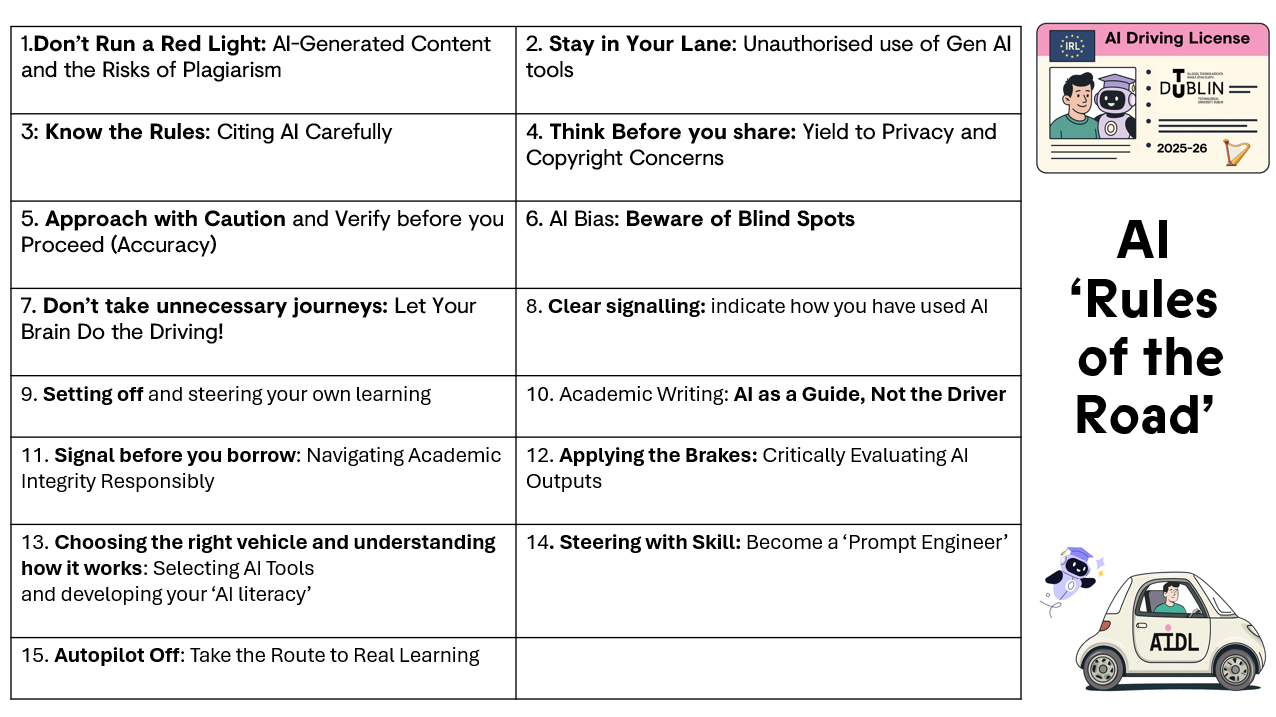
This section brings together a selection of resources developed by academic staff at TU Dublin to support students’ AI literacy and promote clear, meaningful communication about GenAI. These resources can be used as they are or adapted to suit different disciplinary, programme, and student contexts.
AI Literacy Slide-decks for TU Dublin Learners
Developed by Damian Gordon and Markus Hoffman from the Faculty of Computing, Digital and Data, this set of presentations has been designed to support the initial development of AI literacy among first-year students as part of the School’s induction process. Their approach provides a useful example of how communication about GenAI can be introduced early in the student journey and embedded within a disciplinary context.
Other schools and disciplines may wish to adapt these materials and approaches to reflect their own subject areas and programme needs. However, induction should be seen as a starting point rather than a one-off intervention. Students’ AI literacy and understanding of GenAI need to be developed and reinforced over time, through continued communication and learning opportunities across modules, semesters, and the wider programme.
- 1. Student Orientation in the Use of GenAI for Learning
- 2 What is GenAI?
- 3 What is Prompting?
- 4 Using GenAI for Learning
- 5 Ethics Careers and the Future
These slide decks are available under a CC BY-NC-SA licence. You may copy, reuse, and adapt them with attribution, for non-commercial purposes, and any adaptations must be shared under the same licence.