
Generative AI and Assessment
The Learning Teaching Assessment (LTA) team at TU Dublin takes a human-centred approach to GenAI that puts pedagogy and the needs of learners first. We view GenAI as an enabler that can support educational goals and potentially extend human capabilities, while recognising that human intelligence, judgement, critical thinking and creativity remain central to educational practice. Decisions about the use of GenAI should therefore always begin with a critical consideration of why, whether, and under what conditions these technologies might meaningfully contribute to the achievement of learning outcomes or enhance the learner experience, including whether their use is appropriate or necessary in the first place. At all times, staff who teach at TU Dublin should be guided by our Guidelines on the Responsible use of Generative AI in Teaching, Learning and Assessment.
On this page, you will find information about different approaches to AI and assessment, the AI Assessment Scale, and GenAI, assessment and academic integrity. For further guidance on the human-centred, pedagogically grounded approach outlined above, and resources to support the critical evaluation of GenAI in your teaching practice, please visit our GenAI guidance pages. These pages include guidance on communicating with learners about GenAI, as well as information about relevant institutional policies, available supports and CPD opportunities.
The emergence of generative AI has prompted widespread debate about the future of assessment. While concerns about academic integrity often dominate discussion, the challenge is broader than preventing inappropriate AI use. It encompasses questions of assessment validity, authenticity, equity, workload, skills development, professional preparation, and trust in qualifications. Recent work by Corbin and colleagues (2025) suggests that the assessment challenges associated with GenAI may be best understood as a ‘wicked’ problem: the nature of the challenge may look different from one perspective to another, no single solution will work in every context, and new challenges and possible responses will continue to emerge as the technology evolves.
The GenAI assessment challenge can be viewed through a variety of lenses. The table below outlines some of the most common framings.
| Main Concern | Questions to Consider |
|---|---|
| Academic Integrity | How can I protect the integrity of my assessment and respond to inappropriate AI use? |
| Learning & Assessment | How can I ensure my assessment supports learning while still providing meaningful evidence of what students know, understand and can do, given the availability of GenAI? |
| Learning & Skills Development | If I allow for, or explicitly integrate AI, in my assessments, what knowledge, skills and capabilities might students develop, or fail to develop, as a result? |
| Skills & Employability | How can my assessment prepare students to use and critically engage with GenAI in their future lives and work? |
| Equity and Fairness | How can I ensure that my approach to GenAI does not advantage or disadvantage particular learners? |
| Practicability & Workload | Can I manage the additional demands of addressing, monitoring or reviewing GenAI use in a sustainable way? |
In practice, many lecturers will recognise elements of several of these perspectives in their own work. While they may point towards different responses, there is rarely a single solution that resolves every concern. Instead, assessment design involves making professional judgements that balance educational goals, learner needs, disciplinary values, and practical realities. Framing the Gen-AI Assessment challenge in this way is helpful because it removes the expectation that educators must immediately find the perfect solution. As Corbin et al. note, no single assessment method, policy, or institutional response can be expected to address the GenAI assessment challenge fully or permanently. Instead, effective responses are likely to be context-sensitive, informed by disciplinary values, and continually adapted as technologies and educational practices evolve. The goal is not to "solve" GenAI once and for all, but to make thoughtful, evidence-informed decisions that support learning while maintaining confidence in assessment and academic standards. This may feel like a difficult landscape to navigate, but a clear focus on learning, context and purpose can help guide decisions.
GenAI Assessment Challenge Podcast
If you would like to learn more about the 'Gen AI Assessment Challenge', you can listen to the first episode of our 'LTA in Conversation' Podcast' ( by clicking on the image below) in which Derek Dodd is joined by Damian Gordon, Lecturer in Computer Science, and Róisín Guilfoyle, Research Librarian, for a wide-ranging discussion on the challenges Generative AI presents for teaching and learning in higher education, with a particular focus on assessment design, integrity, and validity.
Questions about AI in assessment are often easier to address once there is clarity about the learning our assessments are intended to evidence. So, it can be helpful to start with the following questions:
- What learning is this assessment intended to provide evidence of?
- What do we want students to know, understand, do or demonstrate?
- Which knowledge, skills, capabilities or attributes are most important?
- What would convincing evidence of that learning look like?
While these questions may seem obvious, being clear about the learning we intend to evidence is an important first step in considering whether and how GenAI might affect the assessment. This provides a basis for making intentional, pedagogically grounded decisions about GenAI: whether and how it should be used, what uses might support learning, and where its use might undermine the learning the assessment is intended to evidence.
Certain features of an assessment, such as the type of task, how evidence of learning is elicited, and the conditions under which it is completed, may make it more vulnerable to AI substituting for the thinking, practice or skill development it is intended to support. Vulnerability can arise both when expectations around AI use are unclear or difficult to enforce, and where its use is permitted or deliberately integrated in ways that have unintended consequences for learning.
To help us reflect on how GenAI might influence student learning in different assessment contexts, the glossary below introduces some concepts that can help us identify and think through these effects. These concepts are not all inherently positive or negative. Their significance depends on the learning students are expected to develop and demonstrate, and the conditions under which assessment takes place. Whether GenAI use is authorised or unauthorised, consider how it might affect student performance, learner engagement, and the evidence on which judgements about learning are based.
| Term | Definition | Questions to consider when designing assessments |
|---|---|---|
| AI Substitution | When AI does a task that a person would previously have done themselves. | If AI performs some or all of a task, whether authorised or unauthorised, does the assessment still measure the intended knowledge, skill or capability? |
| AI Augmentation | When AI helps a person perform a task better, faster, or more effectively, while the person remains responsible for the thinking, decisions, and final outcome. | Could AI use improve the quality of performance while still providing valid evidence of the intended learning? Might some forms of apparent augmentation actually substitute for, or reduce opportunities to demonstrate, the knowledge, skills, or judgement being assessed? |
| Cognitive offloading | Using tools or resources to reduce the amount of thinking or remembering you need to do yourself. For example, using a calculator for arithmetic, a notebook for reminders, or AI to summarise a text. | What cognitive work might learners offload to AI, whether or not this is allowed? Is the offloaded activity incidental to, or central to, what the assessment is intended to measure? |
| AI delegation/cognitive outsourcing | Intentionally asking an AI system to perform part of the thinking, analysis, judgement, or creation involved in a task instead of doing it yourself. | Which parts of the task might learners delegate to AI, whether permitted or prohibited? Would such delegation change the nature of the performance being assessed? |
| Learning displacement | When AI use reduces a learner's opportunity to engage in the thinking, practice, or problem-solving that would normally contribute to learning and development. | Could AI use reduce learners' engagement with the thinking or practice needed to achieve the learning outcomes? Conversely, could prohibiting AI remove opportunities to learn how to use AI appropriately? |
| Skill displacement | When opportunities to develop, maintain, or demonstrate a skill are reduced because technology routinely performs that skill instead. | Which skills might be displaced by AI use, and which new skills might emerge? Would permitting or prohibiting AI affect learners' opportunities to develop or demonstrate the intended skills? |
| Cognitive atrophy | The gradual weakening of thinking abilities because they are used less frequently or practised less often. | Could learners using AI, in authorised or unauthorised ways, achieve success in the assessment without regularly exercising the knowledge, skills, or forms of thinking it is intended to develop? If so, what are the implications for both the evidence of learning and the longer-term development of those capabilities? |
| Over-reliance/overdependence | Becoming so dependent on AI that you stop checking, questioning, or thinking critically about its outputs. | If learners routinely rely on AI, whether permitted or not, what knowledge, skills, or forms of judgement might become less practised, less developed, or more difficult to demonstrate independently? |
| Epistemic dependence | Relying on others, including AI systems, as sources of knowledge, reasoning, and decision-making, rather than developing or verifying knowledge independently. | Could learners successfully complete the assessment by relying on AI-generated knowledge claims without exercising their own judgement? If so, what implications does this have for the learning being evidenced? |
To apply these ideas, you might choose a specific assessment or an assessment method you use regularly, and consider which concepts in the glossary are most relevant to your context. Using these as prompts can help you reflect on how learner use of GenAI might affect learning and inform your approach to its use in assessment.
Rather than starting with 'How do I stop students using AI?' or 'How should I allow for or integrate it into my assessment?', it may be helpful to start with a different question:
- What evidence would convince me that a student has achieved this learning outcomes, and how might AI affect that evidence?
These considerations can then help inform how you approach AI in your assessment, whether by designing for robustness or resilience in the face of AI, or by deliberately integrating or enabling its use as part of the learning and assessment experience. You can read more about these broad design approaches below.
Having identified the learning to be demonstrated, the evidence needed to assess it, and how GenAI might affect that evidence, the next step is to determine the role AI should play. There is no single correct approach; the choice will depend on the learning being assessed, the task’s vulnerability to AI substitution, and concerns about things like assessment validity, integrity, cognitive offloading and AI over-reliance. The approaches below outline a range of broad approaches to AI in assessment and the assumptions underpinning them.
| Type | Focus and Definition | Examples | Pedagogical Assumptions |
|---|---|---|---|
| AI Robust Assessment | Minimizing or eliminating the possibility of students using GenAI inappropriately to complete the task. |
|
|
| AI Resilient Assessment | Designing tasks that are inherently difficult or less useful for AI to complete without substantial human intervention. |
|
|
| AI Integrated Assessment | Designing assessment tasks that explicitly require or guide students to use GenAI, with their use of AI made transparent and assessable. |
|
|
| AI Enabled Assessment | Redesigning assessment so that students use GenAI to achieve higher-order cognitive goals that would be difficult or impractical without it, or to enable assessment formats and experiences that would otherwise not be possible. |
|
|
The table below explains AI Robust, Resilient, Integrated, and Enabled approaches to assessment in simple terms.
| Gen-AI Robust It’s 'AI-proof' | Takes place in secure conditions where the environment renders AI use impossible (e.g., Vivas, Exams, in-person performance) |
| Gen-AI Resilient: AI doesn’t break it | The task remains valid and effective in measuring student learning despite the availability of Gen AI tools. |
| Gen-AI Integrated: AI is built into it | The workflow explicitly requires AI for specific stages, such as data cleaning, initial drafting, or code generation, followed by human refinement. |
| Gen-AI Enabled: AI makes it possible | AI enables tasks that would be impossible, or significantly more difficult, for a student to achieve alone. |
Reflecting on your approach(es)
There is no need to choose a single approach for an entire assessment strategy. Individual assessments may draw on different approaches, depending on the learning being assessed, the needs of your learners, and the role you want AI to play.
Consider:
- Which approach (AI robust, resilient, integrated, or enabled ) feels most appropriate for your assessment practice and learners?
- What role, if any, do you want GenAI to play in demonstrating the learning you value?
- Where might a combination of approaches be more appropriate than a single approach? (see 'layered approach' discussed below)
- What might you gain or lose by changing the role of AI in your assessment?
Expand the next section to explore the AI Assessment Scale as a tool for thinking through how much, and what kind of, AI involvement is appropriate for your assessments. It provides a framework for considering what AI use might look like in practice and how to communicate expectations to learners, whatever approach you take, including approaches that limit or prohibit AI use.
TU Dublin recommends the use of the Artificial Intelligence Assessment Scale as a framework for assessment design and for communicating expectations to students about the use of Generative Artificial Intelligence (GenAI) in assessment.
The Artificial Intelligence Assessment Scale (Perkins, Furze, Roe & MacVaugh, 2024) provides a framework for considering the different ways in which GenAI may be used in an assessment, from restricting or prohibiting its use to actively integrating it into the assessment task. When designing an assessment, lecturers can use the framework to determine what level and type of GenAI use is appropriate for that particular assessment, and communicate this clearly to students in the assessment brief. Rather than applying a single set of rules across all assessments, the framework supports a flexible, assessment-specific approach, recognising that the appropriate role of GenAI will depend on the learning being assessed, the evidence required, and the context in which students are learning and working.
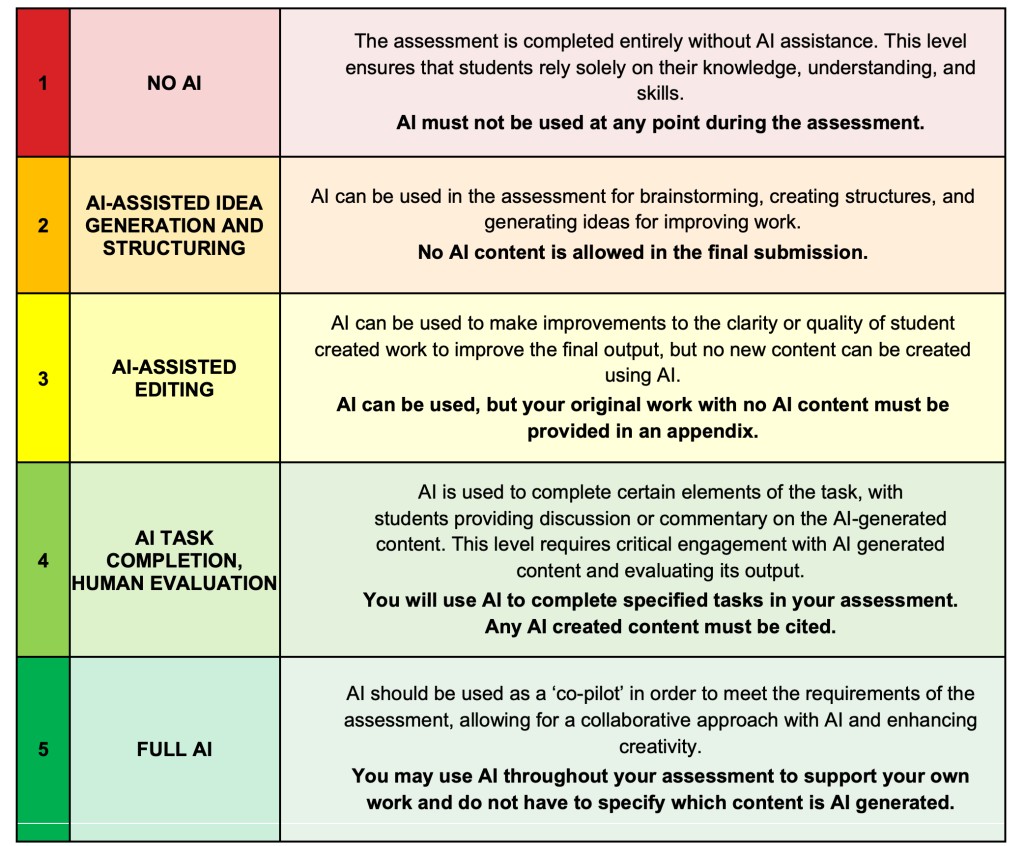
As of September 2026, TU Dublin’s Guidelines on the Responsible Use of GenAI in Learning, Teaching, Assessment and Feedback recommend Version 1 of the Artificial Intelligence Assessment Scale.
The Scale, developed by Perkins, Furze, Roe & MacVaugh (2024), is a framework for helping educators decide how GenAI should be used across different assessment strategies and individual tasks. It provides a clear way to indicate whether AI use is restricted, limited, permitted, or encouraged. Lecturers determine the appropriate level for each strategy or task based on its learning outcomes, purpose, and considerations such as academic integrity, and communicate this clearly to students. The scale is a flexible guide rather than a set of rules, supporting educators to make context-specific, pedagogically informed decisions.
The scale pictured above has five levels, each describing the permitted role of GenAI, what students are expected to do, and the boundaries around acceptable use. The levels also help clarify what evidence students should provide to distinguish their own contribution from that of AI tools. The scale can be used both as a design tool for educators and as a way to support transparent conversations with students about responsible AI use. It ranges from 'No AI', where students are not permitted to use GenAI, through to 'Full AI', where GenAI can be used extensively as a central part of completing the assessment (such as in the 'AI integrated' and 'enabled' approaches discussed above). For each assessment strategy or task, educators can use the scale to identify the level of AI use that best supports the intended learning and assessment purpose. Students can then be given clear guidance about what AI use is permitted and what they need to demonstrate as their own work. It is important to note that the numbers and colour coding do not indicate a hierarchy or progression from “better” to “worse” approaches, or suggest that higher levels of AI use are preferable. Each level represents a different approach that may be appropriate depending on the learning being assessed and the purpose of the task.
The table below explains each level of the AI Assessment Scale in straightforward terms, showing how AI may be used and what students are still expected to do themselves.
| Level | In Simple Terms | What can students use AI for? | What remains their responsibility? |
|---|---|---|---|
| No AI | Students complete the assessment without using GenAI. | Nothing: AI use is not permitted. | All aspects of the work. |
| AI-Assisted Idea Generation and Structuring | Students can use AI to help get started and organise their thinking but create the work themselves. | Brainstorming, exploring ideas, planning, outlining and organising. | Developing the ideas and producing all substantive content, analysis, arguments or solutions. |
| AI-Assisted Editing | Students create the work themselves, then use AI to improve how it is expressed or presented. | Proofreading, grammar, clarity, style, accessibility, formatting, presentation or similar improvements. | The underlying ideas, knowledge, arguments, analysis and original content. |
| AI Task Completion, Human Evaluation | Students can use AI to produce substantial parts of the work, but must critically evaluate and improve what it produces. | Generating content, ideas, analysis, solutions, code or other substantial elements of the task. | Checking accuracy, identifying errors and limitations, critical evaluation, making judgements and improving the AI output. |
| Full AI | Students can use AI extensively as a collaborator or co-creator throughout the assessment. | AI can be used across most or all stages of the task, within any boundaries set by the lecturer. | Directing and managing AI, making decisions, evaluating outputs, applying context and demonstrating critical and professional judgement. |
Reflecting on your use of the scale
We believe that the AI Assessment Scale is most useful when it follows from a clear decision about what you want students to learn and demonstrate, rather than being used simply to decide whether AI should be allowed. Consider:
| Main Concern | Questions to Consider |
|---|---|
| Learning | What am I prioritizing? What do I need students to know, do or demonstrate? (the learning) |
| Evidence | What would provide convincing evidence of that learning? Could AI use change or obscure the evidence of learning? |
| Assessment conditions | What are the specific conditions of this task, and how might GenAI affect them? |
| AI approach | What role do I want AI to play? Do I want to minimise AI use (Robust), design tasks that are less susceptible to AI substitution (Resilient), make AI use part of the task (Integrated), or use AI to enable new forms of assessment (Enabled)? |
| Scale level | Which level of the AI Assessment Scale best reflects this decision? |
| Student contribution | What do students need to demonstrate, explain or document to make their own contribution clear? |
Rather than considering an assessment as a single, indivisible task, it can be useful to decompose it into the individual activities learners undertake to complete it. Visualising these activities as a workflow helps us to see the assessment more holistically: what learners are being asked to do, what they are expected to learn or demonstrate at different points, and where different forms of knowledge, skill and judgement are evidenced. This can support more thoughtful and proportionate decisions about the use of AI. Instead of asking simply whether AI should be permitted or prohibited for an assessment as a whole, we can consider its appropriate role at the level of individual tasks and activities, based on what learners are expected to demonstrate and the purpose that each activity serves. In this way, AI decisions become more granular and purposeful, allowing for different forms and degrees of AI use across an assessment where appropriate. Some questions to consider include:
- What are the key activities involved in completing the assessment, and in what sequence do they typically occur? (Map the assessment as a 'workflow')
- Which activities are the most important for achieving and evidencing the intended learning?
- What should students be able to do independently, and what should remain demonstrably their own?
- What role, if any, should AI play at each stage?
And most importantly:
- If AI contributes to this activity, what still needs to come from the student for me to be confident that meaningful learning has taken place?
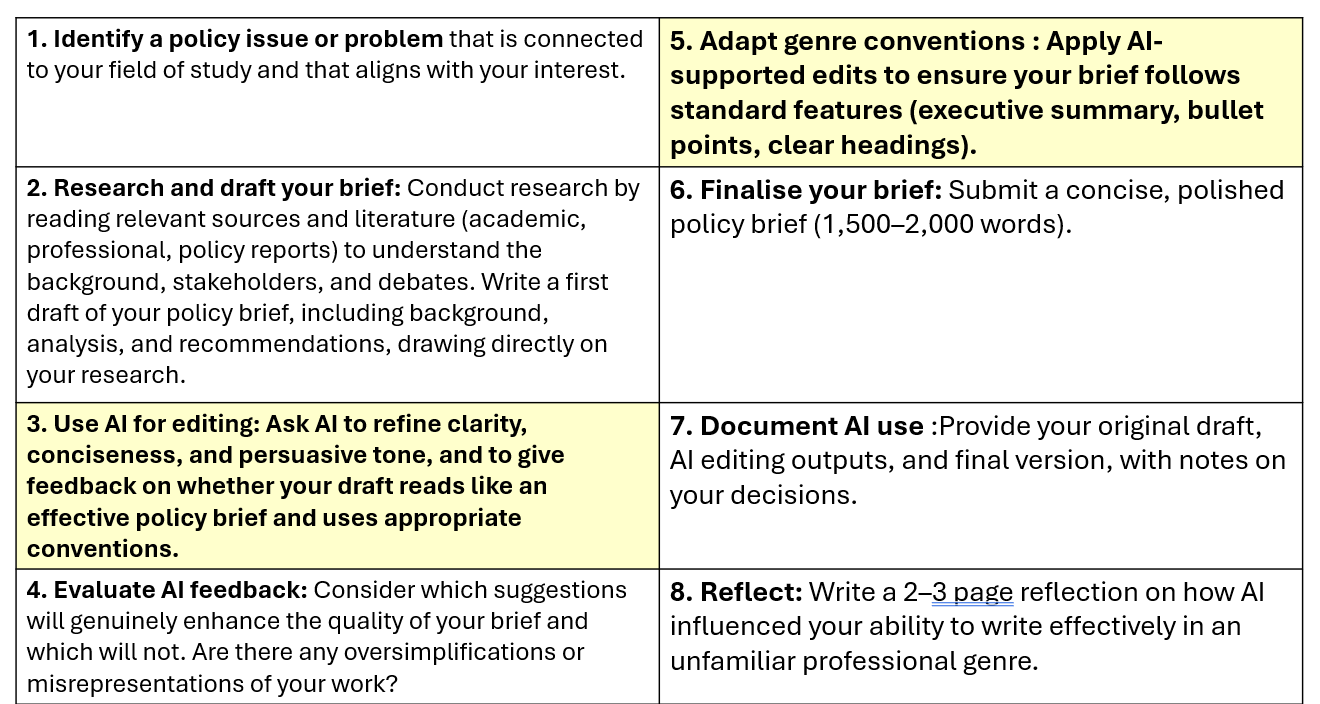
The workflow examples below illustrate two different ways of designing the same policy brief assignment. In the first, AI is used primarily to edit and refine work produced by the student (AI Assessment Scale Level 3). In the second, AI plays a more substantial role in generating the initial content or product, which students must then critically evaluate, interpret and improve (Level 4). Comparing the examples highlights how moving between AI Assessment Scale levels changes what students are responsible for doing, what evidence of learning is generated, and what needs to be assessed. Importantly, these levels do not necessarily need to apply to an assessment as a whole. Different levels of AI use can be specified for different components or stages of the same assessment, depending on the learning being evidenced. For example, a policy brief might involve Level 3 use during drafting and Level 4 use during a subsequent activity in which students evaluate and substantially revise an AI-generated brief. In each image, the colour-coded cells indicate a task in which learners are permitted or required to use AI in specified ways.
Level 3 Example : Learner-produced content with AI refinement
Level 4: Learners evaluate and improve AI-generated work
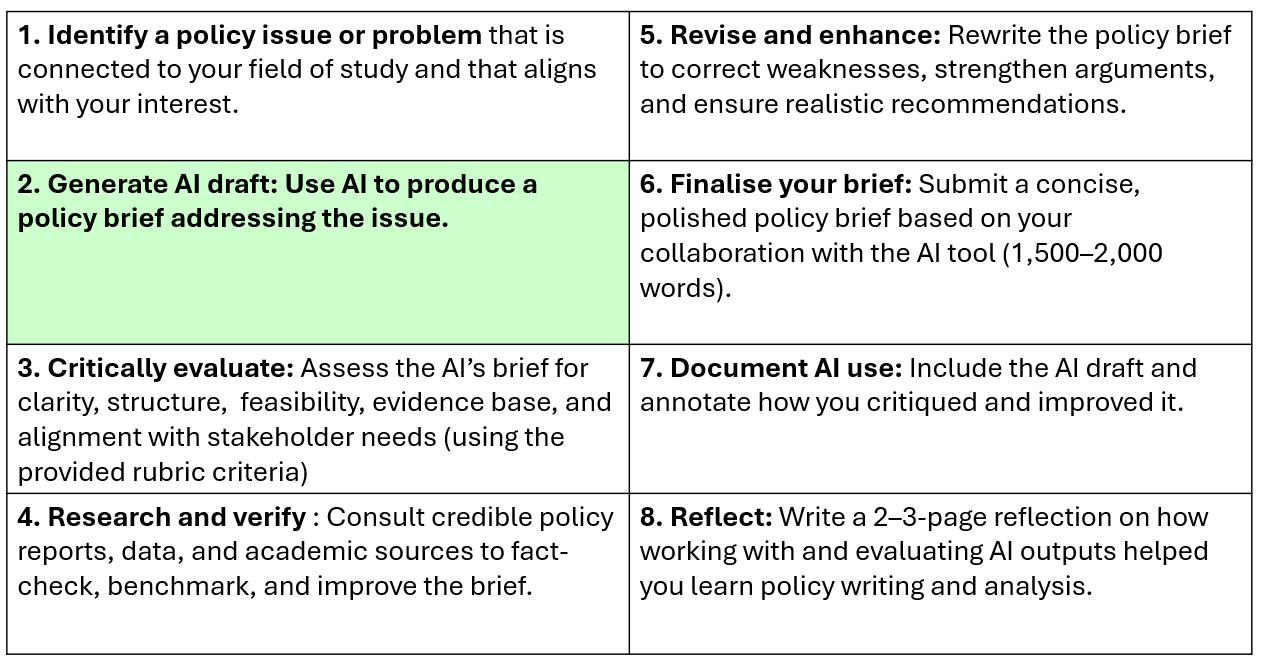
In this example, a Level 4 approach may help students develop the critical oversight skills needed to work effectively with AI-generated content. By evaluating, fact-checking and improving an AI-generated draft, students apply their disciplinary knowledge to identify inaccuracies, biases, gaps and weaknesses, while developing a clearer understanding of what constitutes effective work within a particular genre.
Podcast - Taking your First Steps with the AI Assessment Scale
If you'd like to learn more about the scale and how it can be applied in practice, click the image below to listen to Episode Two of the LTA in Conversation podcast. In this episode, academic developers Derek Dodd and Ana Schalk explore the scale in more detail and offer practical advice for getting started.
Webinar Recording: The AI Assessment Scale in Practice with Leon Furze
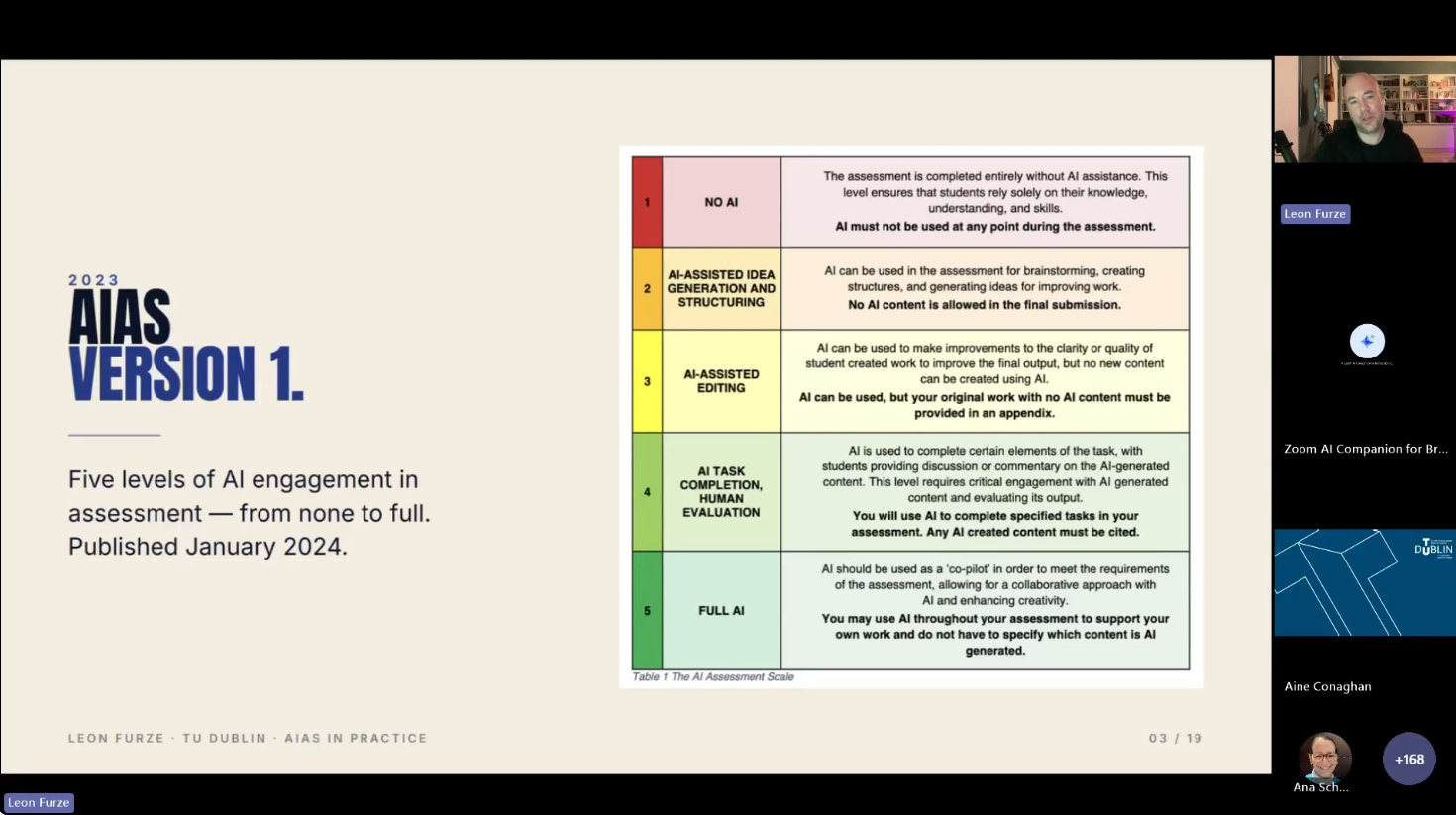
In May 2026, TU Dublin’s Learning Teaching Assessment (LTA), in partnership with South-East Technological University (SETU), team hosted a webinar with Leon Furze, one of the co-creators of the AI Assessment Scale. In this webinar, Leon explores the AI Assessment Scale and how it can be used as a practical tool for assessment design in the age of generative AI. The session considers how educators can make informed decisions about appropriate AI use, communicate expectations clearly to students, and design assessments that provide meaningful evidence of learning while responding to the opportunities and challenges of rapidly evolving AI technologies.
TU Dublin staff can click on the image below to access the recording (52 mins).
The team behind the AI Assessment Scale also maintains the AI Assessment Scale (AIAS) website, which provides an excellent source of information on the scale’s development and iterative refinement, its practical application across different contexts, and the growing body of research underpinning its use.
Layering assessment to strengthen validity and integrity (the 'Swiss Cheese' model)
Frameworks such as the AI Assessment Scale can help us articulate different levels of acceptable AI use and communicate expectations clearly to learners. However, the boundaries between different forms of AI use are not always clear-cut. As Corbin et al. (2025b) observe, generative AI can blur the distinction between acceptable assistance and inappropriate delegation at every stage of the assessment process, raising questions such as when 'AI-assisted editing becomes AI-authored content', or when brainstorming becomes 'outsourced thinking'. This suggests that simply specifying what students may and may not do with AI for an entire assessment or module, and relying on students to interpret and comply with those boundaries, may not be sufficient to maintain assessment validity (See also Corbin et al, 2025c).
Corbin et al. (2025b) distinguish between discursive changes to assessment, which primarily involve communicating expectations about appropriate AI use, and structural changes, which alter the 'nature, format or mechanics' of the assessment itself. While clear guidance, transparency, and ongoing discussion of academic integrity remain important, they argue that changes to assessment design may offer a more robust response by reducing reliance on students' interpretation of, and adherence to, increasingly complex expectations regarding AI use. The key question therefore becomes not simply 'How should we tell students they may or may not use AI?', but 'How can we design assessments that continue to generate valid evidence of learning in an AI-enabled world?'.
The table below provides examples of discursive and structural changes to assessment (Corbin et al, 2025b).
| Assessment | Discursive Change | Structural Change |
|---|---|---|
| Traditional take-home essay | Telling students to use AI for editing but not for generating text | Supervising the generation of parts of the essay |
| Online multiple-choice quiz | Warning screen on first page of quiz telling students to not use AI | Discussing random questions with each student in interactive oral assessment |
| Lab report | Raising the importance of not fabricating data with AI | Checkpoint in live assessment requiring tutor signoff on lab work |
One way of responding to this challenge is through a layered assessment strategy. Rather than attempting to make an individual assessment task “AI-proof” (Dawson, 2024) , layering involves designing multiple, connected assessment activities that build on one another and collectively provide evidence of learning. While diversification broadens the range of assessment methods used, layering connects them, so that each activity provides a different but related source of evidence and contributes to the assessment of the same broader learning.
This approach draws on the Swiss Cheese model of risk and safety management, in which multiple layers of protection work together to reduce the likelihood that a weakness in any one layer will result in failure. Applied to assessment, each assessment activity can be understood as a layer with particular strengths and vulnerabilities. Rather than expecting any single task to be resistant to inappropriate AI use, we can combine activities so that the limitations of one are offset by the strengths of another. The result is a more resilient assessment strategy in which confidence in student achievement does not depend entirely on a single piece of evidence or on students complying with a particular set of AI-use instructions.
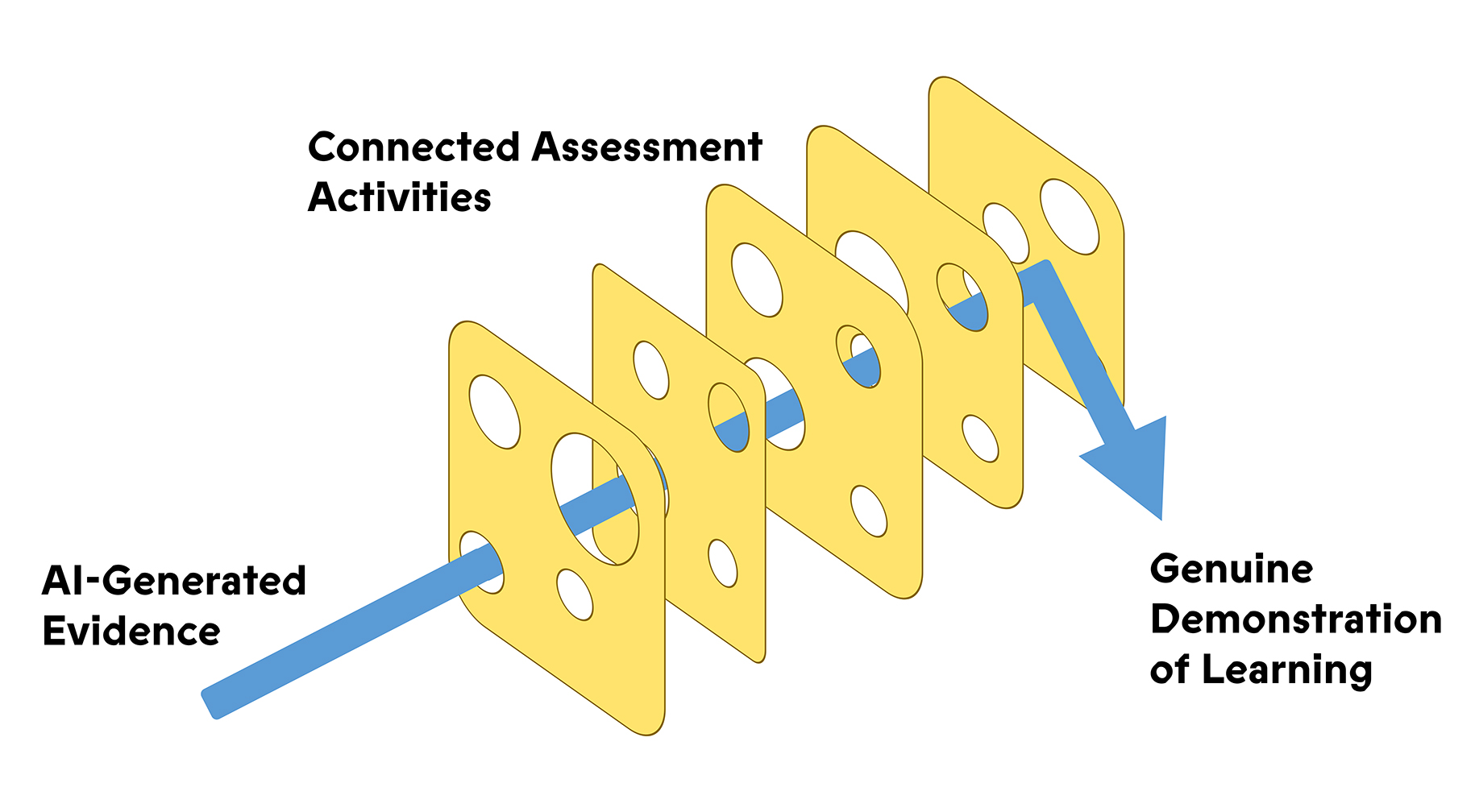
For example, rather than relying solely on a high-stakes written assignment, educators might use a sequence of connected activities that allow students to develop and demonstrate their learning over time. This could include a proposal, a research or analytical task, a written submission, and a presentation or discussion. Drafts, reflections, feedback activities, and process documentation can provide additional evidence. These activities should be intentionally linked, with each building on previous work and contributing complementary evidence of learning, rather than simply adding more assessment.
Layering therefore offers a way of moving beyond a binary question of whether AI is “allowed” or “not allowed”. Different activities within the assessment can have different purposes and different expectations around AI use, while the assessment strategy as a whole provides multiple opportunities to evidence learning. It also complements the process of decomposing an assessment into its constituent activities: once we understand what students are doing at each stage and what learning each activity is intended to evidence, we can consider where additional or alternative layers might strengthen the overall validity and resilience of the assessment.
The aim is not to eliminate the possibility of inappropriate AI use, nor to create assessments that are supposedly immune to AI. Rather, a layered approach seeks to strengthen the overall validity and resilience of the assessment strategy by creating multiple, connected opportunities for students to demonstrate their learning. In an AI-enabled environment, confidence in assessment may come less from finding a single 'secure' assessment method and more from designing a set of complementary activities that, together, provide a robust picture of what learners know, understand and can do.
You can learn more about the Swiss Cheese model by listening to this episode of the the 'AI in Education Podcast' (Bowen & Fleming, 2024) where the concept it outlined by Phil Dawson, of the Centre of Research in Assessment and Digital Learning (CRADLE) at Deakin University.
There is no single correct response to Generative AI in assessment. Effective assessment design involves making informed, context-sensitive decisions based on the learning being assessed, the evidence required, the needs of learners, and the role AI is expected to play. The framework below summarises the key questions explored throughout this guide and can be used as a practical sequence for reviewing existing assessments or designing new ones.
| Step | Key Question | Consider |
|---|---|---|
| Step 1: Start with the Learning | What is most important for students to learn, develop or demonstrate? |
|
| Step 2: Identify the Evidence | What would convince you that learning has taken place? |
|
| Step 3: Consider AI Vulnerability | How could AI influence the learning or evidence? |
Reflect on things like:
Ask yourself: If AI contributed to this task, would I still be confident that the evidence represents the learning I intend to assess? |
| Step 4: Decide the Role of AI | What role, if any, should AI play? |
Remember that different parts of an assessment may employ different approaches. |
| Step 5: Select an AI Assessment Scale Level | What level of AI use is appropriate? |
Remember: The scale should be a consequence of your design decisions, not the starting point. |
| Step 6: Decompose the Assessment | What are students actually doing? |
Map the assessment as a workflow:
This often reveals opportunities for more nuanced and purposeful assessment design. |
| Step 7: Consider Structural Changes | Would redesign strengthen validity more effectively than simply changing the rules? |
Where possible, focus on generating stronger evidence rather than relying solely on compliance. |
| Step 8: Consider Layering | Do you need more than one source of evidence? |
|
As we review and redesign our assessments in response to generative AI, it is important to keep practicability in view alongside validity, integrity and the student learning experience. This connects to Principle 6 of our Principles of Good Assessment Practice: sustainability. Assessment needs to be practical to deliver and coherently integrated within the wider learning experience and programme. In this context, practicability means that assessment is proportionate, feasible and manageable for both students and staff, given the time, resources and workload available.
This extends to the work required in reflecting on and modifying our assessment designs: There is now a dizzying array of considerations, frameworks and possible approaches available to us when thinking about assessment in an GenAI-ubiquitous environment. While this provides valuable opportunities for innovation, it can also make the task of redesign feel overwhelming. We should also be realistic about the scale of change that is possible and desirable. It is neither practical for us, nor fair to our learners or programmes, to undertake a complete top-to-bottom redesign of our assessments every time a new technology or challenge emerges. Assessment needs continuity and stability, and learners need to be able to understand and navigate coherent assessment experiences across their programmes.
While this provides valuable opportunities for innovation, it can also make the task of redesign feel overwhelming. We should also be realistic about the scale of change that is possible and desirable. It is neither practical for us, nor fair to our learners or programmes, to undertake a complete top-to-bottom redesign of our assessments every time a new technology or challenge emerges. Assessment needs continuity and stability, and learners need to be able to understand and navigate coherent assessment experiences across their programmes.
It is also worth remembering that, as we discussed earlier, the generative AI assessment challenge is a wicked problem. There is no single solution that will work equally well across disciplines, programmes, assessment types or cohorts, and approaches that are useful in one context may be less appropriate in another. As we experiment with new approaches, we will inevitably encounter new questions and complexities. This is part of the process of developing our practice.
Remember, we do not need to solve everything at once. Start with the assessments where there is the clearest need or opportunity to review practice, make changes that are purposeful and manageable, evaluate what happens, and build from there. Small, well-considered changes can be more valuable, and more sustainable, than attempting to redesign everything at once. The aim is not to create a perfect or 'AI-proof' assessment system overnight, but to continue to develop assessment practices that are valid, meaningful, sustainable and fit for the challenges we now face.
- Perkins, M., Furze, L., Roe, J., & MacVaugh, J. (2024). The artificial intelligence assessment scale (AIAS): A framework for ethical integration of generative AI in educational assessment. Journal of University Teaching & Learning Practice, 21(6), Article 6. https://doi.org/10.53761/q3azde36
- Learning Innovation Practice Ltd. (n.d.). The AI Assessment Scale: Resources and information for the AI Assessment Scale (AIAS). Retrieved August 28, 2026, from https://aiassessmentscale.com/
- Technological University Dublin. (2025, April). Guidelines on the responsible use of generative AI in teaching, learning, feedback and assessment in TU Dublin. Online here.
- Corbin, T., Bearman, M., Boud, D., & Dawson, P. (2026). The wicked problem of AI and assessment. Assessment & Evaluation in Higher Education, 51(4), 736–752. https://doi.org/10.1080/02602938.2025.2553340
- Corbin, T., Dawson, P., & Liu, D. (2025). Talk is cheap: why structural assessment changes are needed for a time of GenAI. Assessment & Evaluation in Higher Education, 50(7), 1087–1097. https://doi.org/10.1080/02602938.2025.250396
- Corbin, T., Dawson, P., Nicola-Richmond, K., & Partridge, H. (2025). ‘Where’s the line? It’s an absurd line’: towards a framework for acceptable uses of AI in assessment. Assessment & Evaluation in Higher Education, 50(5), 705–717. https://doi.org/10.1080/02602938.2025.2456207
-
Dawson, P. (2024, September 12) in (D. Bowen & R. Fleming, Hosts) AI in Education Podcast. https://aipodcast.education/assessment-and-swiss-cheese-phill-dawson-episode-9-of-series-9
-
Bowen, D., & Fleming, R. (2024). AI in Education Podcast [Audio podcast]. https://aipodcast.education/