
Teaching and Learning with AI - Making Informed Decisions
 Over the past few years, academic staff in higher education have been exploring different ways of using GenAI in teaching and learning. These experiences have opened up new possibilities, while also raising questions about when AI use genuinely supports learning and when it may distract from or undermine it. For educators, the challenge is not simply to decide whether GenAI can be used, but to consider whether its use adds genuine educational value. This raises an important question:
When and how can these technologies meaningfully support learning, and when might they have little value or even hinder it?
In this section, you can explore how to:
- Keep learning outcomes, pedagogy and disciplinary context at the centre of decisions about GenAI.
- Critically evaluate whether, when and how GenAI can support student learning and development.
- Reflect on the opportunities, limitations and risks of GenAI within your disciplinary and teaching context.
- Use educational frameworks and reflective questions to inform responsible, evidence-informed approaches to teaching and learning with AI.
Any decision about whether and how to use GenAI in teaching and learning should begin with pedagogy and disciplinary context rather than the technology itself. Consideration of GenAI should be grounded in a clear understanding of what students are expected to learn, the needs of learners, and the kinds of knowledge, skills, and ways of thinking that the discipline seeks to develop. From this starting point, educators can evaluate whether GenAI has the potential to meaningfully support learning, enrich the student experience, or help achieve intended learning outcomes. When its use is pedagogically justified, GenAI should be integrated through thoughtful learning design and aligned with established educational principles. Where this rationale is unclear, its use may offer limited educational value and, in some cases, reduce opportunities for students to engage in the cognitive and creative processes that support learning.
A critical aspect of engaging with GenAI in teaching and learning is the deliberate design of authentic contexts, scenarios and disciplinary challenges aligned with the intended learning outcomes. These contexts can deepen reasoning and require students to identify, interpret and evaluate nuance, applying their knowledge in meaningful situations. In doing so, they reinforce the importance of human thinking and judgement, capacities that AI tools cannot fully replicate.
It is also important to distinguish between successful task completion and evidence of learning. Emerging research suggests that strong performance with AI support does not necessarily demonstrate learning (OECD, 2026). Students may complete a task, receive convincing explanations or feel more confident while having had limited opportunities for independent reasoning, reflection or knowledge construction.
When considering GenAI, ask not only
Does it help students complete the task?
but also:
Does it help students develop what they need to learn?
This keeps pedagogical and disciplinary purpose at the centre of decisions about when and how GenAI is used.
A useful starting point for considering the role of GenAI in teaching and learning is Bloom's Taxonomy, a framework that categorises learning according to increasing levels of cognitive complexity, from remembering and understanding through to analysing, evaluating, and creating.
Drawing on this framework, Oregon State University has developed an adapted model that distinguishes AI capabilities from human skills, helping educators identify where GenAI may support learning and where student engagement in cognitive processes remains important. The model can be used to evaluate the alignment between intended learning outcomes, disciplinary expectations, and decisions about engaging with GenAI.
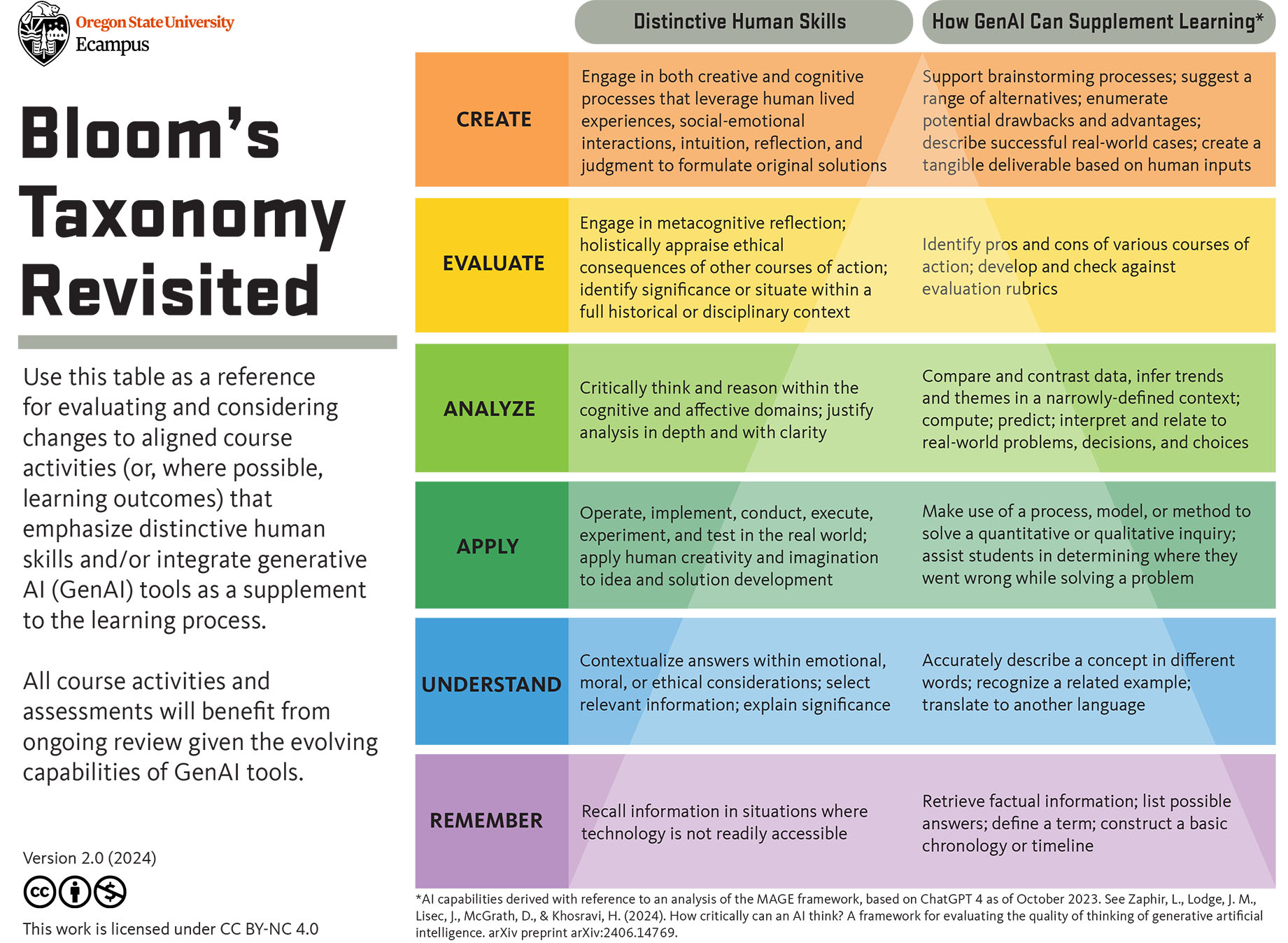
Bloom's Taxonomy Revisited. Oregon State University Ecampus. Licensed under CC BY-NC 4.0 (https://creativecommons.org/licenses/by-nc/4.0/). Used with attribution.
This revised version of Bloom's Taxonomy offers one way to consider how GenAI might influence the relationship between learning activities, assessment, and the skills we want students to develop. It also provides an opportunity to revisit alignment: are our learning outcomes, learning activities and assessments working together to support the learning we value?
While frameworks such as Bloom's Taxonomy can help academics consider where and how GenAI may support learning, decisions about its use cannot be separated from disciplinary context. Different disciplines value different forms of knowledge, ways of thinking, professional practices, and approaches to inquiry. As a result, the educational opportunities, risks, and appropriate uses of GenAI are likely to vary across fields of study.
When planning a teaching and learning experience, it is important to consider how learning outcomes, students’ needs and disciplinary requirements align. This is particularly important when considering the role of GenAI, as each discipline has its own ways of understanding and explaining the world. Disciplines develop distinctive forms of knowledge, inquiry and professional identity, shaped by their conceptual, epistemological, social, material and moral dimensions (Quinlan, 2021). A discipline-contextualised approach therefore provides an important basis for considering whether, when and how GenAI might be used. Its potential benefits, risks and appropriate uses will vary according to the knowledge, practices, challenges and goals of different disciplines. There is, therefore, no single framework or approach that will work equally well across all disciplines.
Academic staff are encouraged to explore, experiment, evaluate and make informed decisions about what is appropriate within their disciplinary context, and what is not.
Ongoing, reflective conversations within schools and programmes are essential. The Learning Teaching Assessment (LTA) team can support these conversations through tailored workshops exploring the opportunities, challenges and appropriate uses of GenAI in your disciplinary and teaching context.
Find out more about the GenAI supports and workshops that you can request from the Learning Teaching Assessment (LTA) team.
TU Dublin’s Guidelines on the Responsible Use of GenAI in Teaching and Learning recommend the AI Assessment Scale (AIAS) as a useful framework for communicating and clarifying expectations around GenAI use in assessment. You can learn more about the scale and its use in the section on GenAI and Assessment.
However, the AIAS is one of many frameworks available to support thoughtful engagement with GenAI in education. Additional models are outlined below.
The SAMR Model
One useful way to consider the role and impact of AI in education is through the SAMR model (Puentedura, 2006; ref. 2021). This model offers a way of thinking about different levels of technology use, from substitution, where technology replaces an existing practice with little change, through augmentation and modification, to redefinition, where technology enables approaches that would not otherwise have been possible.
| Definition | Potential impact on learning | |
|---|---|---|
| Subtitution | Technology acts as a direct substitute for an existing tool, with no functional change to the task. | It may make a task more convenient or efficient, but may have little effect on the learning experience itself. |
| Augmentation | Technology acts as a direct substitute for an existing tool, with functional improvements that enhance the task. | It may improve how students access, complete or engage with a learning activity, potentially providing them with additional support, guidance or feedback as they complete a task. |
| Modification | Technology enables significant redesign of an existing learning task. | It may create new ways for students to engage with content, collaborate, practise skills or demonstrate their understanding. |
| Redefinition | Technology enables the creation of new learning tasks that were previously inconceivable. | It may create entirely new learning opportunities, although these should still be evaluated in terms of their educational value and intended learning outcomes. |
The SAMR model provides one useful way of thinking about how technology can change a learning activity, but it does not tell us whether that change will lead to better learning. Moving towards the higher levels of the model does not necessarily mean greater educational value. What matters is whether the use of technology supports the intended learning outcomes and meets the needs of students in a particular context.
Additional Frameworks
The frameworks listed below offer different perspectives and practical approaches for thinking about these questions. They range from supporting intentional AI use and reducing cognitive offloading, to developing AI fluency and exploring creative applications in teaching. They are not intended to provide a single right answer, but can be used as starting points for reflection and discussion, helping you consider what might be useful and appropriate within your own disciplinary and educational context. We recommend exploring the frameworks at your own pace, and considering which perspectives help you to ask useful questions about your own use of GenAI. You may find that some are more relevant to your discipline, teaching context or current practice than others.
- PAIR (Problem, AI, Interaction, Reflection) Framework , which promotes an intentional and right balance that is required to provide students with guidance and structure on how to use AI through a flexible and adaptable structure that facilitates informed decisions through disciplinary critical thinking.
- Resistance as a Framework for Combating Cognitive Offload (Furze, L.), which encourages students to self-regulate their learning, or teaching staff to apply positive friction to trigger student engagement and motivation.
- 4 D AI Fluency Framework (Dakan & Feller). This framework facilitates the development of four key AI Literacy skills: Delegation, Description, Discernment, and Diligence in academic staff and students for ethical and responsible use of GenAI.
- 13 ways to integrate AI in your teaching (Compton, M), offers creative ways of using AI to support your teaching practice in an ethical and responsible manner.
Explore our Assessment Guidance and Curriculum Design Guidance for practical ideas and approaches to designing learning experiences and assessment that keep learning at the centre.
Questions for Lecturers to Consider
As you consider your own practice, you might ask:
- What do I want students to know, understand or be able to do as a result of this learning?
- Does the way I am using, or asking students to use, GenAI support these learning outcomes?
- What opportunities do students have to develop and demonstrate their own thinking, judgement and understanding?
- Could using GenAI change what students need to do to achieve or demonstrate the intended learning?
- Is there anything important that students might miss out on if GenAI does part of the work?
- Do my learning activities and assessments still align with what I want students to learn?
- What knowledge, skills and ways of thinking are essential for students to develop in my discipline, and where might GenAI support or undermine these?
- For my teaching and assessment, where could GenAI enhance learning, and where might it replace the thinking or practice students need to do themselves?
- What do students need to know about the strengths, limitations, biases and appropriate uses of GenAI within my discipline?
Questions for Programme Teams to Consider
As a programme team, collectively you should consider:
- Where do we need greater consistency across modules or programmes in how we approach GenAI in teaching, learning and assessment?
- Which uses of GenAI, if any, might become part of professional or disciplinary practice in our field, and what would responsible use look like?
- Where and when might GenAI be appropriately integrated across the programme, and how can we ensure a balanced approach that develops both AI-enabled and independent disciplinary capabilities?
- How can we engage with students, employers, professional bodies and other stakeholders to understand emerging and future uses of GenAI in our field, and what these might mean for our curriculum?